

On 26 February 2026, the Swedish Navy patrol boat HMS Rapp detected a drone launched from the Russian signals-intelligence vessel Zhigulevsk in the Öresund strait, while the French nuclear-powered aircraft carrier Charles de Gaulle was docked at Malmö as part of NATO exercise activities. Systems aboard the Rapp took electronic countermeasures to disrupt the drone. The Zhigulevsk had entered Swedish territorial waters; the Rapp shadowed it until it left, and Sweden's Armed Forces said the ship was later tracked into the Baltic Sea. French military spokesperson Guillaume Vernet said the drone came no closer than 10 kilometres (6 miles) to the Charles de Gaulle and had no impact on the carrier group's activity.
Swedish authorities have not disclosed the exact time the drone was detected. Defence Minister Pål Jonson said on the evening of 26 February that the drone appeared to be Russian; the Armed Forces' formal confirmation followed the next day, 27 February. This reconstruction uses an evening window on 26 February, consistent with Jonson's same-day statement, for the wind reference below.
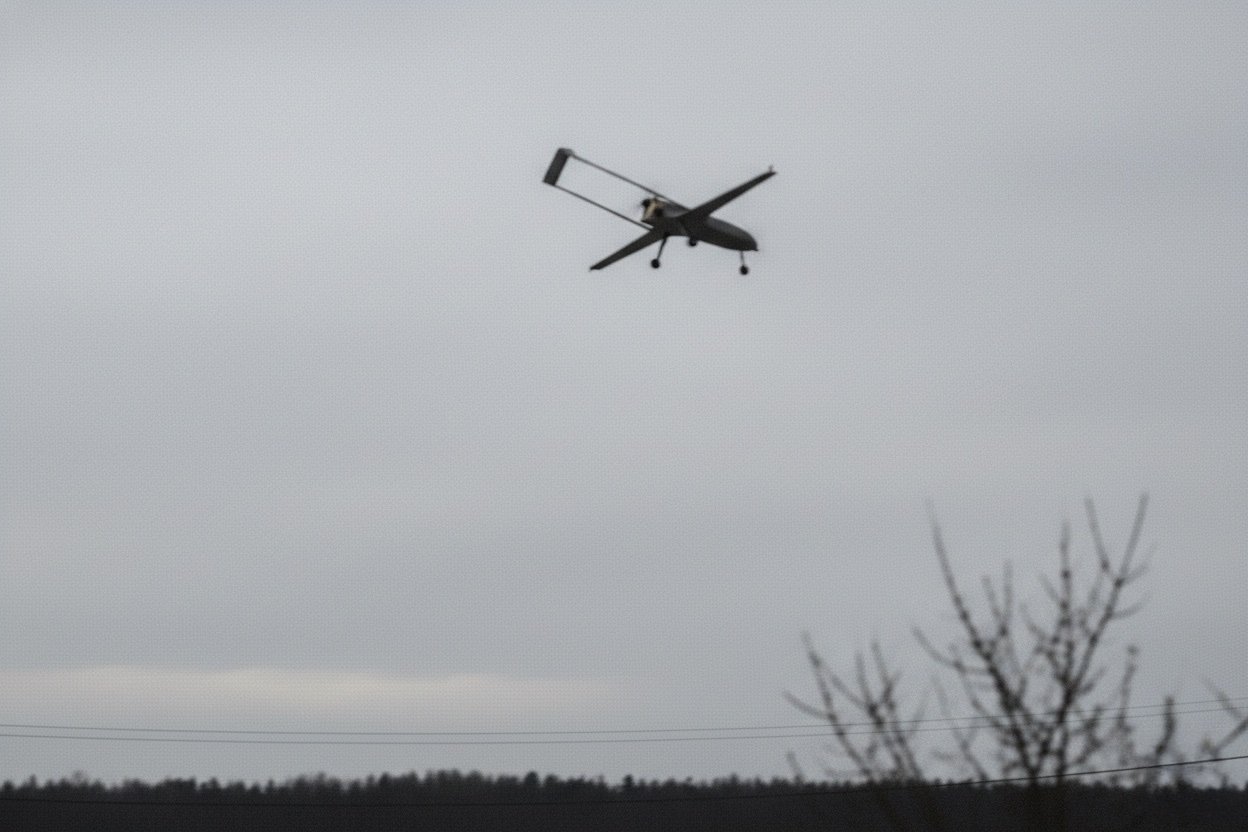
Sweden identified the source vessel and neutralised the threat before it reached the carrier
Defense Express, a Ukrainian outlet that first published Sweden's account in depth, called the case one of the first in which a Western military both identified the source of a drone threat immediately and neutralised it before it reached a protected military asset - contrasting it with a January 2026 incident in Germany, where authorities failed to intercept three unidentified drones near an Arrow 3 missile defence site. The Zhigulevsk, a Project 503R signals-intelligence ship built on a fishing-trawler hull, entered within about 22 kilometres of the Swedish coast; the drone it launched was neutralised roughly 12 kilometres from the Charles de Gaulle's anchorage.
Swedish Defence Minister Pål Jonson wrote: "The Swedish Armed Forces can now confirm, based on technical data, that an unauthorized drone was launched from the Russian signals intelligence vessel Zhigulevsk. The incident occurred near the French aircraft carrier Charles de Gaulle during its visit in Malmö." Sweden's military said the Zhigulevsk had also failed to follow the transit rules that apply to vessels passing through the strait in Swedish waters. Prime Minister Ulf Kristersson, visiting the Charles de Gaulle on 27 February, called the incident "serious and maybe not surprising." Kremlin spokesperson Dmitry Peskov said he was not aware of the incident and called it "absurd" to attribute the drone to Russia based on the ship's presence alone.
Part of a wider pattern of drone activity near NATO assets and exercises
Western officials describe a broader campaign of sabotage and disruption they attribute to Russia across Europe since the start of the full-scale war Russia launched against Ukraine in 2022, with well over 100 documented incidents - not all publicly confirmed, and some taking months to link to Moscow. Defense Express assessed the Öresund case as evidence that Russia has refined a practice of launching drones from vessels tied to its shadow fleet for reconnaissance near NATO assets, and noted it may be the first known attempt to launch a drone directly from a Russian military ship rather than a civilian-flagged one.
Wind conditions over the Öresund strait
At 18:00 UTC on 26 February, AirVeto's wind model returned data for the Öresund strait grid at the 3,000 m level only: wind blowing east-northeast at 73 km/h. The 500 m and 2,000 m levels returned no reading from the model for this marine location at that hour.
This reconstruction draws on reporting by Defense Express and the Associated Press (via Daily Sabah), and on AirVeto's wind-model data for the 18:00-19:00 UTC window on 26 February 2026. How the model is built and where it is reliable is on the methodology page. A full archive of drone and airspace incidents across the EU's eastern border is at the incident archive.