
Live · 141 days tracked

See where the wind takes it.

Live wind visualization for Eastern Europe. Predict the drift paths of smuggling balloons before they cross the border.
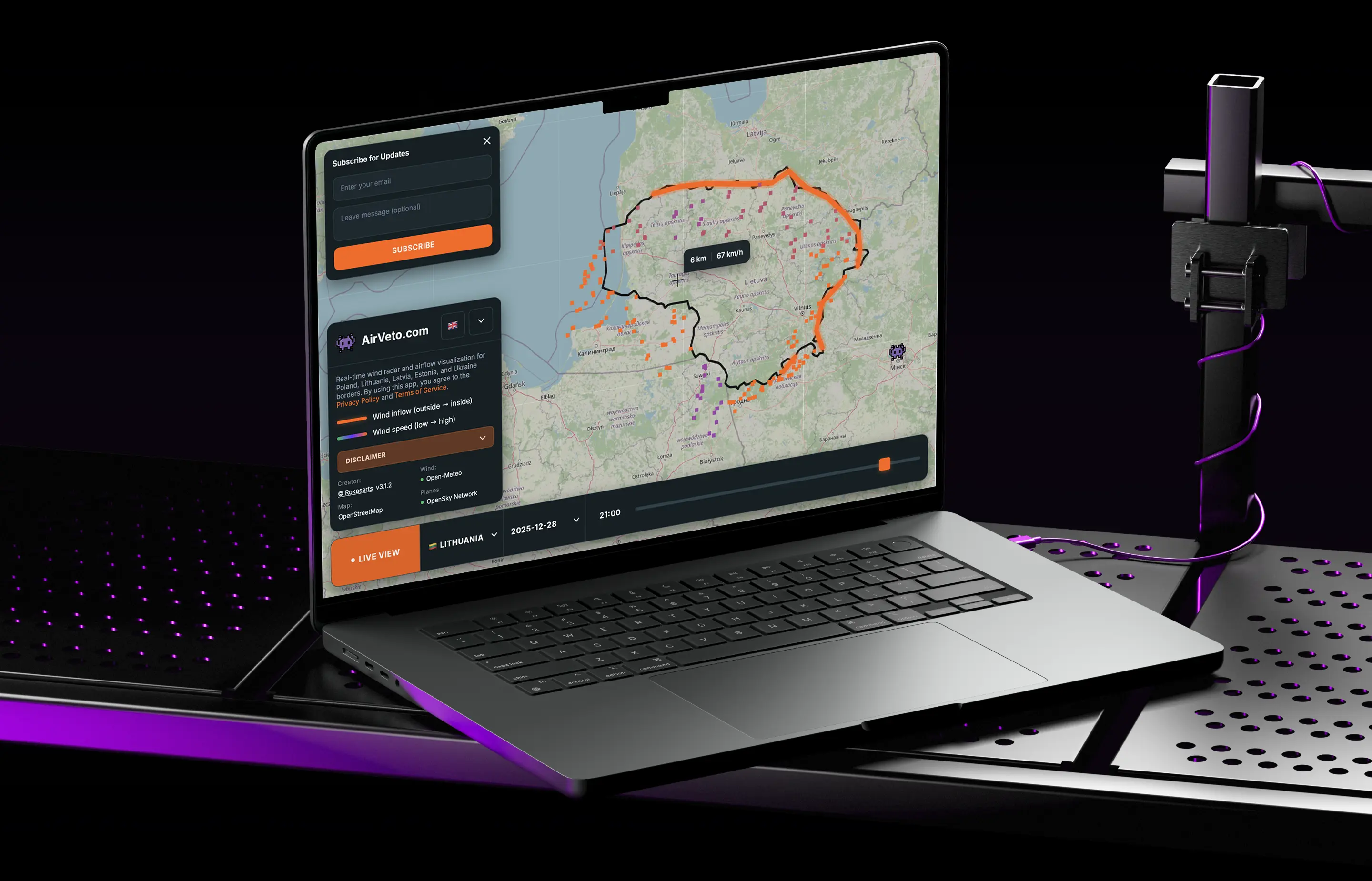
AirVeto wind map showing balloon trajectory prediction across Lithuania
01 Coverage

Tracking across five countries.

AirVeto covers Poland, Lithuania, Latvia, Estonia, and Ukraine — the EU's eastern frontier. Hourly wind vectors, near-real-time aircraft positions, Baltic Sea vessel tracking, and satellite orbits, rendered as a continuous field on a single map.

02 Data

Built on public signals.

Wind comes from Open-Meteo, aircraft from the ADS-B receiver network, vessels from the Baltic AIS feed via Digitraffic, and satellites from public TLE data propagated locally with SGP4. Basemap by OpenFreeMap.

03 Custom data

Connect your own sources.

Pro users can connect custom APIs to overlay their own data on the live map. Track drones, monitor radar detections, or follow fleet vehicles — all in real time.

Drone Telemetry

Track drone positions at altitude with live speed and heading data.

Radar Networks

Display radar stations and their detections with connection lines.

Fleet GPS

Monitor patrol units or research vehicles with real-time position updates.

Read the Custom Data Guide →

04 Questions

FAQ.

What is AirVeto?
A real-time wind and tracking visualization service covering Poland, Lithuania, Latvia, Estonia, and Ukraine. It tracks cross-border airflow, aircraft, Baltic Sea vessels, and satellites.
What wind data is available for the Suwałki Gap?
Hourly wind vectors across the corridor between Poland and Lithuania, sourced from Open-Meteo. Orange border segments flag where wind is currently entering the EU from the Belarusian side of the gap.
How do balloons drift from Kaliningrad across the Polish border?
AirVeto does not track balloons directly. It renders the wind field at the selected altitude (default 3,000 m, selectable up to 5,000 m) and marks border segments where wind is currently flowing from Kaliningrad into Poland — the envelope within which airborne objects released on the Kaliningrad side can drift across the border.
How does ADS-B coverage work over the Baltic Sea?
Ground stations ring the Baltic — Estonia, Latvia, Lithuania, Poland, Sweden, Finland — giving near-complete aircraft coverage above 2,000 m. Coverage thins below 1,000 m over open water and deteriorates across Belarus where few receivers are deployed.
Is there a free wind map covering Estonia, Latvia, and Lithuania together?
Yes — AirVeto is free to use across all three Baltic states plus Poland and Ukraine. Unlike country-by-country weather services, the entire region renders on one canvas so wind patterns crossing between Estonia, Latvia, and Lithuania are visible as a continuous field.
How accurate is cross-border wind drift prediction?
Wind vectors come from Open-Meteo, which blends the ECMWF and GFS models refreshed hourly. AirVeto applies cross-border inflow detection at the selected altitude. Accuracy is typical of public meteorological models — useful for situational awareness, not for safety-critical or legally binding decisions.
What is the difference between AirVeto and Windy for Baltic region tracking?
Windy is a global weather platform. AirVeto focuses on the EU's eastern frontier with Russia and Belarus, combines wind with aircraft (ADS-B), Baltic vessels (AIS), and satellites (TLE/SGP4) on a single map, and adds cross-border inflow detection plus custom API overlays on Pro.
How does AirVeto relate to airspace incidents along the Polish-Belarusian border?
AirVeto provides real-time wind data and aircraft tracking for the Polish-Belarusian border region, which has been a focal point for recent airspace incidents. Users can see the wind field, aircraft positions, and which border segments currently have inflowing wind — context for understanding cross-border air movement.
How does flight path prediction work?
We analyze real-time wind direction and speed to estimate drift trajectories. Orange borders highlight where wind is entering from outside the country.
How accurate is the data?
Wind data is sourced from third-party meteorological models. Aircraft, vessel, and satellite positions come from public feeds (ADS-B, AIS, TLE). Data may contain inaccuracies — do not use it for aviation, navigation, or safety-critical decisions.
What tracking is available?
Real-time aircraft positions (ADS-B), Baltic Sea vessel tracking (AIS via Digitraffic), and satellite positions (TLE/SGP4 propagation). Tap any object to see details.
Is AirVeto free?
The wind map, aircraft tracking, vessel tracking, satellite tracking, and social post generator are all free. Pro features like 3-day forecasts are available with a Pro plan.
Can I connect my own data sources?
Yes. Pro users can connect custom APIs to display drone telemetry, radar detections, fleet GPS, or sensor data on the map in real time. Your browser fetches directly — nothing passes through our servers. See the Custom Data Guide.
Is this open source?
Free to use, but proprietary code. No copying, modifying, or redistributing without permission.
Data not loading?
The data source API may be temporarily down, or rate limits may have been applied due to fast date switching or frequent refreshing. Try again in a moment. We're working to make rate limits as seamless as possible.

See it in action.

Live wind data. Real-time predictions. No signup required.