
Eight smuggling balloons intercepted near Vilnius airport
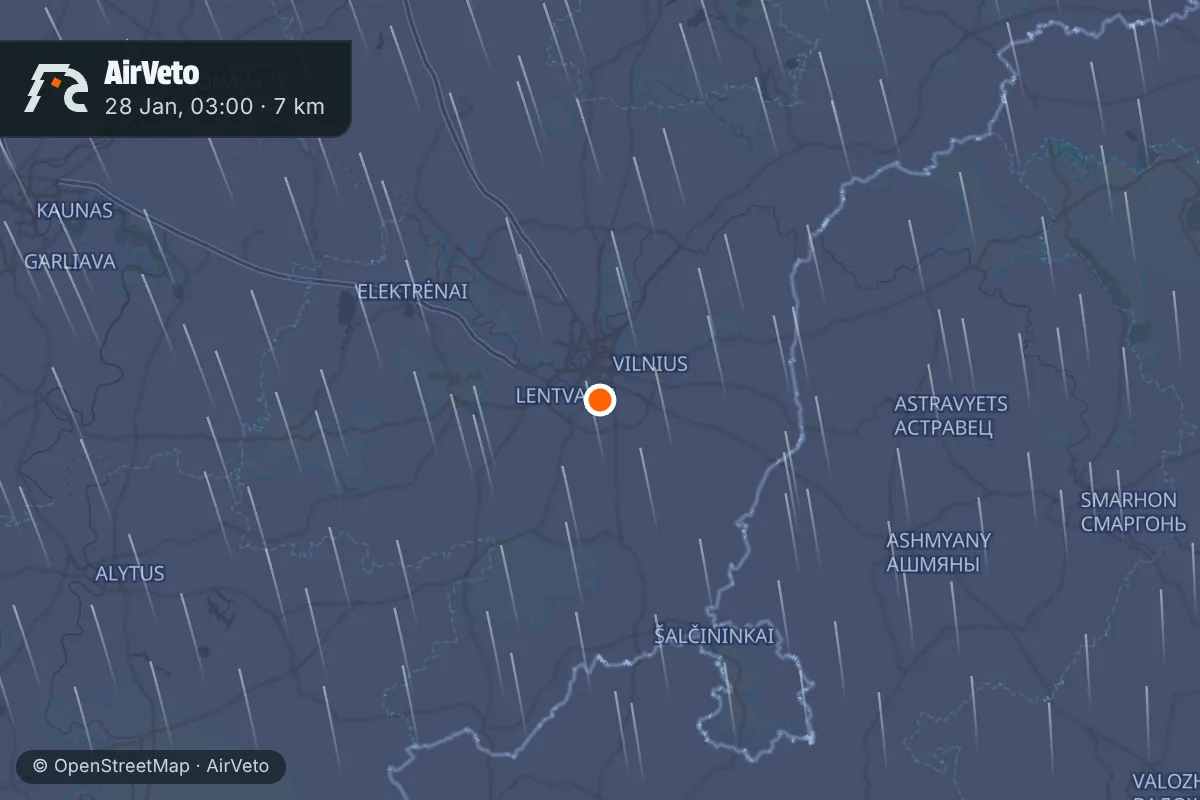
Eight balloons entered Lithuanian airspace near Vilnius Airport at 03:00 UTC on January 28, 2026; four suspects were arrested. AirVeto's 7 km wind log shows ~71 km/h flow pushing NNW from Belarus.
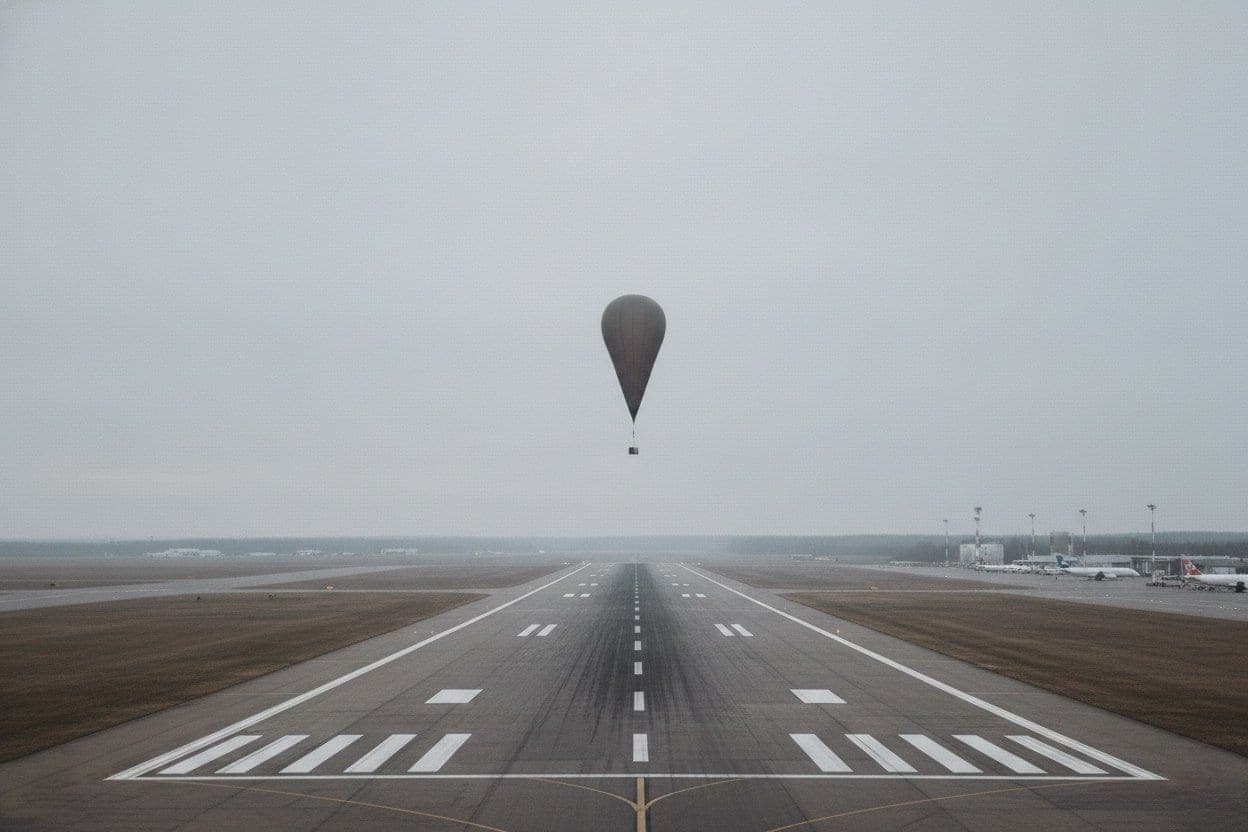
At approximately 03:00 UTC on January 28, 2026, eight balloons entered Lithuanian airspace in the vicinity of Vilnius International Airport. The Lithuanian State Border Guard Service (VSAT / @pasienislt) intercepted all eight and arrested four individuals in connection with the incident. LRT confirmed the recoveries in its English-language coverage the same day. The episode was one of a rapid-fire cluster of Vilnius airspace disruptions in late January 2026.
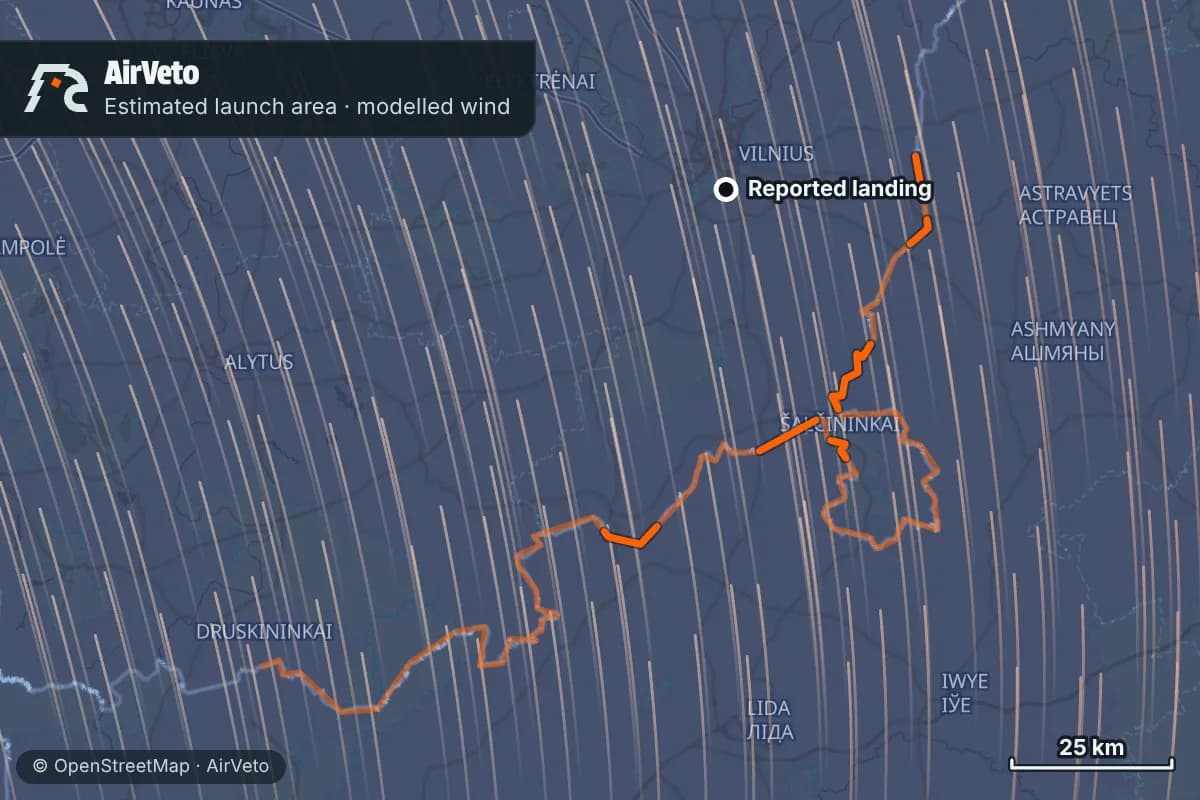
Estimated launch area, consistent with the wind and the reported landing
Core: 50 km of border, where 80% of the wind traces cross
Full spread: 275 km of border
Streaks: model wind at 7 km altitude at 28 Jan, 03:00, the start of the reported window, from this incident's wind data, extended across the frame from the nearest data; they point the way the wind blew, longer means faster (53 to 91 km/h here)
Rests on 35 of 35 back-traces that reached the border within 12 hours, at 7 of 7 heights, from 5 start times across the reported window.
Model wind, unknown launch time and height; the area shows where the wind could have carried the balloon from. How this is estimated
AirVeto wind log at the event
AirVeto’s wind layer at 7,000 m over the Vilnius approach at 01:00 UTC on January 28, 2026, the start of the event window, recorded strong flow pushing NNW at cruise altitude: at the airport grid point (lat 54.634, lon 25.286), wind was arriving from the SSE at approximately 71 km/h, with the broader Vilnius wind flow ranging from SSE to S at 47–96 km/h. That orientation puts inbound drift on the Lithuanian-Belarusian frontier directly within AirVeto's 85° border-normal threshold at this altitude - and at these speeds the cross-border transit time for objects cruising at 7 km is short enough to match the cluster of recoveries during the 01:00–05:00 UTC event window.
| Wind parameter | Value |
|---|---|
| Altitude | 7,000 m |
| Time | 01:00 UTC, January 28, 2026 (event start) |
| Direction (from), at Vilnius Airport grid point | 167° - south-southeast |
| Speed, at Vilnius Airport grid point | ~71 km/h |
| Direction range, Vilnius grid | 152°–193° (SSE to S) |
| Speed range, Vilnius grid | 47–96 km/h |
| Source | Open-Meteo historical-forecast-api |
| Border-normal threshold crossed | Yes - Lithuanian-Belarusian segments, 85° |
Published to AirVeto's social channel the same day.
AirVeto's account of this event draws on reporting by LRT, Euromaidan Press, and Reuters; the wind layer provides the meteorological context.
Altitude context
Smuggling balloons over the Belarusian-Lithuanian border typically cruise between roughly 3,000 m and 8,000 m at the release-to-recovery phase, to stay above radar ground clutter while the helium payload gradually leaks. The 7,000 m wind reading is inside that envelope and was therefore operationally relevant for the event - lower altitudes (3,000 m and below) on the same date showed a lighter and more variable field, which is why altitude selection materially changes the inflow reading on AirVeto. How that field is modelled, and where it is reliable, is described on the methodology page.
In one line: AirVeto’s 7 km view on the night of 28 January was reading a strong south wind aimed straight at Vilnius. Eight balloons rode it across the border. That’s the predictive value of a wind layer on this frontier — the inflow conditions are visible before the recovery report lands.
The 28 January cluster fits a pattern of disruptions on the Vilnius Airport approach in early 2026 — see the 9–10 April closure and the wider incident archive. The Lithuanian smuggling-balloon category hub, with every documented incident and wind reconstruction, is Kontrabandos balionai.
Related location
- Vilnius International Airport (EYVI) - Lithuania's main airport, 30 km from the Belarusian border - repeatedly closed by balloon incursions since October 2025.
Corrections
: The wind was first published as 180° (from the south) at 55 km/h, from an AirVeto log entry for 28 January. It is now 167° (from south-southeast) at 71 km/h, the 7,000 m wind data for the Vilnius Airport point at 01:00 UTC on 28 January 2026.
Sources
- LRT English - Smuggler balloons disrupt Vilnius Airport again, 'most intense' wave this year (January 28, 2026)
- Euromaidan Press - Lithuania protests after Belarusian smuggling balloons ground Vilnius Airport three times in one night (January 29, 2026)
- Reuters - Vilnius Airport halts flights again after suspected Belarus balloon incursion (January 27, 2026)
- AirVeto - 28 January log post
- Methodology
Last updated: