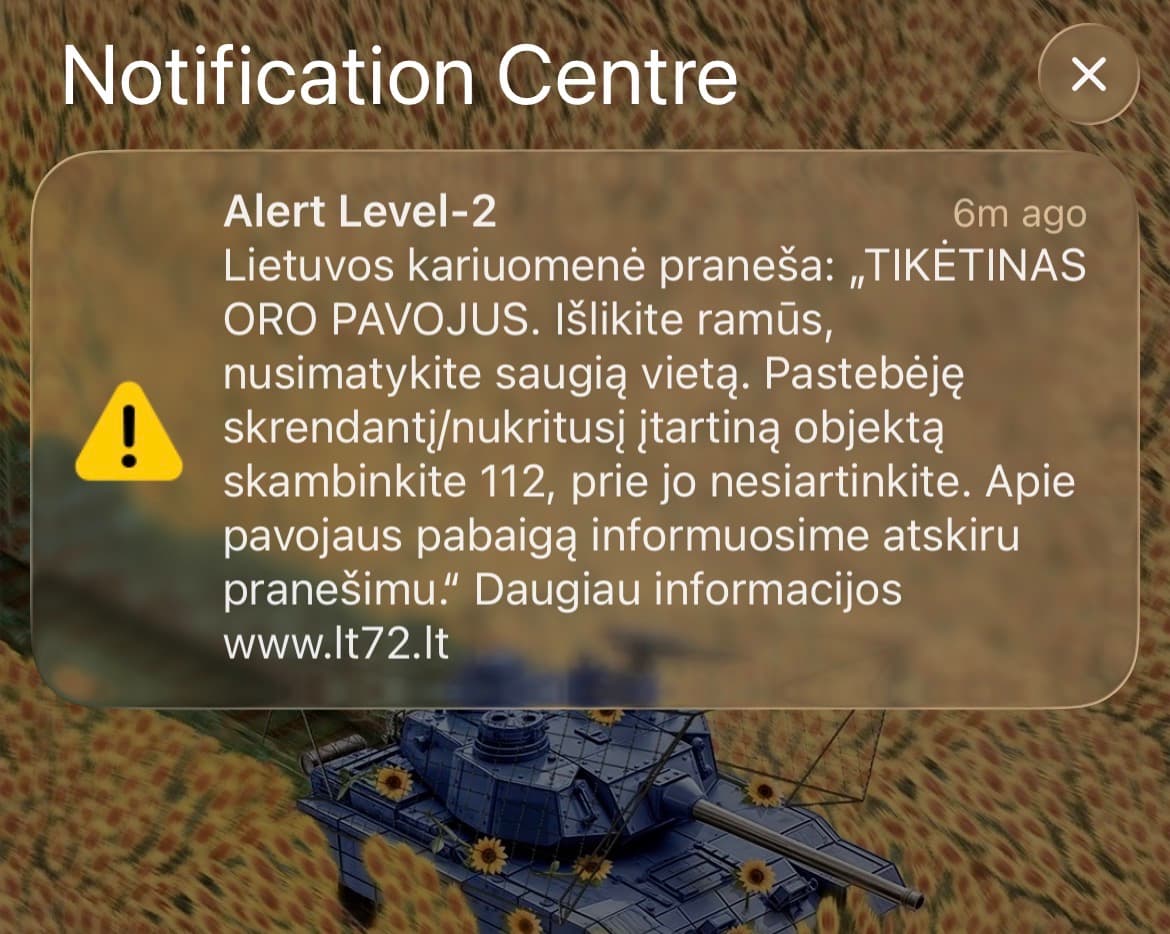
On the morning of 20 May 2026, every phone in four Lithuanian border districts buzzed at once. Within the hour, so did every phone in Vilnius, and then in the Alytus region to the south. Translated from Lithuanian, the first message read:
"PROBABLE AIR DANGER. Stay calm, identify a safe place. If you notice a flying or fallen suspicious object, call 112 and do not approach it."
It suspended flights at Vilnius Airport. It emptied train platforms. It sent the president's staff into a shelter. And it told the people who received it almost nothing — not what was inbound, not where, not from which direction, not how sure anyone was. A "suspicious object". Somewhere. Probably.
Issuing a warning was defensible: a radar contact really had appeared near the Belarusian border, and the full event is documented on our incident page. But as a piece of data reporting, the alert is close to a worked example of how to do it badly — and the failures it exposes are not unique to air-raid systems. The same mistakes show up in status pages, analytics dashboards, scientific press releases and newsroom copy every week. So it is worth being precise about what went wrong.
A signal with no referent is just an alarm
The most important word in any urgent message is the noun. What is it.
The 20 May alert never supplied one. "Suspicious object" is not a referent — it is a placeholder for one. And over this particular border the placeholder could resolve to at least three completely different things, each demanding a different response:
- A smuggling balloon — a customs matter that drifts overhead and lands in a field. The right response is to leave it alone and report it later.
- A stray drone — a falling-debris and unexploded-ordnance hazard. The right response is distance.
- A missile — the right response is to be underground immediately.
Someone told only "suspicious object" cannot choose between those. They have been handed the alarm without the single fact that would let them scale a response to it. What that produces is not informed caution; it is undirected fear — which is worse for the public and, over time, worse for compliance, because people who cannot tell a precaution from a catastrophe eventually stop reacting to either.
The fix here was not length. It was the noun. "An unconfirmed drone-type radar contact" is four words longer and an order of magnitude more useful.
Report the uncertainty — don't just gesture at it
The alert's one nod to uncertainty was the word "probable". That word does real damage, because it signals doubt without locating it.
Good reporting of uncertain data separates three things and states all of them: what is known, what is inferred, and what is unknown. The 20 May message blurred them into a single hedge. Was the object probable, or the danger? Was it probably a drone, probably going to cross the border, or probably going to reach a city? "Probable" answered none of that — it just transferred the discomfort of not knowing from the sender to the receiver.
A confidence statement is not an admission of weakness. "Early radar detection; type and trajectory not yet confirmed" is a stronger message than "probable air danger", because it tells the reader exactly how much weight to put on it. Hiding inside a vague qualifier does the opposite.
Scope is data, too
The 20 May alert began in four border districts, widened to Vilnius and its region, and then reached Alytus. By the end, much of the country had received the same buzz.
When you warn everyone, you have told no one anything specific. The set of people affected (who and where) is part of the payload, not packaging around it. A reader in central Vilnius and a reader in an Ignalina border village were sent an identical message about a contact that was, in reality, far more relevant to one of them than the other. Each was left to do their own threat geography with no inputs.
Precision of scope is what lets a recipient answer the only question they actually care about: does this mean me? Without it, a blanket national alert and a genuine national emergency become indistinguishable — and once they are, the next blanket alert is quietly discounted.
Name the trade you made
There is a real and defensible reason the alert was vague: it was fast. It fired on a raw radar return, before anyone could confirm what the return was. Speed and precision genuinely trade against each other in an emergency, and choosing speed can be the right call.
But the message never said that. It presented an early, low-confidence detection in the same voice it would use for a confirmed inbound threat. Naming the stage of your data ("this is a detection, not a confirmation") is itself information, and it costs nothing. It is the difference between a reader who calibrates correctly and one who either panics now or, next time, ignores you.
What this has to do with a wind map
AirVeto exists because the opposite discipline is possible.
Every view on AirVeto is anchored to specifics: a named coordinate, a chosen altitude, a particular minute, the actual modelled wind field rather than a word about it. Every incident report is timestamped and tied to named primary sources, and each one states its own limits plainly — the wind layer is a model, not a measurement, and an inflow segment means the wind could carry something across a border, not that anything is. The referent, the confidence, the scope and the stage are all on the page, because stripping them out is exactly how urgent data stops being data.
The 20 May alert is now one of those reports — see the full reconstruction, wind field and all. It earned its place in the archive twice over: once as an airspace event, and once as a reminder that getting the data is only half the job. The other half is not throwing away the parts that made it worth having.