
Drone alert shuts Vilnius airport, president moved to shelter
An unidentified radar mark from Belarus triggered Lithuania's air-danger alert on May 20, 2026, closing Vilnius Airport and moving officials to shelter; lifted at 10:58 with no impact confirmed.
On the morning of Wednesday, May 20, 2026, a radar mark approaching from Belarus set off the widest Lithuanian air-danger alert of the spring. The Lithuanian Armed Forces detected the contact near the eastern border, issued cell-broadcast warnings that escalated from a precautionary advisory to a shelter order, and saw the alert spread within the hour from four north-eastern districts to Vilnius and its surrounding region. Vilnius Airport suspended flights, trains were halted, and the NATO Baltic Air Policing mission was scrambled. The alert was lifted at around 10:58 local time, roughly 80 minutes after it began.
AirVeto's wind-model data for the event window: At 06:00 UTC on 20 May - at the start of the alert window - the 1,000 m layer across the zone between the north-eastern border and Vilnius showed NNE wind at 19.6 km/h.
No object was reported to have struck the ground, and authorities did not confirm that anything crossed into Lithuanian airspace. As with the suspected drone over the Utena district three days earlier, the public picture stayed thin even after the all-clear: the alert was driven by a radar track, and the most concrete fact on the record remained that the contact was first seen over Belarusian territory, moving toward Lithuania.
The alert - probable danger, then shelter, then all-clear
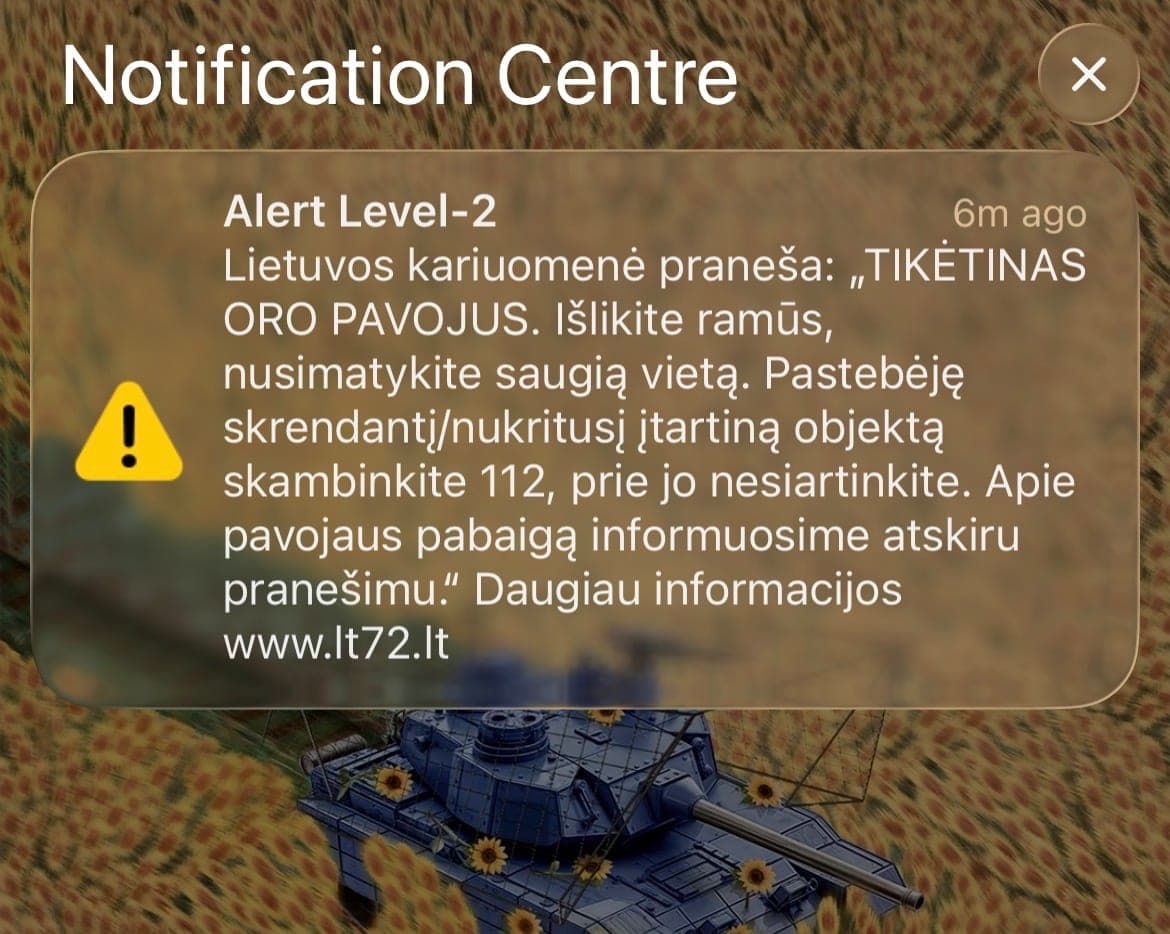
The first cell-broadcast, which reached phones in the Ignalina, Utena, Švenčioniai and Zarasai border districts shortly after 09:36 local time (06:36 UTC), was deliberately generic. Translated from Lithuanian, it read:
"PROBABLE AIR DANGER. Stay calm, identify a safe place. If you notice a flying or fallen suspicious object, call 112 and do not approach it. We will inform you of the end of the danger in a separate message."
The first Level-2 alert - "probable air danger", shown above as the page's cover image. It names no object type, no location, and no direction.
That message is notable for what it leaves out. It does not use the word "drone", does not say which district lay under the track, and does not say whether anything had crossed the border. The one concrete detail on the record came from a separate Armed Forces statement to the press: a radar mark over Belarusian territory. The alert that reached the public said none of this.
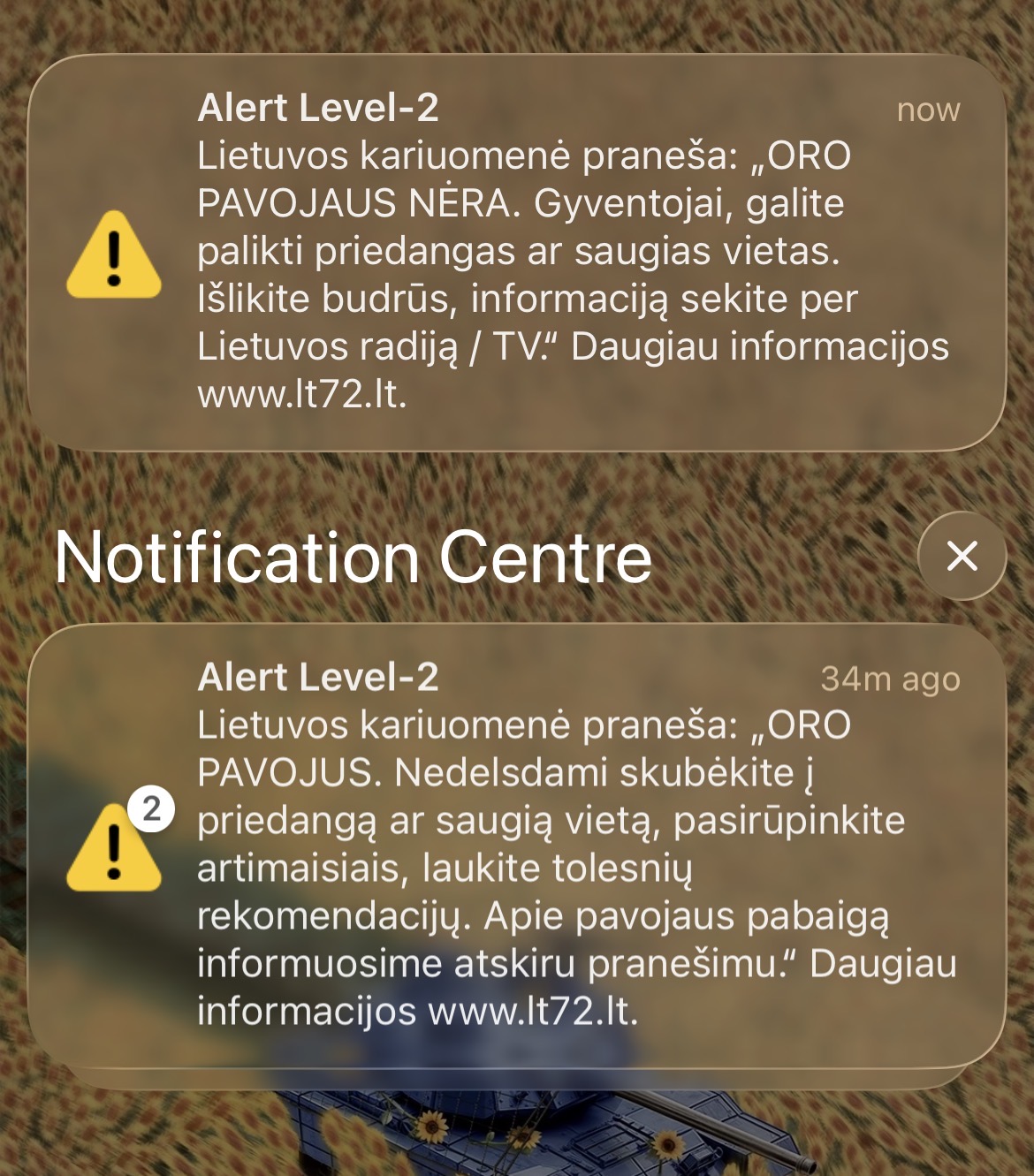
Within the hour the warning hardened. A second broadcast dropped the word "probable" and told residents to move immediately:
"AIR DANGER. Immediately hurry to a shelter or safe place, take care of your loved ones, and await further recommendations."
This shelter order was extended beyond the border districts to Vilnius and the surrounding region - and, as the morning wore on, as far south as the Alytus district. The airport closures, rail halts, and shelter order that followed are what separated 20 May from the lower-key border alerts earlier in the month.
The all-clear came at around 10:58 local time:
"THERE IS NO AIR DANGER. Residents, you may leave shelters or safe places. Stay alert and follow information via Lithuanian radio and TV."
Vilnius airport, trains, and shelters
For roughly 80 minutes the alert disrupted the capital. Vilnius Airport suspended flights after radar detected the drone approaching from Belarus. Train services were halted in parts of the country, and passengers in the Vilnius district and at Vilnius railway station were directed into shelters. President Gitanas Nausėda and presidency staff were taken to shelter for the duration of the alert.

This was the practical reach of a single radar contact: a precautionary detection on the eastern border emptied an international airport's departure boards and cleared a national rail network's platforms before anyone had confirmed what the contact was.
Public frustration - drone, missile, or balloon?
The wording of the alerts became a grievance in its own right. Neither the "probable air danger" advisory nor the "air danger" shelter order said what was inbound - and over this frontier that ambiguity matters, because the objects Lithuanians have learned to expect in their sky demand completely different responses. A smuggling balloon is a customs problem that drifts harmlessly overhead; a stray drone is a falling-debris and unexploded-ordnance hazard; a missile is a reason to be underground immediately. The broadcast collapsed all of them into a single phrase, "suspicious object," and left residents to guess which.
The geography was just as thin. The alert named no specific locality, no direction, and no sense of who was exposed, even as it widened from the four border districts to Vilnius and, later, as far as the Alytus region. Residents posted screenshots of the warnings on social media questioning whether they described a real threat at all, some of them taken aback that a message they associated with the eastern border had reached the capital and beyond.
That frustration is the predictable cost of detection-stage alerting: a system that fires on a raw radar return cannot tell people what the return is, only that something is there. It buys speed and caution at the price of precision - and on a morning when that same unidentified return shut an international airport and emptied train platforms, the gap between "an object" and a named threat was exactly what the public was left to sit with.
A radar mark, not a confirmed incursion
Two things kept this in the category of an alert rather than a confirmed incident. First, the object was a radar signature - the Armed Forces described its characteristics as typical of an unmanned aircraft, not as a confirmed UAV, and no drone was reported found or downed. Second, the contact was first tracked on the Belarusian side of the border; no crossing into Lithuanian airspace was confirmed, even after the all-clear.
Escalating public warnings, an airport closure, and the activation of NATO Baltic Air Policing - the response reflects the precautionary posture the Baltic states have adopted through spring 2026, in which alerts are issued on detection rather than after the fact. NATO fighters on the Baltic Air Policing rotation, flying from Šiauliai Air Base, scramble on this kind of cue; whether they engaged anything was not reported.
Where this fits
The 20 May alert capped a near-continuous run of drone-related events along the Baltic states' eastern frontier in May 2026:
- May 17, 2026 - Samanė, Utena district. A destroyed drone, later assessed as probably Ukrainian, was found in a field; explosives at the site were neutralised in a controlled detonation. See the Utena Samanė incident page.
- May 19, 2026 - Estonia. A Romanian NATO F-16 shot down an intruding drone over Lake Võrtsjärv - the first NATO fighter intercept of a drone over the Baltic. See the Estonia drone shootdown page.
The recurring assessment from Baltic capitals is that these objects are Ukrainian long-range strike drones, launched at Russian targets, chiefly the Baltic-coast oil terminals at Ust-Luga and Primorsk, and pushed off course by Russian electronic warfare. The 20 May contact was not confirmed as one, and its origin was left open. What 20 May did show is how far a single unverified track now propagates through Lithuanian public life. The following afternoon brought a second air-danger alert, this time tracking two objects toward Utena on 21 May.
Wind conditions over the northeast Lithuania alert zone
At 06:00 UTC on 20 May - at the start of the alert window - the 1,000 m layer across the zone between the north-eastern border and Vilnius showed NNE wind at 19.6 km/h. A light flow pushing SSW was the atmospheric background during the two-hour alert. The model and its limits are documented on the methodology page. This reconstruction draws on reporting by LRT, Al Arabiya, and 15min.lt, and on AirVeto's wind-model analysis for the 06:00–08:00 UTC alert window on May 20, 2026.
Vilnius Airport has been disrupted repeatedly through 2026; the Vilnius Airport location hub collects those events, and the full set of reconstructions is indexed at incident archive. The alerts did not stop with 20 May - the following afternoon brought a second day of warnings as two more objects were tracked over Utena. Every documented Lithuanian drone and airspace-alert incident is collected at the category hub: Dronai Lietuvoje (in Lithuanian).
Related location
- NATO eastern flank - The frontier where EU airspace meets Russia and Belarus across five NATO member states - the active zone of drone incursions, smuggling balloon recoveries, and Baltic Air Policing intercepts since 2025.
Sources
- LRT - Kariuomenė: netoli sienos pastebėtas įtariamas dronas, aktyvuota NATO oro policijos misija (May 20, 2026)
- LRT English - Air alert in Vilnius lifted following drone sighting in border regions (May 20, 2026)
- Al Arabiya / Reuters - Lithuania's Vilnius airport suspends flights due to drone warning (May 20, 2026)
- 15min.lt - Kariuomenės įspėjimas: oro pavojus Vilniaus apskrityje atšauktas, įspėti Alytaus rajono gyventojai (May 20, 2026)
- Wikipedia - 2026 Ukrainian drone incursions into Baltic states
- Methodology
Last updated: