
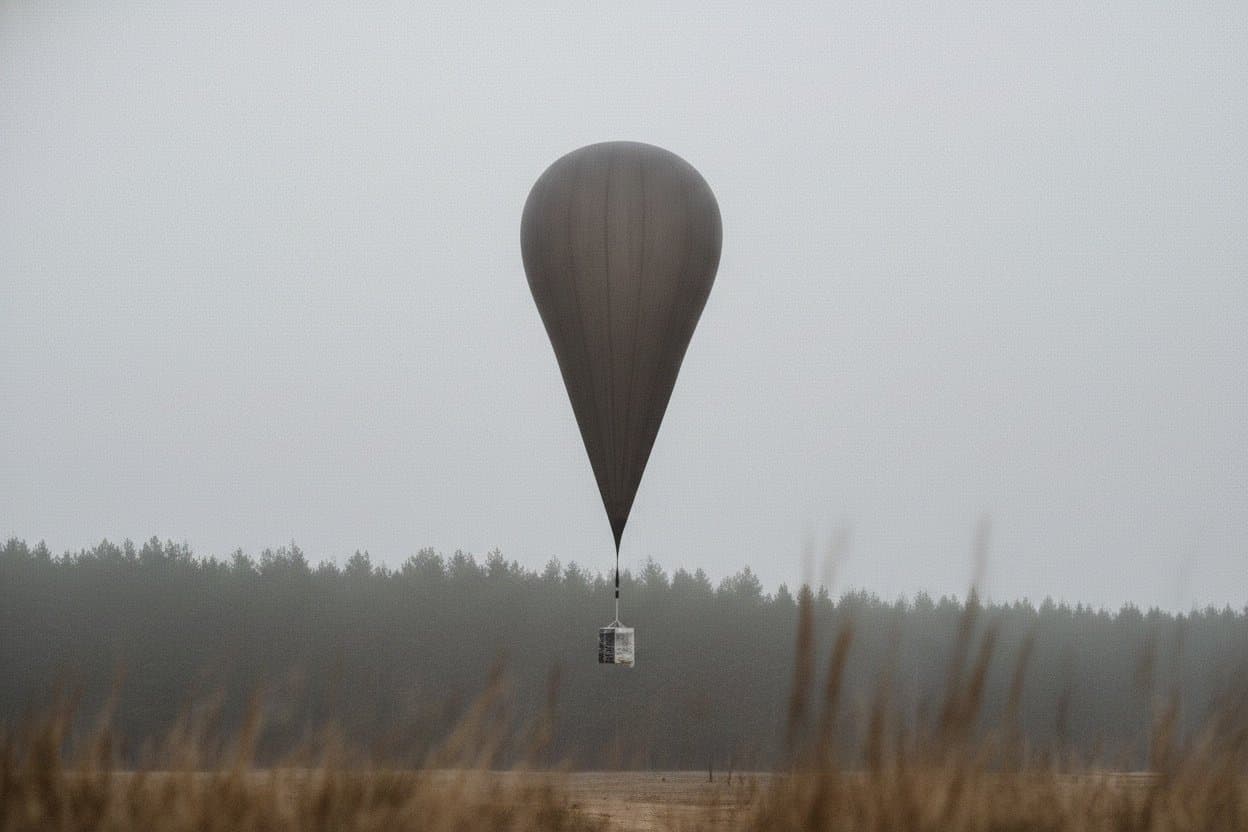
Lithuania's hydrometeorological service (LHMT) issued an orange-level storm warning on June 11, 2026, covering Vilnius, Utena, and Panevėžys counties — the three easternmost administrative regions in the country and the three that sit directly over the Suwalki corridor and the Lithuanian-Belarusian border zone.
What the Warning Covers
The warning window runs from 14:00 to 21:00 local time. LHMT meteorologist Paulius Starkus identified the Vilnius district as the zone where the strongest storm cells are most likely to form first, around 14:00.
The full set of conditions:
- Squalls with wind gusts of 15–20 m/s, locally up to 25 m/s (90 km/h)
- Thunderstorms with heavy rain
- Possible hail
- Wind direction: southeast and south, shifting to west and northwest as the system passes
The storm system extends beyond Lithuania's border. Latvia's central and eastern regions are under a parallel warning, with gusts forecast at 20–24 m/s and a risk of large hail.
Emergency SMS alerts were sent to residents of the affected counties before 11:00 on June 11.
Why Wind Direction Matters Here
The Suwalki corridor is a 65-kilometre land gap between Belarus and the Kaliningrad exclave — the narrowest point on NATO's eastern land border. This is the gap that most balloon-carried contraband must cross when entering Lithuanian or Polish airspace from Belarus.
Today's storm is approaching from the southeast and southeast, the direction of Belarus. As the squall line moves west-northwest through the afternoon, it carries air that originated over Belarus and western Russia directly into the corridor zone.
At 25 m/s, wind speed exceeds the typical release-window threshold used for contraband balloon operations. No operator would release a balloon in these conditions — the unpredictability of squall-embedded turbulence makes any trajectory calculation unreliable and recovery impossible. The corridor is, in practical terms, closed for airborne activity today.
What Squall Winds Do to Airborne Objects
At 15–20 m/s sustained, a balloon at 500 metres altitude crosses the full 65-kilometre Suwalki gap in approximately 54–72 minutes — half the time it takes at typical 8–10 m/s corridor wind. At 25 m/s gusts, it covers the same distance in under 45 minutes.
More practically: squall lines produce wind shear — abrupt changes in speed and direction over short vertical distances. A balloon at 500 metres may be travelling northwest at 20 m/s while a balloon at 1,000 metres is travelling west at 10 m/s. The two trajectories diverge by kilometres within an hour. Trajectory prediction breaks down under these conditions in ways that do not affect normal corridor monitoring.
This is not a monitoring gap. It is a pause in the activity itself.
The Live Map
The map above shows current wind conditions over the Suwalki corridor in real time, with altitude layers from 80 metres to 7 kilometres. Orange border segments indicate crossing points where wind is currently flowing from outside the EU into Lithuanian or Polish airspace. During active squall conditions, those segments will show the highest surface-wind values the map records.
For context: the Suwalki corridor typically shows 8–12 m/s at corridor altitude (500–1,000 m) on a standard June day. Today's orange segments will show 2–3 times that.
Frequently Asked Questions
Does storm weather stop balloon incidents on the Lithuanian-Belarusian border?
Severe storm conditions do not eliminate balloon activity, but they make controlled operations infeasible. Wind gusts above 20 m/s produce trajectory variance too wide to reliably cross a target zone. Historical AirVeto incident data shows no confirmed contraband balloon incidents on days with orange or red wind warnings in the corridor counties.
How does LHMT's orange warning compare to red?
MeteoAlarm uses a three-tier scale for wind: yellow (be aware), orange (be prepared, dangerous), red (take action, very dangerous). Orange wind warnings in Lithuania typically correspond to gusts of 20–28 m/s. Red warnings are issued above 28 m/s and have occurred twice in Lithuania in 2025–2026.
Why does this storm affect Latvia too?
The storm system is a large-scale squall line moving west-northwest across the eastern Baltic region. It entered Lithuania from the southeast and will reach central and eastern Latvia by evening. The MeteoAlarm warning for Latvia covers the same time window with comparable parameters: gusts of 20–24 m/s and large hail in some areas.
Primary sources
- LRT — Severe storm warning issued for eastern Lithuania (11 June 2026)
- LRT — Laukia visas kompleksas: liūtys su perkūnija, škvaliniai vėjai (11 June 2026)
- 15min — Pateikta naujausia informacija apie artėjančią audrą (11 June 2026)
- 15min — Labai smarki audra: meteorologai skelbia, kur juda stichija (11 June 2026)
- tv3.lt — Stipri audra artinasi: gresia kruša ir škvalas (11 June 2026)
- MeteoAlarm — Lithuania Orange Warning (11 June 2026)