
Ukraine Landed an Armed Robot Ashore by Drone Boat. A First.
On July 13, 2026, Ukraine's 123rd Brigade used an unmanned surface vessel to land an armed ground robot on Russian-occupied Kinburn Spit, the first documented USV-to-UGV combat delivery in warfare.
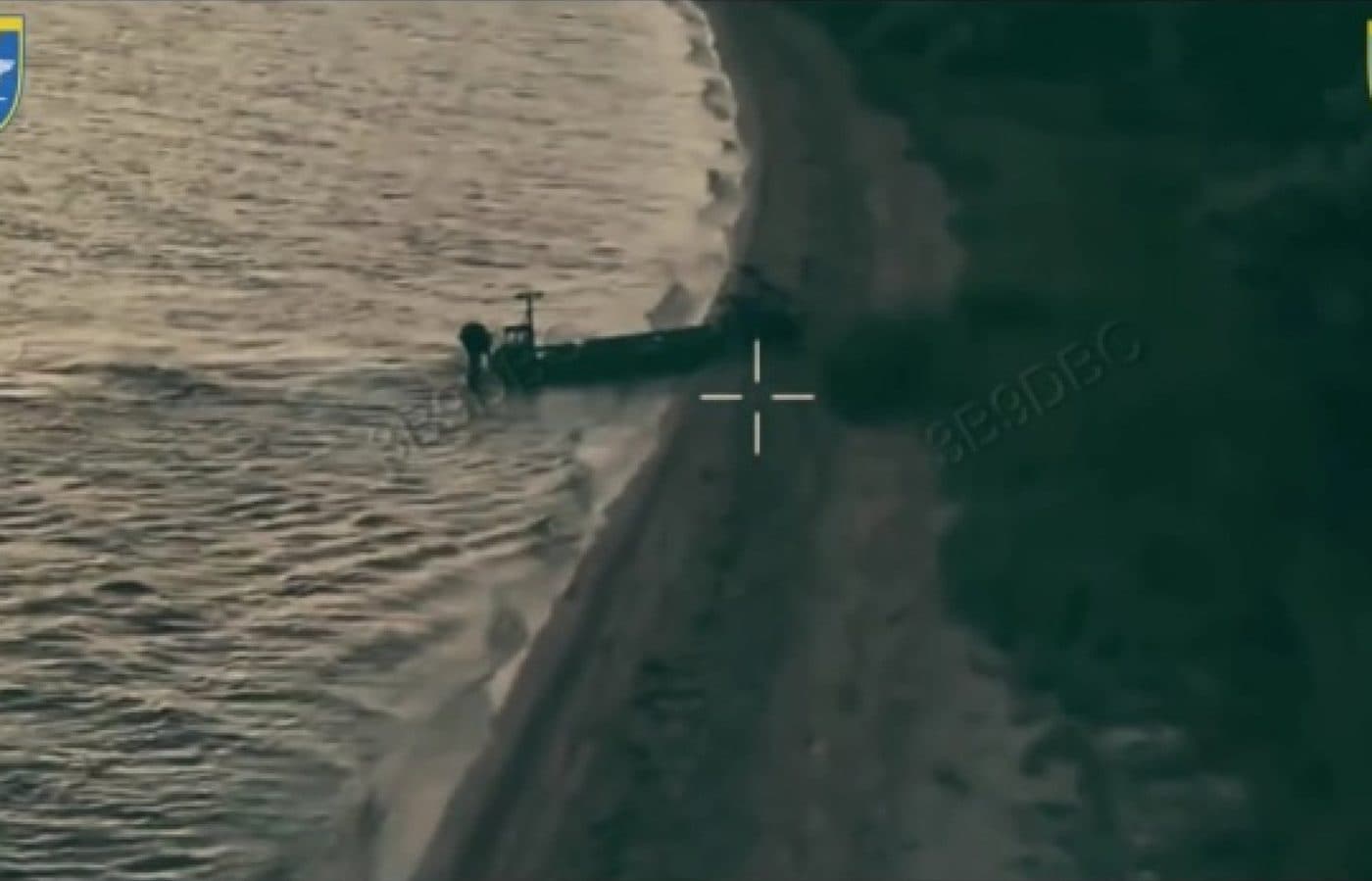
On July 13, 2026, Ukraine's 123rd Separate Territorial Defense Brigade announced it had delivered an armed unmanned ground vehicle onto Russian-occupied Ukrainian territory using an unmanned surface vessel, the first documented operation of this kind, as the brigade described it, "in the world." The landing site was the Kinburn Spit, a narrow sand peninsula in Mykolaiv Oblast that Russian forces have held since the autumn 2022 offensive. No casualties to Ukrainian personnel: the entire operation was conducted remotely.
The operation was led by Colonel Oleh Makukha, commander of the 123rd Brigade, and coordinated by Major Denys Hipik, commander of the brigade's 1st Unmanned Systems Battalion.
A drone boat crossed Russian-occupied water and put a combat robot ashore
The unnamed unmanned surface vessel crossed the water to the Kinburn Spit's occupied coastline, lowered a front ramp, and drove an armed ground robot onto the beach. The brigade's statement described the sequence as: "the ground robotic complex was delivered to the enemy shore using an unmanned maritime platform, landed on occupied Ukrainian territory, and employed to accomplish a combat task."
Ukraine has not officially identified the USV model used in the operation. Media analysis of footage suggested the ground robot may be a Rys-type UGV, a Ukrainian-made platform produced by Roboneers and typically armed with a 7.62mm remote weapon station, but the brigade has not confirmed the model. The combat task it carried out on shore has not been publicly specified.
The logistics chain is the story, not just the platform
Previous Ukrainian USV operations have functioned as strike assets: explosive-payload rams against Russian vessels, missile and rocket launch platforms, and intelligence-gathering probes. What distinguishes the Kinburn Spit operation is the payload: not a warhead but a second autonomous system. The USV acts as a carrier, not a weapon. That is a different problem than a strike mission.
Getting a UGV onto contested ground without a manned vessel or an air insertion requires the USV to beach or ramp-deploy under observation, with the ground robot operating independently once ashore. The 123rd Brigade's operation combined three unmanned domains in sequence: a sea platform for transit, a ground platform for the ground mission, and (according to media reporting) air assets for observation. Whether this constituted a pre-planned doctrine or an improvised capability is not stated in the brigade's announcement, but the operation's structure suggests prior rehearsal.
Ukraine's own production targets give context. From a base of roughly 10,000 UGVs produced in 2025, Ukraine has stated a target of 50,000 in 2026. That scale of ground-robot production, combined with a proven sea-delivery mechanism, changes the calculus for any coastline Russia holds.
Kinburn Spit sits at the mouth of the Dnieper-Bug estuary
The Kinburn Spit is a 10-kilometer sand bar at 46°34′N 31°31′E, projecting west into the Black Sea between the Dnieper-Bug estuary to the north and Yahorlyk Bay to the south. Its only land access runs through Russian-held Kherson Oblast, making it effectively isolated from Ukrainian ground forces. The peninsula is low-lying, typically 2–3 meters above sea level, with no significant natural obstacles between the waterline and the interior.
Ukrainian-controlled territory at Ochakiv sits roughly 10 kilometers to the east, across the Dnieper-Bug estuary. The water crossing from Ochakiv to the Kinburn Spit's occupied western end is one of the shortest water gaps between Ukrainian and Russian positions on the Black Sea front.
The wind field over the Kinburn approach set the operational window
AirVeto reconstructs the wind field over the Black Sea approach and the Dnieper-Bug estuary at the time of the operation. For this event, the wind layer is contextual rather than causal: a powered USV does not drift with the wind the way a contraband balloon does. Wind direction and sea state set the operational window and affect a low-freeboard vessel's ability to beach accurately.
The live map shows current conditions over the southern Ukraine coast and Black Sea.
What comes after a first
Ukraine has been the primary innovator in combat USVs since 2022, with the Magura V5 and Sea Baby platforms accumulating the most documented combat record: strikes against Black Sea Fleet vessels, helicopter shoot-downs, and the 2026 Philippines exercise. The Kinburn Spit operation extends the USV's role from an asset that crosses water to strike a target to an asset that crosses water to deliver another asset.
The implications are not limited to the current front. Any coastline that can be reached by a drone boat is now potentially reachable by a ground robot. That is a new variable for coastal defence planners operating in any theatre where USV access is not blocked.
For coverage of Ukraine's earlier USV operations in the Black Sea, see the Romania naval drones brief and the incident archive.
Sources
- United24 Media - Ukraine carries out world's first sea drone-to-ground robot assault mission (13 Jul 2026)
- The War Zone - Ukraine lands armed robot ashore in Russian-held territory via drone boat (14 Jul 2026)
- Naval News - Ukraine conducts first fully unmanned amphibious raid at Kinburn Spit (Jul 2026)
- Euromaidan Press - Ukraine put armed robot on Russian-held ground. Naval drone was landing craft (14 Jul 2026)
- Militarnyi - The 123rd Brigade deployed unmanned ground vehicle from naval drone onto Kinburn Spit (Jul 2026)
- Forbes - Ukraine carries out first ever robotic amphibious assault (14 Jul 2026)