
Belitsa munitions plant explosion, 10 Aug 2026
An explosion tore through an EMCO ammunition depot near Belitsa, Bulgaria, on August 10, 2026 after a truck fire spread to a warehouse; no casualties, cause still under investigation.
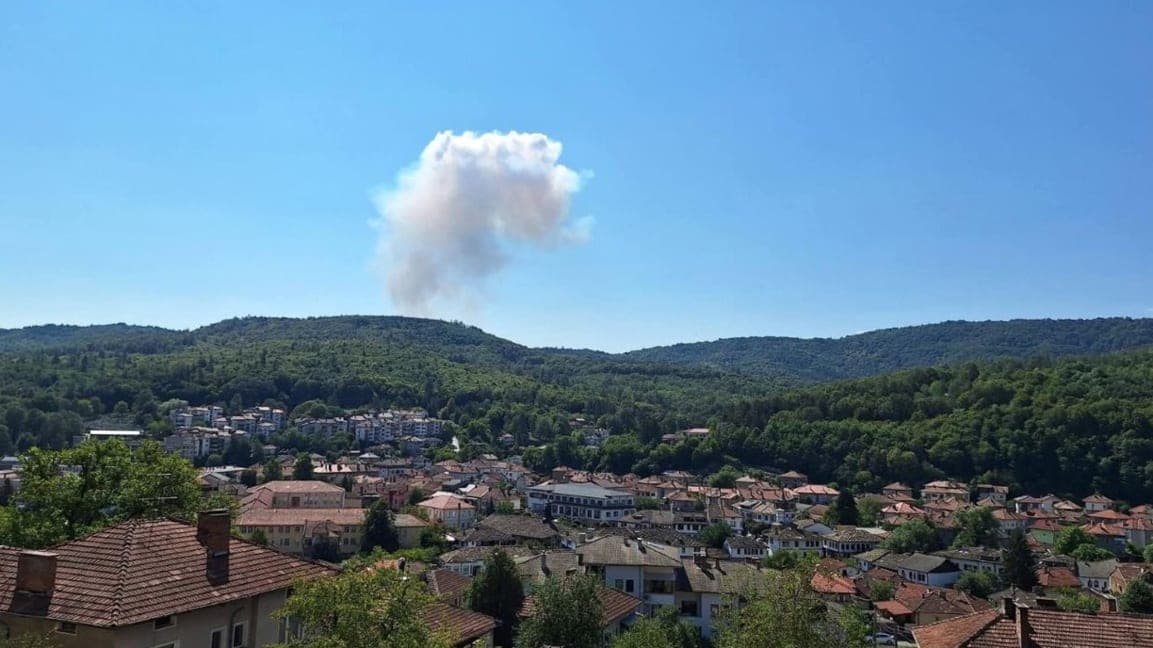
Shortly after 10:30 local time (07:30 UTC) on August 10, 2026, a truck caught fire at the EMCO ammunition plant near Belitsa, a village in Tryavna Municipality in central Bulgaria, according to a statement from the Gabrovo Regional Administration reported by BTA, Bulgaria's national news agency. The fire spread into part of the plant's warehouses and triggered a series of explosions. Tryavna Mayor Dencho Minev confirmed no fatalities or injuries; all EMCO workers were evacuated, and nearby residents were evacuated as a precaution while firefighters from Tryavna and Gabrovo brought the fire under control.
EMCO ruled out human error while Bulgarian authorities kept every option open
The Gabrovo Regional Administration's initial account traced the sequence to a truck fire that spread to a warehouse. EMCO subsequently said it had ruled out human error at the site, while Bulgarian officials said there was no evidence at that stage of foreign interference. Gabrovo District Prosecutor Tihomir Petkov named three lines of inquiry investigators were weighing: the deliberate or accidental introduction of a fire source, a fault in production components, and breaches of storage or handling procedure, with a leading theory expected once the site could be safely inspected. The area's last routine inspection, on 28 July, had found no violations. The BG-ALERT system was activated twice: once for the initial fire, and again two days later to warn residents ahead of a controlled disposal of ammunition still scattered and smouldering at the site.
The Tryavna plant supplies artillery ammunition to Ukraine
EMCO Ltd., privately owned by Bulgarian businessman Emilian Gebrev, is one of Bulgaria's largest private defence manufacturers. Its Tryavna facility produces, repairs and modernises artillery and tank ammunition in calibres from 100mm to 152mm, alongside the company's wider Soviet- and NATO-standard production lines that overlap with calibres still used by Ukrainian forces. Bulgaria's ammunition-manufacturing base has taken on added strategic weight as European stockpiles are replenished and support for Ukraine continues, and Rheinmetall and state-owned VMZ are weighing a joint 155mm production line elsewhere in the country.
Bulgarian prosecutors have tied earlier ammunition-plant blasts to Russian operatives
The 10 August fire is not EMCO's first. The company has pointed to prior incidents at its own facilities in 2011, 2022 and 2023, and Bulgarian prosecutors have separately investigated a wider pattern across the country's defence industry. In 2021, prosecutors said they had identified links among four explosions at Bulgarian ammunition facilities between 2011 and 2020, including an EMCO depot near Lovnidol in 2011, a VMZ Sopot facility near Iganovo in 2015, and an Arsenal depot at Muglizh in 2020, and were examining the involvement of six Russian nationals. Investigators at the time said they were assessing whether the goal was to disrupt ammunition supplies to Georgia and Ukraine.
A 2023 investigation by The Insider and Bellingcat went further, tying the 2011 Lovnidol blast to Unit 29155 of Russia's military intelligence service, the GRU. After a 2022 explosion at EMCO's Karnobat site, company owner Emilian Gebrev publicly alleged Russian involvement, while acknowledging he had no direct evidence. Bulgarian authorities have not attributed the 10 August fire to sabotage, and neither has EMCO.
The blast follows two other hits on Europe's Ukraine-bound ammunition supply chain this month
Belitsa is the third incident in nine days to touch a European site tied to Ukraine's ammunition or cargo supply chain. On 4 August, an explosive-laden drone was found next to Ukrainian Antonov Airlines cargo aircraft at Leipzig/Halle Airport in Germany; only a failed detonator prevented a blast. On 13 August, an explosion tore through the KNDS Ammo Italy munitions plant at Colleferro near Rome, a contractor under the EU's 155mm ammunition framework agreement. Italian investigators ruled out sabotage at Colleferro within hours; Bulgarian investigators have reached no equivalent conclusion at Belitsa nearly a week on.
Wind and smoke conditions over Belitsa on 10 August
At 07:00 UTC on 10 August, close to the fire's start, the 80 m surface layer over Belitsa showed wind pushing southwest at 5.6 km/h. At 2,000 m the flow held toward the southwest at 7.9 km/h; at 3,000 m it shifted to push south at 12.7 km/h, a stronger flow aloft that stayed broadly southward through the lower atmosphere. At surface level, the light flow would have carried smoke from the burning warehouse away to the southwest. This reconstruction is based on reporting by BTA, Adria Defense and Militarnyi, and on AirVeto's wind-model data for the event window. How AirVeto builds this field, and where it is reliable, is described on the methodology page.
Bulgaria's own prosecutors have already treated the country's ammunition-plant fires as a pattern worth investigating for foreign involvement once before. Whether the 10 August fire at Belitsa turns out to belong in that pattern, or is the accident EMCO's own statement implies, is still an open question the Gabrovo investigation has not answered.
Sources
- BTA - Explosions Reported in Ammunition Plant Warehouses in Central Bulgaria, No Casualties (10 Aug 2026)
- BTA - All Possible Causes of Explosions at Ammunition Plant Investigated, BG-ALERT Activated Due to Ammunition Disposal On Site (13 Aug 2026)
- BTA - BG-ALERT Activated Again Due to Detonation of Ammunition Near Belitsa (12 Aug 2026)
- Adria Defense - EMCO Rules Out Human Error in Bulgaria Ammunition Depot Fire
- Militarnyi - EMCO Warehouse Manufacturing Artillery Shells Explodes in Bulgaria
- Methodology