
Four hits on Ukraine's defence supply chain in eleven days
Ammunition plants, an airport, and a robotics maker tied to Ukraine's supply chain caught fire, exploded, or came under threat in eleven days this August.
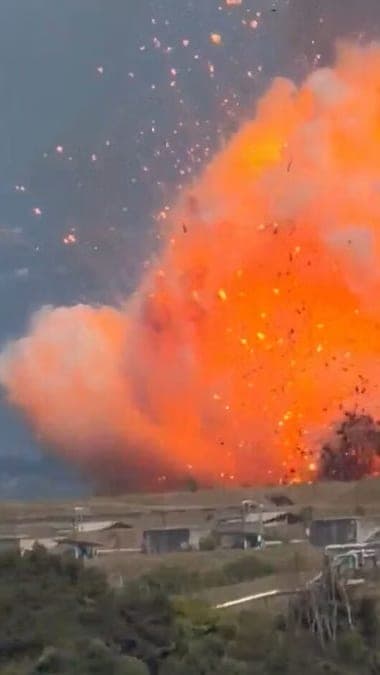
Four sites tied to Ukraine's military supply chain caught fire, exploded, or came under threat within eleven days this August: an explosive-laden drone at Leipzig/Halle Airport on 4 August, an ammunition depot near Belitsa, Bulgaria on 10 August, a munitions plant at Colleferro, Italy on 13 August, and an arson fire at a Milrem Robotics building in Tallinn on 15 August. Investigators have reached three different conclusions across the four - sabotage confirmed, sabotage ruled out, and sabotage under investigation - and no government has formally linked the events to each other.
Quick facts:
- Germany: a drone packed with explosives found beside a Ukrainian cargo plane at Leipzig/Halle Airport, 4 August. Investigators confirmed the charge was Semtex, a plastic explosive.
- Bulgaria: fire at an ammunition depot near Belitsa, 10 August. Cause still unresolved.
- Italy: explosion at the KNDS Ammo Italy munitions plant, Colleferro, 13 August. Sabotage ruled out.
- Estonia: arson at a Milrem Robotics building in Tallinn, 15 August. A Russia sabotage link is under investigation.
The four sites make hardware or move cargo bound for Ukraine's front line
Leipzig/Halle Airport handles Antonov Airlines cargo flights; the drone found there on 4 August, confirmed by German investigators to be packed with Semtex, was positioned beside four Antonov aircraft on the runway. The EMCO plant near Belitsa manufactures artillery shells. The KNDS Ammo Italy plant at Colleferro, a contractor under the EU's 155mm ammunition framework agreement, has supplied Leopard tanks and Caesar howitzers to Ukraine through its parent company. Milrem Robotics builds the THeMIS unmanned ground vehicle, which has operated in Ukraine on logistics and casualty-evacuation runs since 2022; a Netherlands-funded delivery of more than 100 THeMIS units began production in June 2026.
Investigators have not agreed on a single cause
The Leipzig/Halle drone is the only one of the four confirmed as a deliberate bombing attempt: German investigators confirmed the explosive charge was Semtex and that only a failed detonator prevented a blast next to the Antonov aircraft, per dpa. At Colleferro, ANSA's initial wire report placed the blast in the plant's powder-pressing department; AirVeto's fuller reconstruction of the incident, drawing on Italian coverage, found that investigators ruled out sabotage within hours and that the Velletri prosecutor's office is pursuing a fire-related charge instead, pointing preliminarily to an accidental detonation during processing. At Belitsa, Bulgarian prosecutors have not attributed the fire to sabotage or ruled it out - the cause remains under investigation more than a week on, per BTA. In Tallinn, Estonian State Prosecutor Gardi Anderson said the fire was intentional and pre-planned and that three suspects were detained in Latvia, per LRT; Prosecutor General Astrid Asi said motives are still being examined, including whether it was an act of sabotage, per ERR; and Prime Minister Kristen Michal said the state is examining whether Russia was involved, per Kyiv Post.
Officials are treating the pattern as a live concern, without claiming coordination
Estonian Prime Minister Kristen Michal said his government takes the possibility of Russian sabotage against its defence industry seriously and would "protect our people and our companies by any means necessary," per Kyiv Post. Poland and the Baltic states have separately tightened protection around critical infrastructure this year, and officials have warned Moscow may seek to stage operations aimed at undermining support for Ukraine. None of that amounts to an official finding that the four August incidents are connected - Colleferro's own investigators closed the sabotage question locally, and Bulgaria's inquiry into Belitsa remains open on its own terms.
A cluster like this has happened before, in Bulgaria alone
The 10 August Belitsa fire is not EMCO's first incident, and it is not the first time Bulgarian prosecutors have investigated a pattern across the country's own ammunition industry. In 2021, prosecutors said they had identified links among four explosions at Bulgarian ammunition facilities between 2011 and 2020, including an earlier EMCO depot fire, and said they were examining the involvement of six Russian nationals in relation to disruption of ammunition supplies to Georgia and Ukraine. A 2023 investigation by The Insider and Bellingcat tied one of those four blasts to Unit 29155 of Russia's military intelligence service, the GRU. That 2011-2020 pattern took years for investigators to establish and attribute; the four August 2026 sites have not been through anything like that process yet, and may never be linked at all.
This reconstruction is based on reporting by ANSA, BTA, dpa, ERR, Kyiv Post and LRT, and on AirVeto's own incident reconstructions for each of the four events. Each carries its own sourced wind-and-timeline record at Leipzig/Halle, Belitsa, Colleferro, and Tallinn. Whether the eleven-day window turns out to be four unrelated incidents or the first sign of something investigators eventually connect is a question none of the four national inquiries has answered yet.
Sources
- ANSA English - Fire and explosion at munitions plant at Colleferro (13 Aug 2026)
- BTA - Explosions Reported in Ammunition Plant Warehouses in Central Bulgaria, No Casualties (10 Aug 2026)
- dpa via Yahoo News - Semtex used in Leipzig airport drone bomb, investigators confirm (6 Aug 2026)
- ERR News - Estonian defense contractor Milrem Robotics' fire could have been arson (18 Aug 2026)
- Kyiv Post - Estonia Probes Possible Russian Sabotage at Milrem Robotics (18 Aug 2026)
- LRT (LT) - Estija: ginklų įmonės pastato padegimas buvo tyčinis, Latvijoje sulaikyti trys įtariamieji (19 Aug 2026)