
Norway, 10-11 Mar 2026 - Il-20M Coot, transponder off
Norwegian F-35s intercepted a Russian Il-20M reconnaissance aircraft off Finnmark two days running during NATO's Exercise Cold Response 2026, transponder off on the second day.
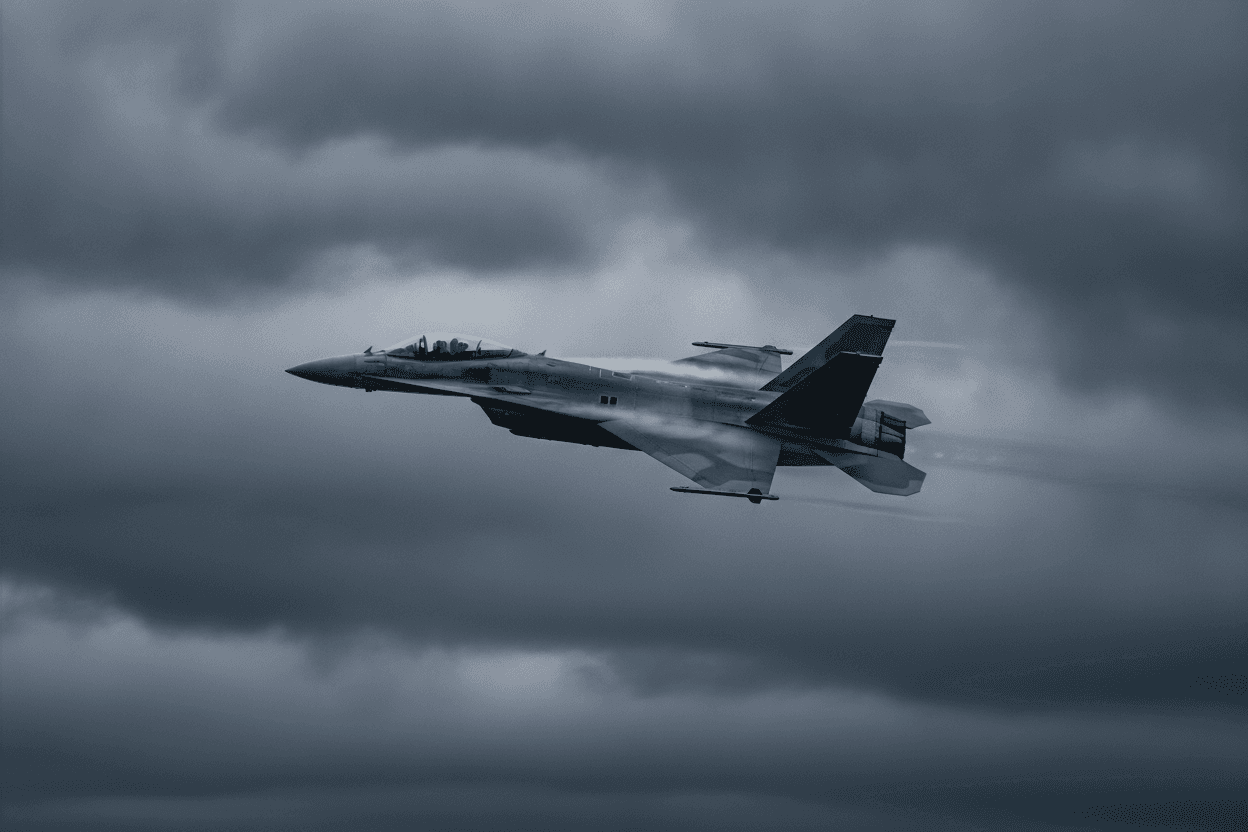
Royal Norwegian Air Force F-35A Lightning IIs intercepted a Russian Il-20M "Coot" reconnaissance aircraft on two consecutive days, 10 and March 11, 2026, while NATO's Exercise Cold Response 2026 was underway in northern Norway. On 10 March, the aircraft was identified and shadowed by two F-35s in international airspace off Finnmark before it turned north from Sørøya and returned toward the Kola Peninsula around midday. On 11 March, the same aircraft, identifiable by its serial number RF-95671, returned to the area flying with its transponder switched off. According to the Norwegian Armed Forces, Norwegian sensors detected it around 09:30 local time (08:30 UTC), and two F-35s on Quick Reaction Alert duty scrambled from Evenes Air Station; AirVeto's wind-model data for the international airspace off Finnmark shows the flow at 3,000 meters running at 34 km/h and pushing east-southeast during that window.
The second day's shadow ran the length of Norway's northern coast
After visually identifying the aircraft on 11 March, the F-35s shadowed it along the Norwegian coast before it turned northwards off Vesterålen, then flew south twice more, reaching as far as Lofoten, before returning to the Kola Peninsula around 13:30 local time (12:30 UTC). The Norwegian Armed Forces said the intercepts were routine and not unusual: "There is nothing unusual or dramatic about such Russian flights, and Russia has the right to conduct these missions." The statement assessed the flights as most likely intended to gather situational awareness of allied activity connected to Cold Response 2026.
The Il-20M is Russia's primary long-range signals-intelligence aircraft
The Il-20M "Coot" is a specialised reconnaissance and electronic-intelligence platform carrying side-looking airborne radar, infrared and optical sensors, and satellite communications equipment, used to detect and locate ground, maritime and aerial emissions. Russian Il-20s fly regularly in international airspace over the Baltic region with transponders off. The type was also intercepted three times in less than a week within the Alaskan Air Defense Identification Zone in August 2025, during a comparable period of allied exercises (Northern Edge 2025) - the same pattern of appearing during major NATO drills repeating in the Cold Response case.
Cold Response 2026, Norway's largest exercise of the year, ran from 9 to 19 March across northern Norway and Finland and in the seas off North Norway, with 32,500 participants from 14 nations - 25,000 training in Norway, 7,500 in Finland.
This kind of scramble is known as a QRA (Quick Reaction Alert) mission, and the Norwegian Armed Forces said its F-35s fly around 40 of them each year. Two in two days off Finnmark during Cold Response is therefore a small but real concentration against that annual baseline, not a one-off.
Wind conditions off Finnmark
At 08:00 UTC on 11 March, close to the start of the second-day intercept window, AirVeto's wind-model data for the international airspace off Finnmark put the flow at 3,000 meters, the incident's plotted altitude, at 34 km/h and pushed toward the east-southeast. Open-Meteo's model returned no usable reading at 2,000 meters for this location and date; the 3,000 meter level is the value used here.
This reconstruction draws on the Norwegian Armed Forces' own account of the intercept, reporting by The Aviationist, and AirVeto's wind-model data for the 08:30-12:30 UTC window on March 11, 2026. How the model is built and where it is reliable is on the methodology page. A full archive of drone and airspace incidents across the EU's eastern border is at the incident archive.
Sources
Last updated: