
Delta, Palantir, SitaWare: Battlefield Systems Compared
Side-by-side comparison of the three battlefield management systems used by Ukraine, the US, and Lithuania, with where AirVeto's public wind layer fits.
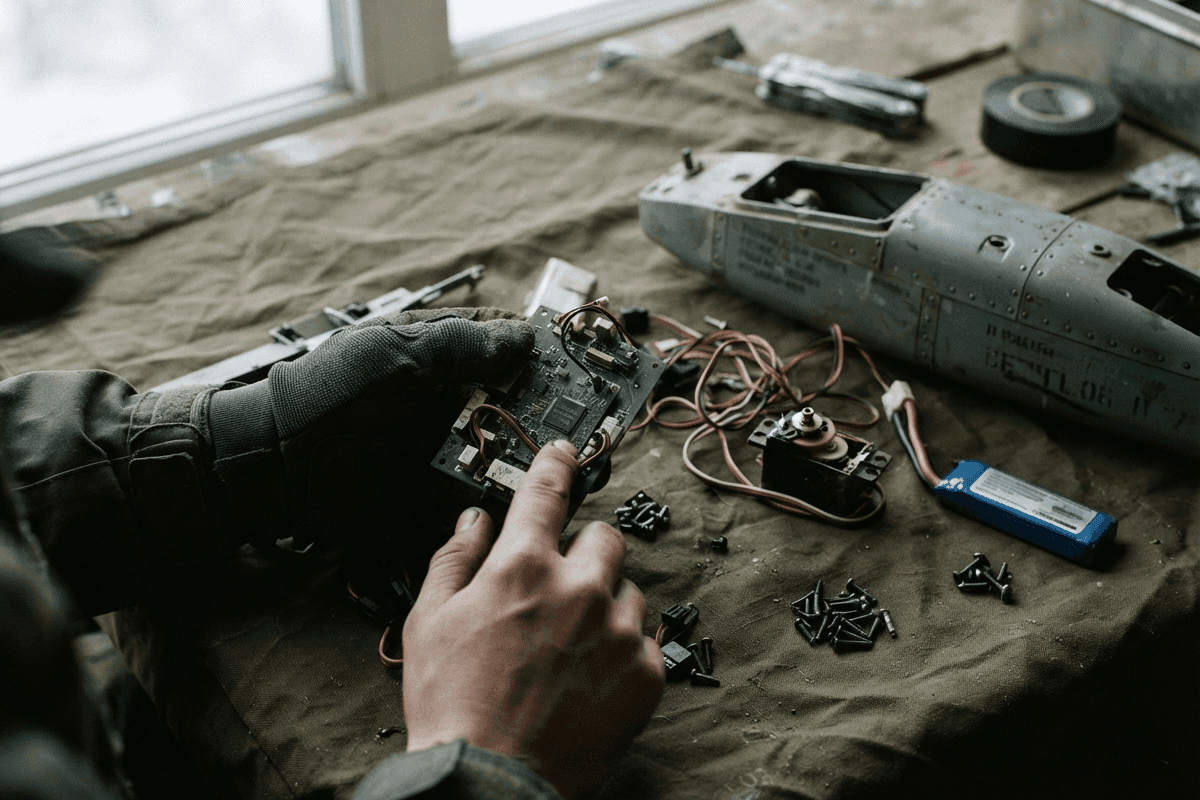
Ukraine, the United States, and Lithuania each operate a different battlefield management system. Ukraine runs Delta, an indigenous cloud-based BMS commissioned in August 2024, alongside Palantir Gotham for fusion analytics. The United States procures Palantir Gotham under a $10 billion, ten-year Enterprise Service Agreement signed with the US Army in 2025. Lithuania has standardised on Systematic's SitaWare, the NATO-standard land C2 platform, across all branches of its armed forces.
This page compares the three on origin, AI capability, NATO interoperability, and combat record, then closes on where AirVeto's public wind layer and balloon-launched strike drones fit.
Three armies, three BMS architectures
Each country built or procured a BMS that matches its operational problem. Ukraine fights a high-intensity war with thousands of daily targets and needs a system that scales targeting, integrates UAV video, and works offline at the front line. The United States supports Ukraine and other allies while modernising its own Army command architecture for long-range precision strikes. Lithuania, a NATO member not at war but bordering Belarus and the Kaliningrad exclave, prioritises interoperability with allied formations stationed on its territory over indigenous platform development.
| Country | Primary BMS | Origin | Strongest at |
|---|---|---|---|
| Ukraine | Delta | Bottom-up, wartime (2016–) | Targeting throughput at scale |
| United States | Palantir Gotham | Commercial contract (2008–) | Data fusion and deep analytics |
| Lithuania | SitaWare | Procured from Systematic (Denmark) | Native NATO interoperability |
Ukraine runs Delta as its sole official data exchange platform, supplemented by Palantir for analytics
Delta began in 2016 as a bottom-up digital map for situational awareness and grew into Ukraine's primary command-and-control platform. It was formally commissioned in August 2024 and has been combat-tested continuously since 2022. In August 2025, Prime Minister Denys Shmyhal signed an order designating Delta the sole official data exchange platform across all branches of the Ukrainian Armed Forces. NATO experts have described the system as "Google for the military."
Delta supports targeting of 2,000+ enemy assets per day
Delta is a cloud-based data lake that integrates UAV feeds, satellite imagery, radar tracks, and human intelligence into a single operational picture, accessed through web, iOS, and Android clients on any commercial device. Its integrated modules cover situational awareness, offline mobile use, UAV video streaming, targeting and fire damage management, mission planning, and secure inter-unit chat. According to Euromaidan Press (August 2025), Delta supports targeting of more than 2,000 enemy assets per day, and over half a million Russian targets have been verified and destroyed via the system to date.
Palantir Gotham complements Delta where deep analytics matter
The United States has supplied Ukraine with Palantir Gotham since 2022, initially free of charge. CEO Alex Karp has stated publicly that Palantir is "responsible for most of the targeting in Ukraine." Ukraine's HIMARS targeting pipeline relies heavily on Gotham's data fusion.
Both Delta and Palantir Gotham operate simultaneously because they are good at different things. Lyuba Shipovich, CEO of Dignitas Ukraine, told CEPA in March 2026: "Palantir has great visualization tools, but Delta is better for data collection. Palantir is mostly used at command centers with strong internet. Delta and Kropyva can work offline, which is a huge advantage."
Kropyva and Avengers complete the Ukrainian tactical layer
Kropyva is an artillery C2 application developed by Army SOS volunteers in 2014. It is used by 90–95% of Ukrainian artillerymen and reduces counter-battery response time by a factor of ten compared to Soviet-era methods. Avengers is an AI video analysis platform that processes approximately 50,000 simultaneous video streams and auto-detects targets from drones and cameras.
NATO interoperability is in active testing, with export talks underway
Delta was tested at NATO CWIX 2024 across five standards in thirteen focus areas. As of April 2025, at least one NATO member state was in export talks for the system. Delta can exchange data with NATO battlefield management platforms and complies with NATO information exchange protocols.
Delta and Palantir Gotham have opposite strengths and complement each other in Ukraine
| Dimension | Delta (Ukraine) | Palantir Gotham (USA) |
|---|---|---|
| Origin | Bottom-up, wartime (2016–) | Commercial, top-down (2008–) |
| Offline operation | Yes | No (requires strong internet) |
| Primary strength | Frontline data collection at scale | Visualisation and deep analytics |
| Hardware requirement | Any commercial device | Enterprise-grade infrastructure |
| Update cadence | Continuously updated in combat | Slower commercial procurement cycles |
| Combat record | Active high-intensity war (2022–) | Iraq, Afghanistan, Ukraine |
The United States procures Palantir Gotham at enterprise scale
Where Ukraine's stack grew bottom-up under combat conditions, the US stack is procured top-down through enterprise contracts. Palantir Gotham, in service since 2008, is the BMS-relevant product: it ingests satellite imagery, drone footage, signals intercepts, and human intelligence to produce an operational picture. In 2025, Palantir signed a US Army Enterprise Service Agreement worth up to $10 billion over ten years, consolidating 75 prior contracts. The procurement model prioritises long-term commercial integration over indigenous in-house development.
Lithuania uses SitaWare as its NATO-standard BMS across all branches
Lithuania does not have a native Delta equivalent and is not building one. It has standardised on Systematic's SitaWare across all branches of the Lithuanian Armed Forces, the de facto NATO land forces standard also used by Germany, Denmark, Sweden, Finland, the United Kingdom, Latvia, and Australia.
The deployment runs SitaWare Headquarters at brigade level and above (also adopted by NATO itself under Project DEMETER), SitaWare Frontline integrated into Vilkas infantry fighting vehicles in the "Iron Wolf" Brigade, and IRIS Forms military messaging. The German enhanced Forward Presence (eFP) Battlegroup stationed in Lithuania uses the same SitaWare Headquarters deployment, so allied interoperability is built into the platform rather than achieved through bridging layers. Lithuania demonstrated SitaWare integrating drones, sensors, and legacy systems into a real-time sensor-to-shooter chain during its War Herald 2026 exercise.
The trade-off is visible: SitaWare is mature, certified, and shared with allies, but Lithuania does not control the roadmap, cannot iterate the platform under combat conditions the way Ukraine iterates Delta, and depends on Systematic for major capability additions. For a country whose primary deterrent is the credibility of allied response, the trade is rational.
Side-by-side: Delta, Palantir, and SitaWare compared (2026)
| Dimension | Delta (Ukraine) | Palantir Gotham (USA) | SitaWare (Lithuania) |
|---|---|---|---|
| Type | Indigenous wartime BMS | Commercial AI and data analytics | NATO-standard C4ISR |
| Origin | Bottom-up, live combat (2016–) | Commercial contract (2008–) | Procured from Systematic, Denmark |
| Offline capability | Yes | No | Partial |
| AI targeting | Advanced (Avengers, Target Hub) | Highly developed (AIP, Maven heritage) | Mature, mostly external integrations |
| Kill-chain timing | Approximately 2 minutes | Minutes | Real-time (demonstrated at War Herald 2026) |
| NATO interoperability | Tested at CWIX 2024; export talks underway | Deep integration | Native (NATO-standard platform) |
| Cost profile | Low (any commercial device) | Enterprise ($10 billion / 10 years, US Army) | Licensed software, enterprise-wide |
| Combat record | Active high-intensity war | Ukraine, Iraq, Afghanistan | Allied exercises; not in active war |
| Roadmap control | Ukrainian MoD | Palantir Technologies | Systematic (Denmark) |
Where AirVeto and balloon-launched strike drones fit
Two systems sitting outside any single BMS intersect with all three: AirVeto, the public wind and airspace tracking layer for the EU eastern frontier, and the recent class of balloon-launched strike drones that have made wind data part of the targeting decision.
AirVeto publishes the atmospheric data BMS targeting systems consume internally
AirVeto is a public web map that visualises live wind conditions at multiple altitudes, cross-border airflow patterns, ADS-B aircraft tracks, Baltic AIS vessels, and satellite passes. The data sources are open: wind vectors come from Open-Meteo (a blend of ECMWF and GFS forecasts on an hourly cadence), aircraft positions from ADS-B Exchange, Baltic ships from Digitraffic AIS, and satellite tracking from Celestrak two-line element sets propagated with SGP4.
We built AirVeto because every operational decision involving a balloon, an aerostat, or an unpowered glide vehicle starts from the same atmospheric input that BMS trajectory algorithms consume internally. Delta processes wind data for its own predictions. Palantir feeds atmospheric models into AIP. SitaWare integrates weather services through its sensor data pipeline. None of these expose the layer to anyone outside the closed C2 stack. AirVeto does.
Balloon-launched strike drones make wind selection part of the targeting decision
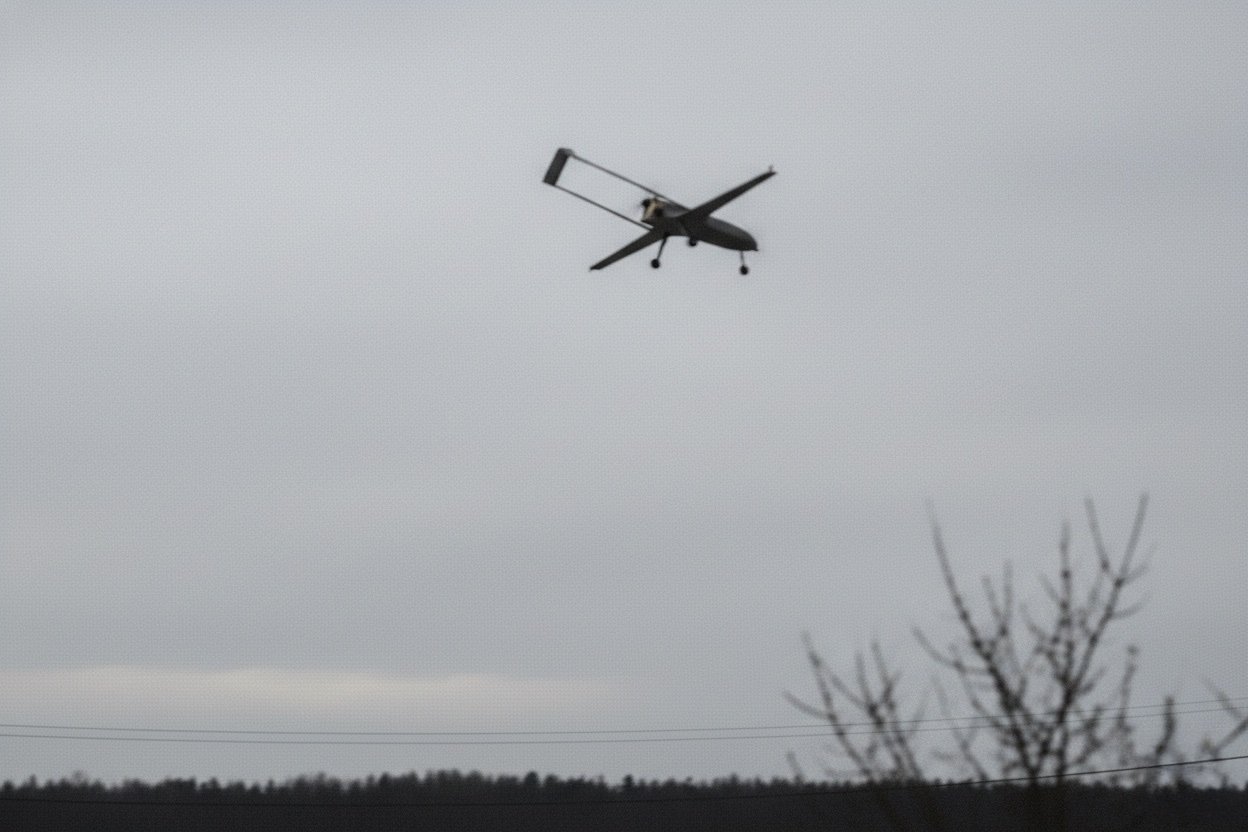
On May 20, 2026, Ukrainian operators tested a balloon-launched configuration of the Hornet strike drone, a single-use platform built by Swift Beat LLC with an open-source-estimated base range of approximately 150 kilometers while carrying a 4–5 kg warhead. The balloon-launch system was developed by KettleTech Labs.
In the test, a helium balloon carried the Hornet 42 kilometers from the launch point and released it at approximately 8,000 meters altitude, with the drone consuming only about 5% of its battery during ascent. bne IntelliNews reports that the configuration approximately doubles the Hornet's effective range, and Defense Express estimates the extended strike radius at 190–200 kilometers. Defense Express also notes that the system can extend further by "exploiting wind direction and altitude" to drift the balloon farther before release. Wind selection is part of the targeting chain.
Where this leaves the three BMS architectures
The wind layer is upstream of any BMS targeting decision involving aerostat or balloon operations. Each of the three architectures consumes it internally, in different ways. Delta and Palantir read it as part of trajectory estimation for targeting and threat assessment. SitaWare reads it through allied meteorology integrations. None of them publish it.
AirVeto is the public version of the same layer. It is not a BMS, does not connect to one, and cannot target. What it does is make the atmospheric step legible to anyone reading from outside a closed C2 stack: journalists reconstructing a balloon incident, OSINT analysts tracking airflow activity, researchers comparing forecast performance against actual drift, or border-state populations watching what is happening over their own territory. The Hornet case demonstrates that the same data layer carries equal weight on the offensive side. The physics does not change with the direction of the operation; what changes is who can read the data, and from where.
Sources
- Euromaidan Press - DELTA now scales across the entire military (Aug 2025)
- NATO ACT - Battlefield Innovation: DELTA at CWIX24 (Jul 2024)
- CEPA - The Heart of War: Ukraine's Key Drone Battlefield System (Mar 2026)
- Eurasia Review - Software On The Front Line: Palantir in Ukraine (Sep 2025)
- Nitishastra - The Digital Leviathan: Palantir's Expansion (Apr 2026)
- Systematic - Lithuania opts for SitaWare across all forces
- Systematic - NATO Chooses SitaWare HQ for Land C2 (Project DEMETER)
- Army Recognition - SitaWare Frontline: Lithuanian Land Forces
- ACIG Journal - Military Situation Awareness: Ukrainian Experience (Jul 2024)
- NATO NCIA - Ukraine Showcases Battlefield Technology at NATO Edge 24 (Dec 2024)
- United24 Media - Ukraine's Delta Combat System May Be Exported to NATO Ally (Apr 2025)
- Defense Express - Ukraine's Hornet UAVs Targeting Crimea Corridor Could Fly Farther With Balloon Deployment (May 2026)
- bne IntelliNews - Ukraine tests balloon-launched drone system to extend strike range (May 2026)