

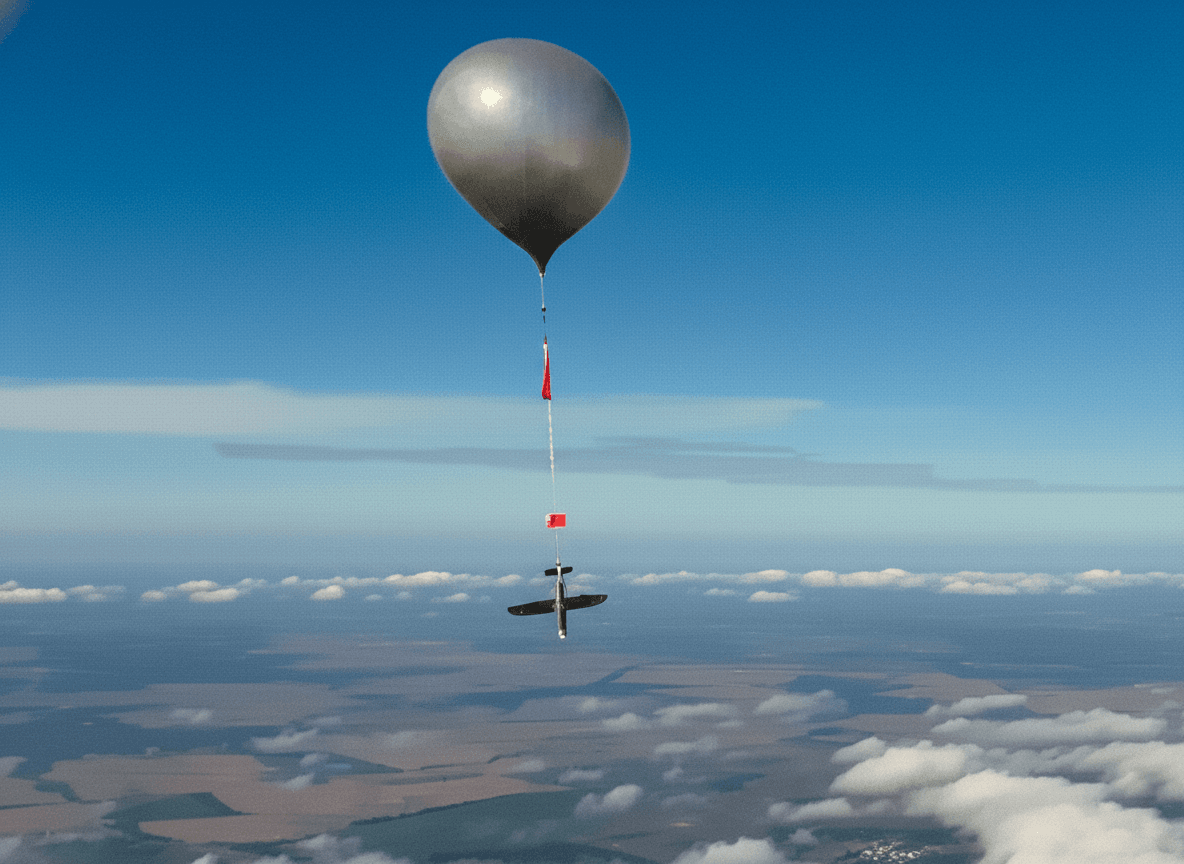
Hornet AI drone suspended beneath a helium aerostat during testing. The balloon carries the drone to 8,000 m before release. Screenshot: Visionergeo / X via Euromaidan Press.
On 21 May 2026, Euromaidan Press reported that Ukrainian developers have been testing a helium aerostat as a launch platform for the Hornet AI attack drone — a 2-metre-wingspan aircraft that Ukraine has adapted and deployed in large numbers against Russian logistics targets. The concept: a balloon carrying the drone to 8,000 metres altitude, then releasing it. The Hornet glides down before engaging its electric propeller, conserving battery charge for the final approach. Effective strike range potentially doubles, from roughly 200 kilometres to around 400 kilometres.
The same atmospheric principle that governs where a contraband balloon from Belarus lands in Lithuania governs where a Hornet released from an aerostat arrives over its target: the wind at release altitude is the dominant variable.
Why wind is the scheduling constraint, not just the background
At 8,000 metres, the wind field is typically driven by large-scale synoptic patterns. Speeds of 60–150 km/h are common across the region in spring; directions rotate as fronts pass. A drone released into a 100 km/h headwind at that altitude arrives in a different place than one released into calm conditions or a tailwind, with the same electric propeller budget.
Ukrainian operators, according to the Euromaidan Press report, wait for appropriate atmospheric conditions before launch. That is not an operational footnote — it means the upper-air wind forecast is part of the targeting calculus. "When do we release?" cannot be answered without "what is the wind doing at 8 km?"
AirVeto's altitude selector reaches 7 km, one layer below the aerostat operating ceiling. At that level, the wind visible on the live map reflects the environment the drone encounters at the beginning of its glide phase — when it is heaviest relative to its lift and when the wind's influence on ground track is largest. The remaining descent passes through 5 km, 3 km, and 2 km, each of which the map also exposes.
The same map, two different directions
The balloon-borne payload category now spans two distinct operational contexts along the EU's eastern border:
East-to-west: contraband. Belarus releases meteorological-style balloons carrying contraband cigarettes into Lithuania and Poland. Wind at 500 m to 3 km is the trajectory variable. The payloads descend into fields and suburbs.
West-to-east: military. Ukraine releases aerostats carrying Hornet drones toward Russian-occupied territory and Russia itself. Wind at 8,000 m is the scheduling variable. The payloads glide to logistics targets up to 400 km out.
The physics are identical. The altitudes differ because the objectives differ — a contraband balloon wants to descend into an unpopulated field on the Lithuanian side, a strike drone wants to maintain altitude as long as possible before attacking a logistics node deep inside Russian-controlled territory. In both cases the operator's first decision is the same: is the wind doing what we need it to do?
What changes with aerostats at scale
Ukraine is not the first to use aerostats as delivery platforms. What is new here is the combination: a balloon costing a few thousand dollars paired with a capable AI-enabled drone at a fraction of the cost of a cruise missile, producing a deep-strike option that is difficult to intercept at the balloon phase (aerostats present a low radar cross-section and move slowly) and difficult to intercept at the drone phase because the glide is unpowered and near-silent until terminal approach.
For wind-layer purposes, the critical window is the moment of release. Once the drone is gliding, its trajectory is a function of its aerodynamics, its onboard targeting, and the winds it passes through at each descending altitude layer. The aerostat itself, before release, drifts with the wind at its operating altitude — that offset between launch point and release point is the first variable the wind determines.
The full Euromaidan Press report on balloon-launched Hornet testing: Ukraine is lofting its AI drones 8,000 meters up — then letting them glide into Russia.