

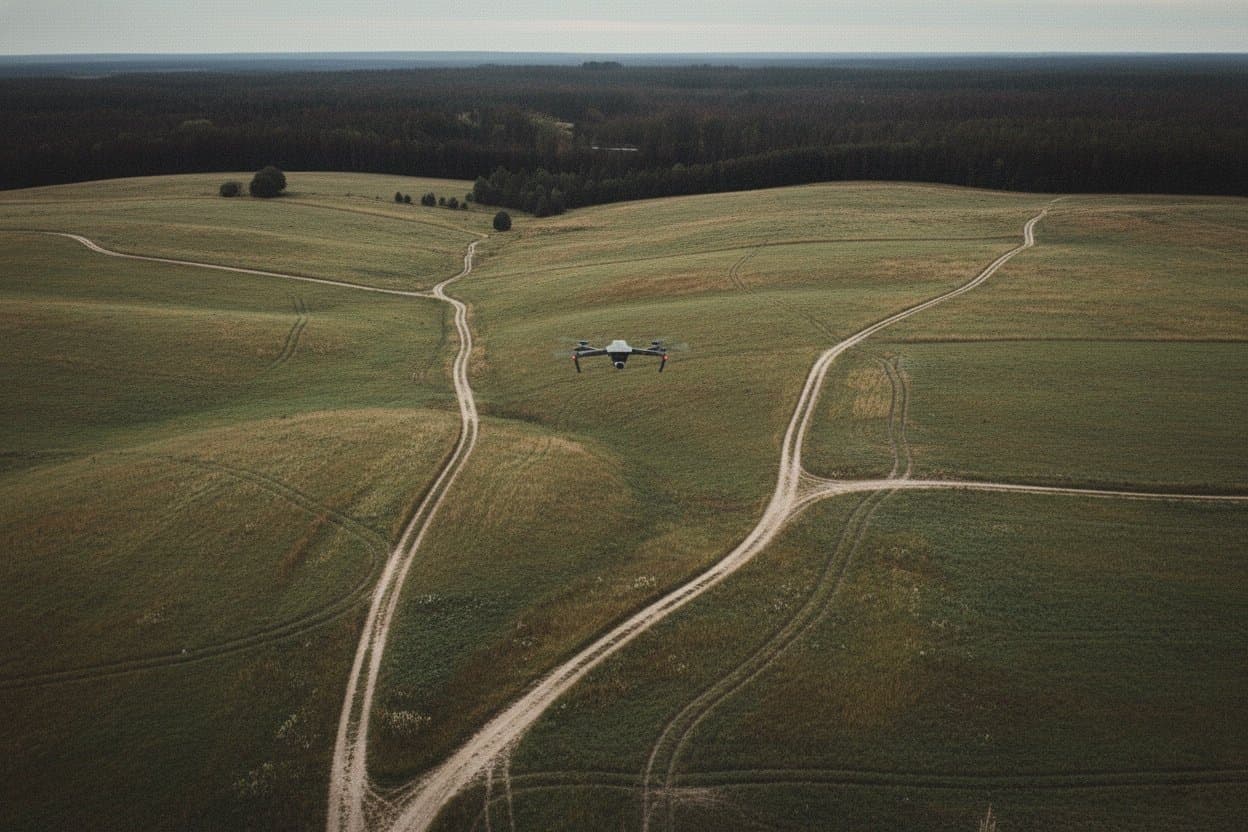
Lithuania's Commander-in-Chief, General Raimundas Vaikšnoras, told LRT that funding is secured for the country to field a Ukrainian acoustic drone-detection system called Sky Fortress from 2026, adopting a technology built to catch the low-flying drones and cruise missiles that radar handles poorly. The system listens for the sound a target makes and passes a bearing to the source, rather than a radar return, into the same fire-control chain as conventional air defence.
Radar is expensive, active, and better suited to fast, high-flying targets. A cruise missile skimming in low, under the radar horizon, is exactly what it struggles with. Sky Fortress inverts the economics: instead of one costly sensor, it fields a mesh of cheap ones that simply listen.
Sky Fortress started as a microphone taped to a pole
Sky Fortress emerged in 2022, built by two Ukrainian engineers, i3 Engineering CEO Pavlo Tsiupka and Respeecher co-founder Dmytro Believtsov, in response to low-flying cruise missiles that radar struggles to pick up in ground-clutter blind zones. The earliest nodes were a microphone and a smartphone mounted on a six-foot pole. Later versions added a dedicated processor, sound card, directional microphones, and parabolic collectors or arrays of MEMS microphones.
Each node captures ambient sound, filters out wind, traffic, and birdsong, and runs a machine-learning classifier to recognise an engine's or airframe's acoustic signature. Instead of streaming raw audio, it sends a short message: sensor ID, timestamp, bearing to the source, and a confidence level. That data is fused with radar tracks and passed to mobile fire teams working from tablets and anti-aircraft guns.
A single sensor costs about as much as a smartphone
A Sky Fortress unit runs roughly 400 to 1,000 dollars, cheap enough to deploy in dense, overlapping numbers across a region. Because each node only listens, it emits nothing an adversary can detect or jam. The network has grown to roughly 14,000 sensors across Ukraine, and NATO-backed funding has been committed to add a further 15,000 third-generation units on top of that.
Sky Fortress is often discussed alongside Zvook, a separate Ukrainian acoustic-detection company founded in Lviv in 2023. The two are distinct programmes built on the same passive-listening principle; Sky Fortress carries the larger sensor count and the Lithuanian deployment specifically.
Lithuania is the first Baltic state to field it
Lithuania is the first Baltic state to commit to Ukrainian acoustic detection. General Vaikšnoras told LRT that funding is secured, with testing in late 2025 and deployment from 2026 to complement the country's radar-based air defence. The move fits a wider Lithuanian counter-drone push: the Dragoon Fury 26 exercise this July put anti-drone systems into a battalion evaluation at Kazlų Rūda.
Adoption reaches beyond Lithuania. Sky Fortress has been demonstrated at Ramstein Air Base in Germany, and Romania has begun testing it. Representatives of eleven NATO member states were shown a private European demonstration in which Ukrainian acoustic systems detected and tracked simulated cruise missiles and drones, and defence ministries have pointed to the battlefield record as proof the approach works at scale.
The drones crossing into Lithuania are what these sensors are built to hear
The Shahed-136 and Gerbera types recur in Polish and Baltic wreckage, and Lithuania has logged repeated drone alerts through 2026, from Ignalina and Utena in May to the Vilnius air alert in June and the Druskininkai and Padvarionys events in July. A dense acoustic net over that airspace is built to catch exactly those crossings.
The full technical breakdown is in the Sky Fortress glossary entry, and the wind-drift method behind AirVeto's incident reconstructions is in the methodology. See the live eastern-border wind field on the map.