

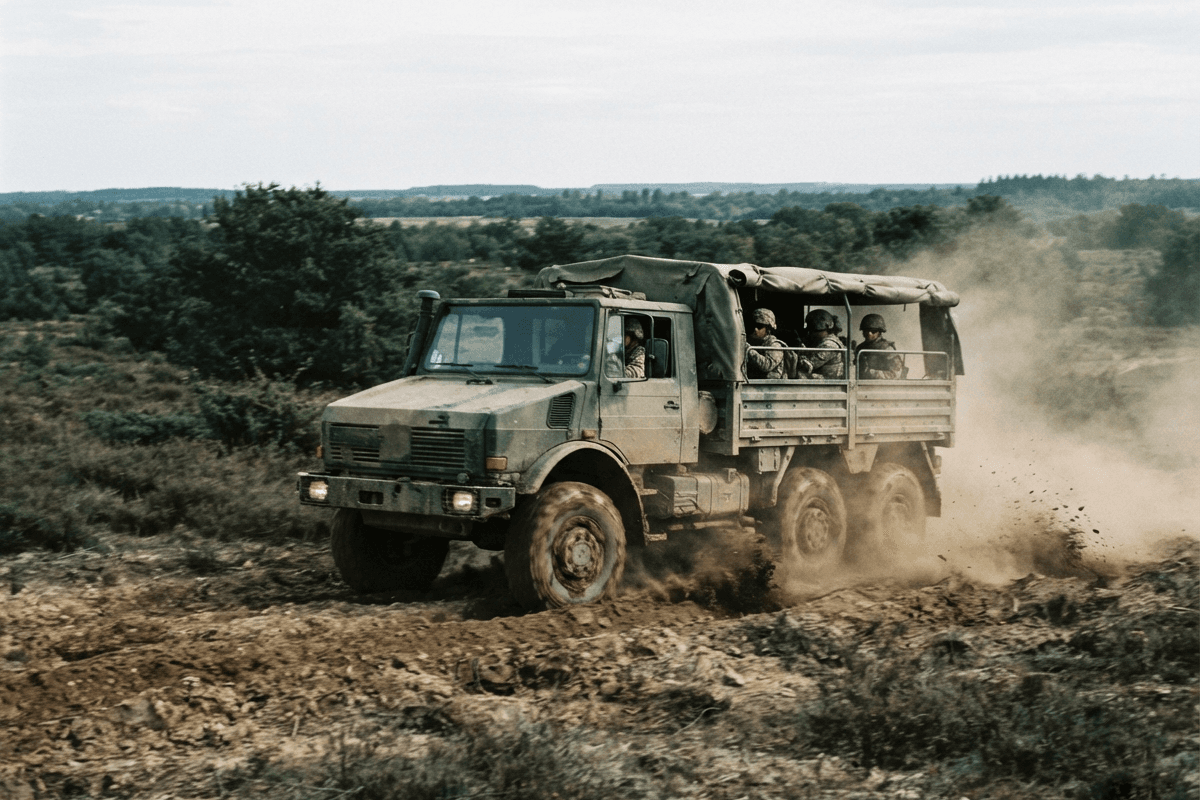
According to LRT, Lithuania's Grand Duke Butigeidis Dragoon Battalion began its Dragūnų įniršis 26 (Dragoon Fury 26) field exercise at the Brigadier General Kazys Veverskis training ground in Kazlų Rūda on 13 July 2026, and the drill's inclusion of counter-drone systems and unmanned aircraft places it inside the same eastern-flank airspace activity AirVeto has reconstructed across Lithuania this year. The exercise runs until 23 July. It is a national readiness evaluation, not a multinational deployment.
The battalion is testing whether its platoons can move, make contact, and hold ground under assessment. What makes the drill relevant here is narrower and more specific: it rehearses defence against the drone incursions that have crossed into Lithuanian airspace repeatedly since the spring.
Lithuania is running a live evaluation of its Dragoon Battalion
The Grand Duke Butigeidis Dragoon Battalion is conducting the exercise to formally assess its units' readiness to carry out tactical marches, movement to contact, and defensive operations. The drills run from 13 to 23 July 2026 at the Kazlų Rūda training ground in southwest Lithuania. Soldiers from the National Defence Volunteer Forces and members of the Lithuanian Riflemen's Union are taking part alongside the battalion.
The exercise also moves hardware across the country. The Lithuanian Armed Forces flagged intensive military-equipment movement along the Klaipėda–Kryžkalnis–Kazlų Rūda route for the duration of the drill. Dragūnų įniršis is a recurring evaluation: the battalion ran a Dragūno įniršis exercise in 2025, and this July's iteration is the 2026 cycle rather than a one-off event.
The drill tests the counter-drone systems AirVeto's incident work documents
The exercise puts advanced command-and-control technology, unmanned aerial vehicles, and anti-drone systems into the tactical scenario. That single line is why the drill sits in AirVeto's coverage area. Military movement and airspace activity along the EU's eastern border are what we track, and counter-drone (C-UAS) capability is the direct operational answer to the incursions our incident record is built on.
AirVeto does not defend airspace or track threats. We reconstruct the wind drift behind airborne objects that have already crossed a border. But the systems Lithuania is rehearsing at Kazlų Rūda exist because objects keep crossing, and the reconstructions we publish are the running evidence of that pattern. The exercise is the response; the incidents are the reason.
A summer of drone incursions sets the timing
The drill opened during one of the busiest stretches of Lithuanian drone activity AirVeto has logged. In the week before Dragoon Fury 26 began, we reconstructed drone events at Druskininkai on 7 July, Prūdelis and Padvarionys on 9 July, and Daugidoniai on 12 July, the day before the exercise started.
That week extended a pattern running since spring. The Ignalina drone alert on 20 May, the Utena drone sightings on 21 May, and the Vilnius air alert on 13 June each pushed unidentified drones into the same national airspace the Dragoon Battalion is now drilling to defend. The Shahed-136 and Gerbera types that recur in EU eastern-border wreckage are the class of object a C-UAS system is built to stop.
Southwest Lithuania fronts Kaliningrad and the Suwałki Gap
Kazlų Rūda sits in southwest Lithuania, the part of the country that faces Russia's Kaliningrad exclave and the Suwałki Gap approach. That geography is not incidental to the exercise. It is the theatre the readiness is built for. The battalion is evaluating defensive operations in the same region where the Suwałki Gap narrows the land link between the Baltic states and the rest of NATO, and where NATO's eastern flank concentrates its air-policing and ground-readiness effort.
For readers following the drone side of this theatre, Lithuania's own incident feed sits at dronai Lietuvoje, and the reconstruction method behind every event we publish is documented in our methodology.
The exercise is the response to a pattern, not the event itself
Dragoon Fury 26 is a scheduled evaluation, and on its own it changes nothing about the airspace picture. Read against the incident record, though, it marks a shift in what Lithuania's ground forces now rehearse as routine: counter-drone defence has moved from a specialist add-on to a line item in a standard battalion assessment. The drones AirVeto reconstructs crossing the border are the reason that line item exists.
See where the wind is carrying things across the eastern border right now on the live map.