
Balloon from Belarus triggers Vilnius alert, fighters scrambled
Lithuania issued a yellow-level air alert for Vilnius on June 13, 2026 after a meteorological balloon drifted from Belarus. All-clear after 23 minutes.
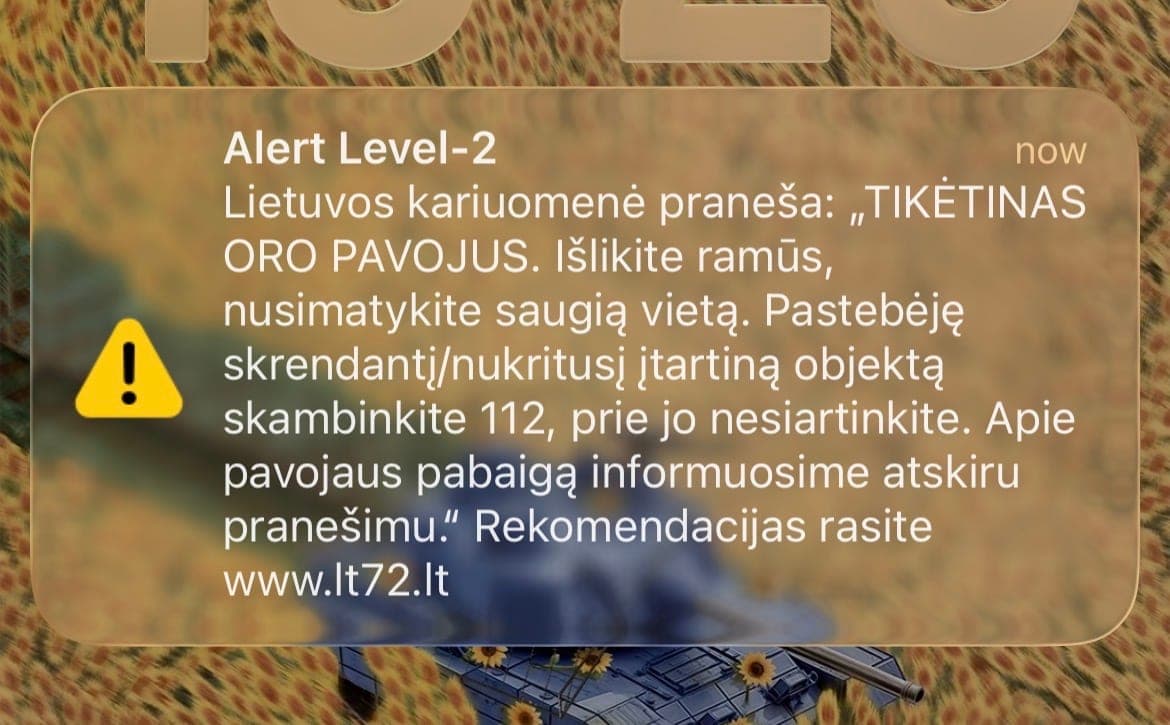
On the morning of Saturday, June 13, 2026, Lithuania's armed forces issued a yellow-level ("TIKĖTINAS ORO PAVOJUS" - probable air threat) cell-broadcast alert to residents of Vilnius district. The notification reached phones across the capital region shortly after 09:30 local time (07:30 UTC). NATO air policing mission fighters were scrambled. Yellow is the middle tier of Lithuania's three-level system: a possible threat is being monitored, but no dangerous object has entered Lithuanian territory. Red would mean an object is in the airspace; white is the all-clear.
The wording was identical to the four alerts that preceded it in May 2026:
"PROBABLE AIR THREAT. Stay calm, find a safe place. If you see a flying or fallen suspicious object, call 112, do not approach it. We will inform about end of danger separately."
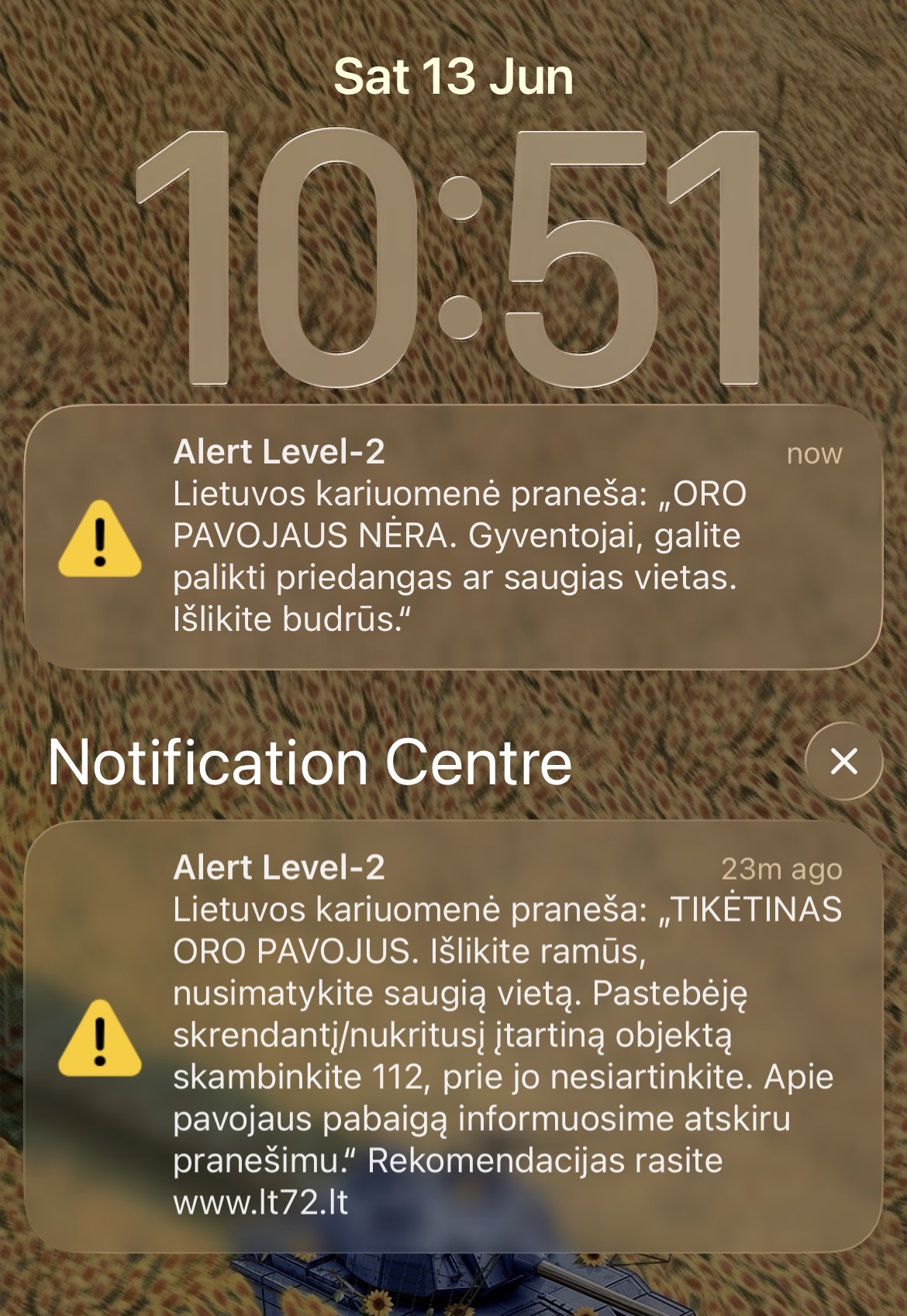
The all-clear came at 10:51 local time (07:51 UTC) - 23 minutes after the alert was issued:
"THERE IS NO AIR DANGER. Residents, you may leave shelters or safe places. Stay alert."
What caused the alert
The object was identified as a meteorological balloon that had drifted into Lithuanian airspace from Belarus. Vilmantas Vitkauskas, head of the National Crisis Management Centre, told LRT television:
"We identified it as most likely a meteorological balloon, not a drone, so we sent residents the all-clear. Stay alert though - more of these objects could show up."
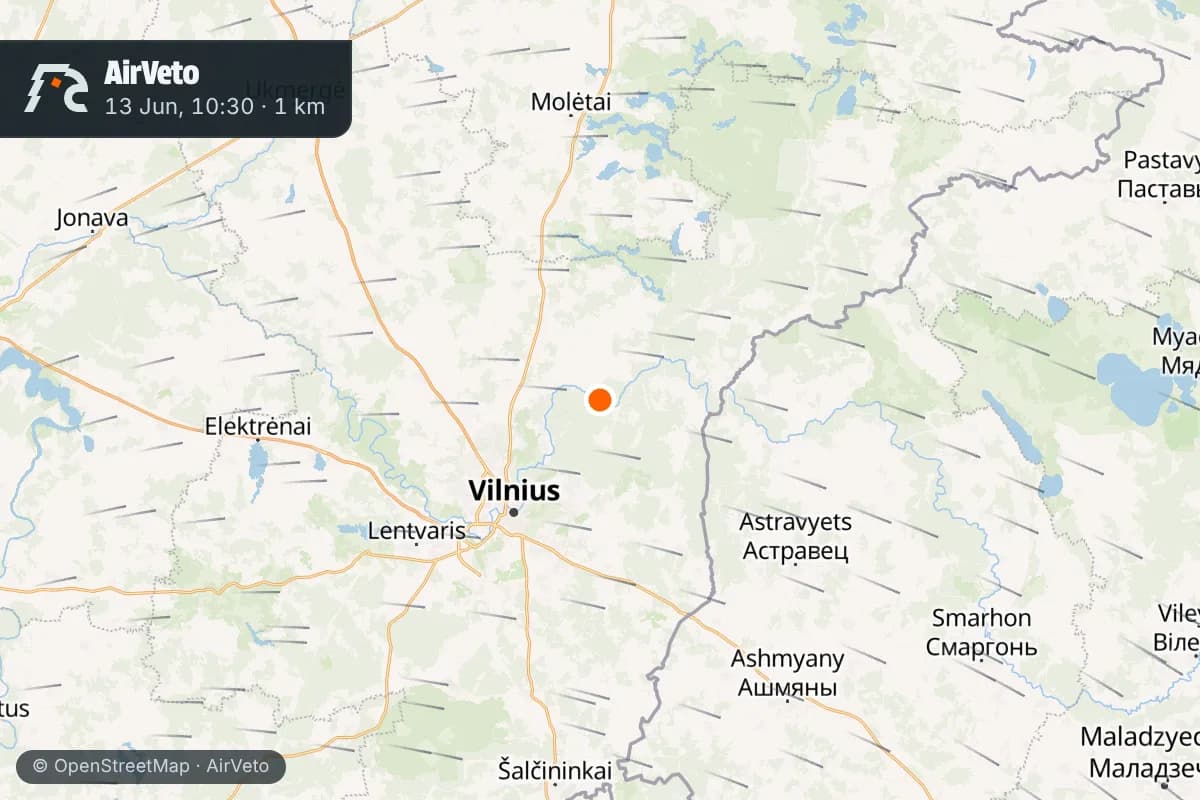
The identification resolved the alert without incident. According to Vitkauskas, the airspace violation was detected near Nemenčinė - a town on the Belarus border roughly 20 km northeast of Vilnius - and the object was tracking northwest. The balloon entered from the Belarusian direction - the same bearing that has triggered every Baltic air alert since May 2026. The alert did not escalate to red level and no interception was carried out.
Pattern context
The June 13 alert is the fifth public air-danger notification in Lithuania since May 17, 2026, and the second to reach Vilnius district directly:
- 17 May - A destroyed drone, likely Ukrainian, was found in a field in Samanė, Utena district. See Utena Samanė, 17 May.
- 19 May - A NATO Romanian F-16 shot down a drone over Lake Võrtsjärv, Estonia. See Estonia drone shootdown, 19 May.
- 20 May - Vilnius Airport closed; President Nausėda and cabinet taken to shelter; alert lifted after 80 minutes with no impact confirmed. See Ignalina / Vilnius alert, 20 May.
- 21 May - Two objects tracked toward Utena; both radar signatures lost; helicopter search found nothing. See Utena alert, 21 May.
- 8 June - NATO jets shot down a drone in Nautrēni Parish, Latvia - the first confirmed aerial intercept over Latvian soil. See Nautrēni, 8 June.
The recurring assessment from Baltic defence officials is that Ukrainian long-range drones aimed at Russian targets are being pushed off course by Russian electronic warfare. The June 13 balloon underlines a second dimension of the alert pattern: weather balloons from Belarus drifting into NATO airspace trigger the same detection and alerting protocols as drones, because identification comes after the alert, not before. As Vitkauskas put it, more of these objects could show up.
Wind layer
As with every event in the archive, the AirVeto wind view shows regional weather context rather than a trajectory reconstruction. This reconstruction is based on reporting by LRT and Lithuania's Crisis Management Centre, plus AirVeto's wind-model data. The wind layer gives orientation for the Vilnius district window on 13 June - the full model methodology is documented at methodology.
The full Baltic airspace alert archive is indexed at incident archive. Lithuanian events specifically are collected at Dronai Lietuvoje (in Lithuanian).
Related location
- NATO eastern flank - The frontier where EU airspace meets Russia and Belarus across five NATO member states - the active zone of drone incursions, smuggling balloon recoveries, and Baltic Air Policing intercepts since 2025.
Sources
Last updated: