

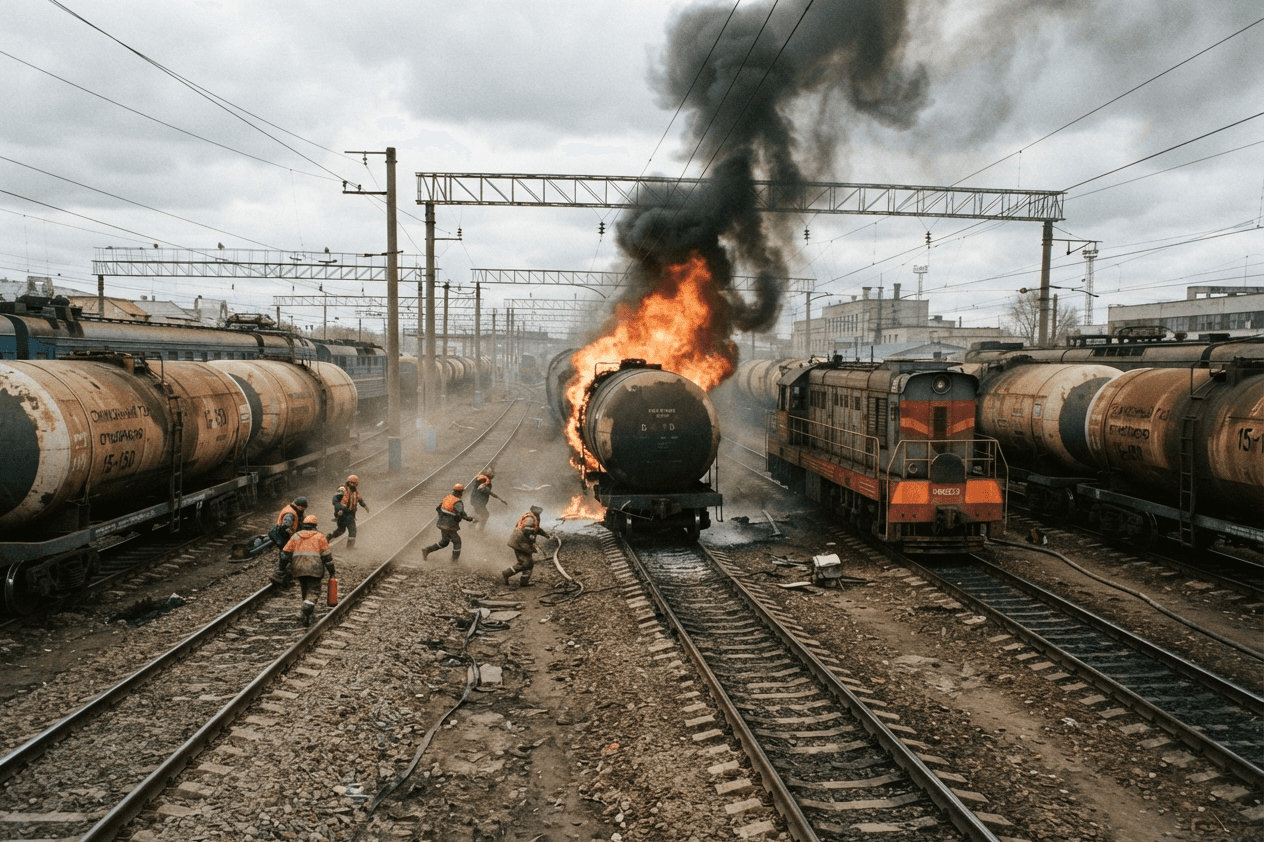
On July 6, 2026, Ukrainian drones struck the Omsk refinery in Siberia—2,500 kilometers behind the Russian border. At least two processing units burned with full pressure still in the pipes. The strike was not a tactical victory. It was a strategic declaration: no Russian industrial facility, however remote, is beyond the reach of autonomous aerial warfare. This is economic strangulation, and Russia's ability to defend against it is approaching zero.
The target and its weight
The Omsk refinery is Russia's largest by nameplate capacity, processing approximately 10% of the country's total refining throughput. It supplies roughly half of Siberia's fuel demand—the Pacific Fleet, rail networks, industrial production across a region the size of Western Europe. The facility sits on the Trans-Siberian Railway and the Siberian oil pipeline network. It is the artery, not a tributary.
A prolonged outage cascades. Diesel shortages ripple through logistics. Rail traffic slows. Industrial production falters. The military's fuel supply—already constrained by sanctions and drone strikes on other refineries—contracts further.
The strike itself
Satellite and eyewitness accounts confirm at least two distillation or hydrotreating units were ablaze. The critical detail from monitoring channels: full pressure remained in the pipes. The units were actively processing when struck. This is not a controlled shutdown; it is a destructive failure of equipment under load, with cascading thermal stress on adjacent systems. Early reports suggest weeks to months of repair, during which that processing capacity remains offline.
The Russian military has not confirmed casualty figures or official damage estimates. This silence itself is the message. There is nothing to announce except failure.
Why this was possible
Ukrainian naval and medium-range drones—primarily the Magura V5 maritime platform—carry a 500–800 kilometer operational range. They are not precision-guided. They are functional enough: a refinery complex covers multiple square kilometers. A drone payload sufficient to damage soft targets (ships, stationary industrial equipment, fuel depots) is adequate for the job.
No air-defense system can defend critical infrastructure at 2,500 kilometers. Russia's air defense—layered, expensive, designed to protect the front line—is useless at depth. The Omsk strike occurred in the interior of Russian territory where defenses were sparse and dispersed. Ukraine did not have to penetrate a wall of missiles. Ukraine had to reach a geography.
The pattern
This is not the first. Ukraine has conducted dozens of strikes on Russian refining, fuel depots, and maritime logistics over the past 18 months. The cumulative effect is measurable: diesel shortages in the Russian Far East and Siberia, where alternative supply routes are limited by geography and sanctions.
Each strike is a data point in a larger strategy: cripple Russia's logistics by targeting the energy infrastructure that sustains them. Not the military bases. Not the weapons factories. The fuel supply. The logistics network. The infrastructure that keeps an army moving.
Why NATO should be paying attention
The Omsk strike demonstrates something that the *Marshal Vasilevskiy* LNG carrier incident illustrated weeks earlier: Russia's civilian infrastructure is now a valid target in a drone warfare context, and Russia knows it.
Ukraine is not attacking Omsk because of NATO's interest in Siberian geopolitics. Ukraine is attacking Omsk because it is economically rational. The strike hurts Russia's ability to sustain military operations, supply its Pacific Fleet, and maintain logistics across Siberia. From Kyiv's perspective, it is a direct return on investment.
But the NATO implication is clear. If Ukraine can reach 2,500 kilometers into Russian territory to strike a refinery, the lesson for the EU eastern frontier is not "Russia's logistics are vulnerable" (they are, but that's a Ukrainian problem). The lesson is: autonomous aerial platforms can reach strategic depth regardless of conventional air defense.
For Poland, Lithuania, Latvia, and Estonia—NATO members on the Russian and Belarusian borders—the Omsk strike is proof that drone capability is not limited by geography or distance. The technology scales. The reach extends. And the cost of defending against it rises exponentially.
The cost of defense
Russia's response to the credible threat of drone attack has been to militarize civilian infrastructure. Gazprom's LNG carrier was armed with machine guns. Civilian energy facilities are now treated as military targets requiring armed defense. This is not just a symbol. This is the cost of operating when the threat has no geographic limit.
As critical infrastructure becomes a valid target in range, the cost of defending it rises. Russia's ability to sustain logistics and supply chains erodes in direct proportion to the range Ukraine achieves. At 2,500 kilometers, there is no practical defense. Only dispersal, redundancy, and damage tolerance. Only accepting that some targets cannot be protected.
This reconstruction is based on reporting by Reuters, The Guardian, Euronews, and other sources, and on the publicly available coordinates and facility data for the Omsk refinery. The strategic implications reflect confirmed reports from monitoring channels and satellite analysis.