

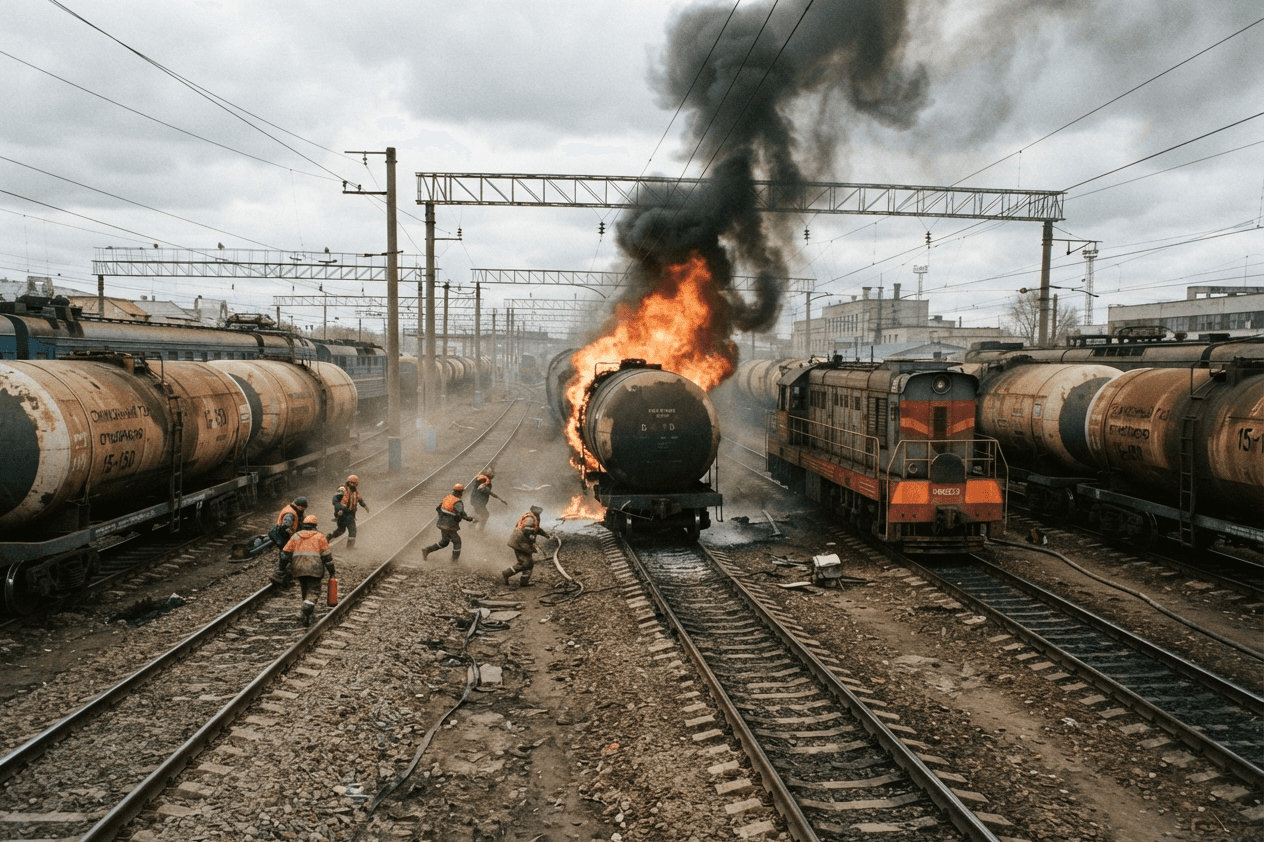
On July 6, 2026 (the day Lithuania marked its Statehood Day and King Mindaugas Day), Ukrainian drones struck Russian ports 400 kilometers away. Fifty-six unmanned aircraft crossed the Baltic, targeting the Leningrad region's Ust-Luga and Vysotsk terminals. Russia's coastal defence systems shot down most; some reached the docks.
The strike matters not because it is militarily devastating (port damage is repairable), but because it is economically crippling and strategically undefendable. Ukraine has no conventional air force left. It has no missiles that can reach Leningrad. What it has is range: civilian-grade maritime drones carried hundreds of kilometers on the Baltic winds, swarming ports Russia believed were too distant to threaten. This is economic sanctions by drone, and it is working.
The Long-Range Calculus
Ukraine's long-range drone strategy is not a new weapon. It is the weaponization of industrial surplus and mathematics.
The Magura V5 maritime drone (the platform Ukrainian operators fielded en masse this year) carries an 800-kilometer range. It is a commercial design, originally a hydrographic survey platform, repurposed into a payload delivery system. No fighter escort needed. No air-defence solution available for a swarm moving at 80 km/h at sea-level across open water.
Russian air defence works well against slow, predictable targets: manned aircraft, cruise missiles, helicopters. It does not work well against flotillas of 2-meter unmanned platforms spread across a 50-kilometer front, each one a $200,000 asset that Russia must expend a $3 million air-defence missile to counter. The arithmetic is catastrophic for the defender. At the Ust-Luga and Vysotsk attack, Russia shot down 56 drones. The replacement cost to Ukraine is ~$11 million. The replacement cost to Russia in air-defence missiles fired is ~$168 million. And the ports are still damaged.
This is not attrition warfare. It is economic strangulation.
Why Russia Armed a Civilian LNG Carrier
Three weeks before the July 6 Leningrad port strike, the Marshal Vasilevskiy (a $300 million Gazprom LNG regasification vessel) was photographed with machine guns sandbagged onto its bridge wings. Russian security personnel were identified aboard. The weaponization of a civilian energy infrastructure ship seemed irrational to Western observers.
It was not.
On June 3, 2026, a Magura V5 drone had struck the Russian corvette Boiky in Kronstadt harbour, 20 kilometers from St. Petersburg. The warship's mainmast and combat operations room were destroyed. This was not a near-miss or a symbolic strike. It was a direct demonstration that the threat Russia feared was not hypothetical.
The Vasilevskiy carries 174,000 cubic meters of liquefied natural gas to Kaliningrad. Loss of the supply chain is loss of the exclave's heating, electricity, and industrial base for months. From Moscow's perspective, a civilian LNG carrier is critical infrastructure. A $200,000 Ukrainian drone will not sink it, but a swarm will damage it, and damage means disruption. And disruption means Kaliningrad goes cold.
So Russia armed the vessel. The machine guns cannot stop a drone swarm. But they announce to Ukraine that any attack will be met with military force. They broadcast to NATO that any boarding or interdiction of the vessel will encounter armed resistance. And they signal to Russia's own logistics managers: this ship matters enough to militarize.
On July 6 (the very day Ukrainian drones struck the Leningrad ports 400 kilometers north), the calculus was proven correct. The threat is real. The range is proven. And civilian infrastructure is no longer off-limits because there is no longer a meaningful difference between civilian and military supply chains in wartime.
The Strategic Picture on Lithuania's Statehood Day
Lithuania celebrated its national independence on July 6, 2026. It is one of three NATO members on the eastern border of Russia and Belarus, a frontline state where independence is not a historical observation but a lived condition, defended every day.
On the same day, Ukraine demonstrated that it could strike deep into Russian territory. Not with weapons Russia respects (missiles, warplanes, artillery), but with drones that cost less than a tank and carry the strategic weight of sanctions. The Leningrad ports handle Russia's oil and LNG exports. They are where energy revenue flows. They are also where Ukraine has chosen to apply economic pressure, using the only long-range tool available: autonomous platforms and the Baltic wind.
For Lithuania, the message is clear: the threat Russia faces from Ukraine is not diminishing. It is innovating. And as Russian logistics become targets, Russian desperation increases, leading to the militarization of civilian vessels like the Vasilevskiy and the expansion of armed infrastructure across the Baltic.
The drone strikes of July 6, 2026 are not the end of this conflict. They are the beginning of a new phase: economic warfare by range, where civilian infrastructure becomes military, and civilian drones become the weapon that changes the cost calculus for the defending power.
Lithuania's Statehood Day was marked not by military parades or speeches, but by the silent hum of 56 drones crossing the Baltic, rewriting the rules of what sanctions look like when they fly.