

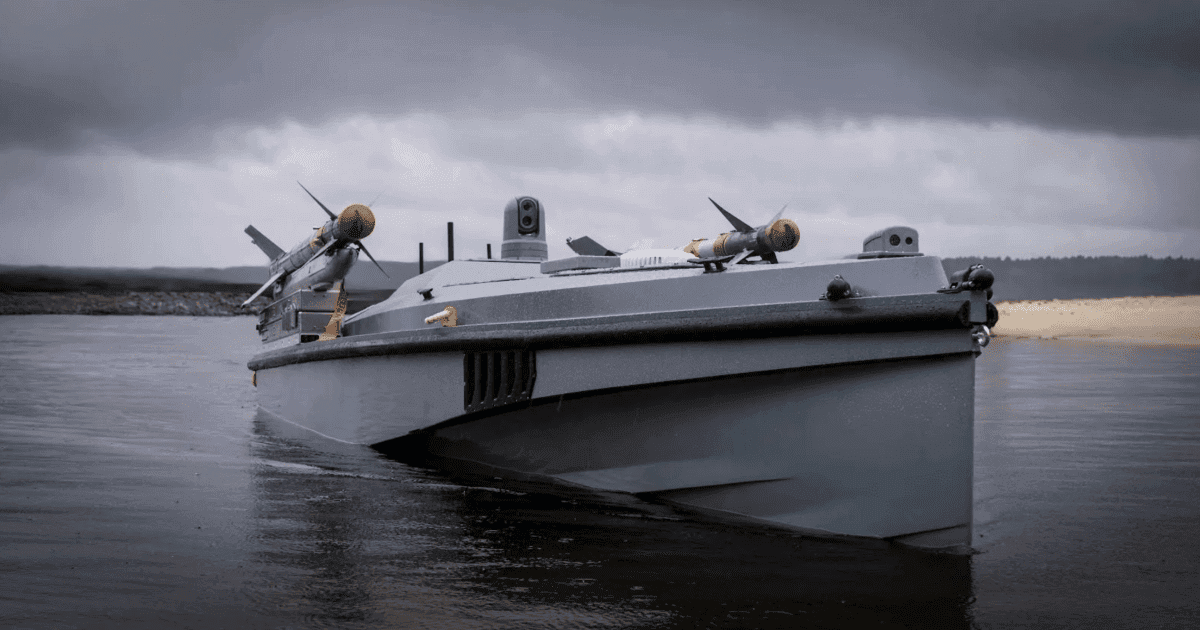
On June 24, U.S. Special Operations Forces sank a decommissioned target ship in the Philippines using Ukrainian-built Magura sea drones. Bloomberg filmed it. The uncrewed vessels closed on the hull and detonated, sending the vessel to the bottom in what was described as an unannounced drill.
That would have been notable regardless. But the Magura fleet arrived in the Philippines with a combat record that set it apart from any other small naval drone: it had already shot down Russian jets.
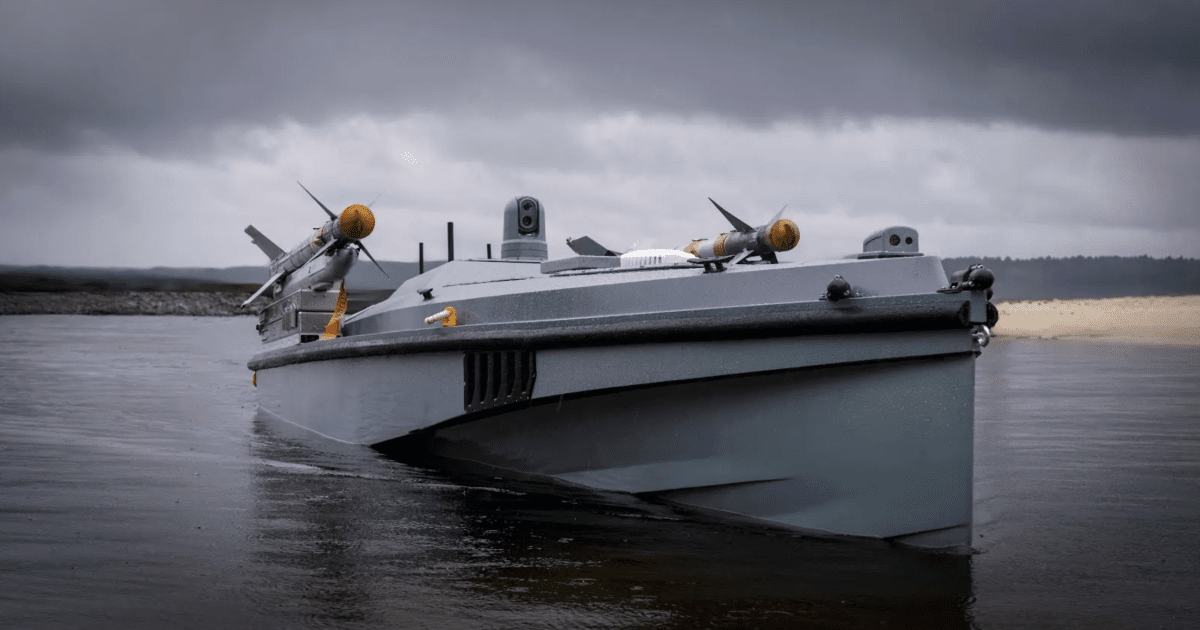 Ukrainian Magura-class USV during trials. Photo: open source.
December 2024: the first time a sea drone shot down an aircraft
The aerial record starts with helicopters. On December 31, 2024, Magura 5 drones armed with R-73 SeeDragon air-to-air missiles engaged and destroyed two Russian Mi-8 helicopters over the Black Sea near Cape Tarkhankut, occupied Crimea. That was the first documented case of a surface drone shooting down any aircraft.
The platform had been designed to detonate against ship hulls. Mounting an air-to-air missile turned it into something else: a sea-level air-defence asset with no radar profile worth targeting and a cost far below the aircraft it can kill.
May 2, 2025: two Su-30s in one day
The helicopter shoot-downs proved the concept. The payoff came months later. On May 2, 2025, Magura 7 drones — a newer variant — used AIM-9 Sidewinder infrared-guided missiles to down two Russian Su-30 fighter jets over the Black Sea. Both were destroyed the same day. One crew ejected and survived; the other was lost.
Each Su-30 is valued at up to $50 million. An AIM-9 Sidewinder runs around $300,000. A Magura drone costs a few hundred thousand dollars. Russia lost approximately $100 million in aircraft on a single day to sea drones that together cost less than one of them.
The operation was run by Ukraine's Defence Intelligence (HUR) with support from the SBU and Ukrainian Armed Forces. At least three Magura 7 drones were involved. Russian military bloggers independently confirmed the kills.
What the base platform actually is
The Magura V5 — the combat-proven foundation of the programme — is a 5.5-metre explosives-laden uncrewed speedboat. It reaches 78 km/h, carries up to 320 kg of explosives, and has a range of nearly 800 kilometres.
Built to race toward a ship and detonate. According to Uforce, its London-based manufacturer, the Magura fleet has sunk roughly ten Russian warships during the war. Newer variants replaced or added to the explosive payload with missiles, converting the platform from a one-way anti-ship weapon into a mobile launcher capable of striking aircraft.
A previous Magura incident on the European periphery: the Constanta port detonation on 5 June 2026, when a Magura lost navigation control after Russian EW jamming and self-detonated at a Romanian NATO port pier.
"Combat-proof is absolutely key"
Oleg Rogynskyy, Uforce CEO, framed the Philippines exercise clearly: "Combat-proof is absolutely key to anything moving forward here."
That claim lands differently when the system being assessed has confirmed aircraft kills. The Philippines drill was not a theoretical evaluation — it was a live demonstration of something already used in war, run by U.S. forces that had chosen to test it there deliberately.
The Philippines is not an incidental choice. It sits at the centre of South China Sea territorial disputes, is in active maritime confrontation with China, and operates under a Mutual Defence Treaty with the United States. Small, cheap, combat-proven sea drones that can sink ships and shoot down aircraft are exactly what a resource-constrained military needs when facing a larger fleet.
Uforce is building for the Indo-Pacific
Uforce is in talks with countries across the Indo-Pacific about procurement, and is considering at least two manufacturing sites in the region. That is different from a standard export deal: local production means supply chains, industrial capacity, and eventually variants adapted to regional requirements. The same model Patria is pursuing in Lithuania for the 6x6 APC programme.
Ukraine's forced-march engineering cycle produced exactly the template these conversations require: a weapons system designed under fire, iterated in combat, with a kill record the buyer can verify independently.
Why this appears on AirVeto
AirVeto tracks what crosses airspace along the EU eastern border. A sea drone that shoots down fighter jets crosses that domain directly.
The Magura programme is also where the Constanta port incident connects back to a live weapons system — one now being evaluated on the far side of the world by the United States. What starts in the Black Sea does not stay there.