

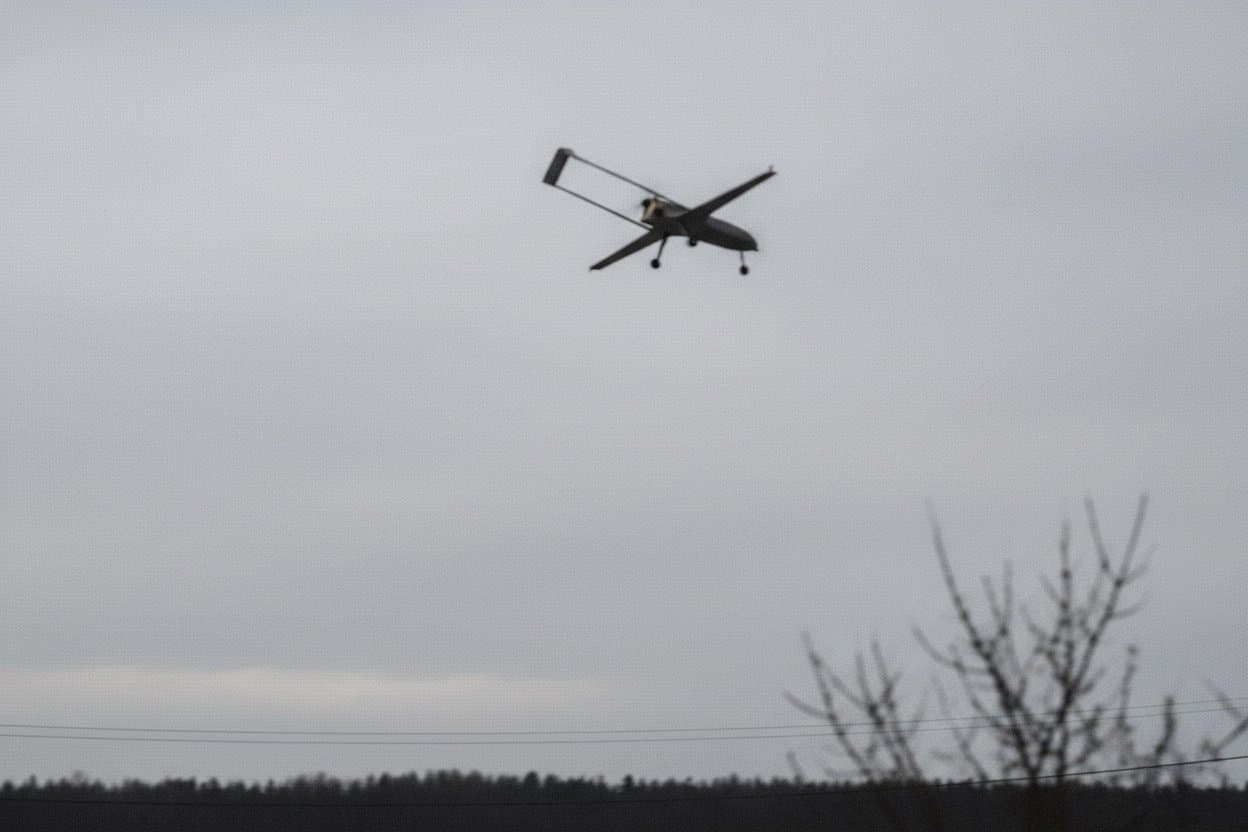
Ukraine's Ministry of Defence launched TrophyLab on 19 June 2026: a unified state platform giving verified partners access to technical documentation, blueprints, and research findings on captured Russian weapons. Mykhailo Fedorov, Ukraine's Digital Transformation Minister, described the logic plainly: "Every missile, drone, and vehicle seized on the battlefield is now a source of knowledge for the free world."
The Shahed-136, the Orlan-10, the Lancet. Every drone type AirVeto has documented crossing the EU eastern border is a Russian system Ukraine has been capturing, studying, and now cataloguing in one place.
What the platform contains
TrophyLab draws data from Ukrainian Defence Forces units, the Main Intelligence Directorate (GUR), the Security Service of Ukraine (SBU), and specialized scientific institutions. Verified users get round-the-clock access to technical documentation and analytical materials on Russian weapons systems — the kind of primary data that until now circulated only through classified channels or fragmented OSINT reporting.
The platform goes beyond documents. Users can submit requests for physical examination of captured samples. Formats range from non-destructive testing to full disassembly. The stated goal is to let engineers test countermeasures against real equipment rather than models, shortening the development cycle for systems designed to defeat what Russia is fielding.
Who can access it
Access is verified. Eligible users include allied governments, defence manufacturers, scientists, engineers, and laboratories. The MoD describes it as a platform for partner nations — not a public database.
For the OSINT and defence research community that makes up a significant part of AirVeto's readership, TrophyLab is worth registering for if you qualify. The technical specifications on guidance systems, operating altitudes, and radio frequencies for the drone types in our archive are exactly the kind of primary source that is hard to cite precisely from open reporting alone.
Why this matters for understanding the incidents
AirVeto's reconstruction methodology is wind-based: we work from what the wind field at the time and altitude of the event tells us about drift corridors. But wind-based reconstruction has limits when the object is powered. A Shahed-136 on a live navigation lock doesn't drift — it follows a programmed route. A Chaika decoy may drift after EW disrupts guidance.
The line between "powered flight" and "wind-dependent object" for any given incident depends on the drone's technical specifications: what guidance system it uses, at what point EW interference degrades it, and what the drone does in terminal failure. TrophyLab's documentation on captured Russian systems is the closest thing to ground truth on those questions that has existed in an open (or semi-open) format.
The glossary entry for each drone type is at /glossary. The incident archive is at /incidents.