
Poland Runs ALARM 2026, a Nationwide Civil Defence Exercise
On July 21, 2026, Poland ran ALARM 2026: nationwide sirens across all 16 voivodeships, military deployment in the Opole-Zawadzkie-Turawa area, and simultaneous activation of emergency services.
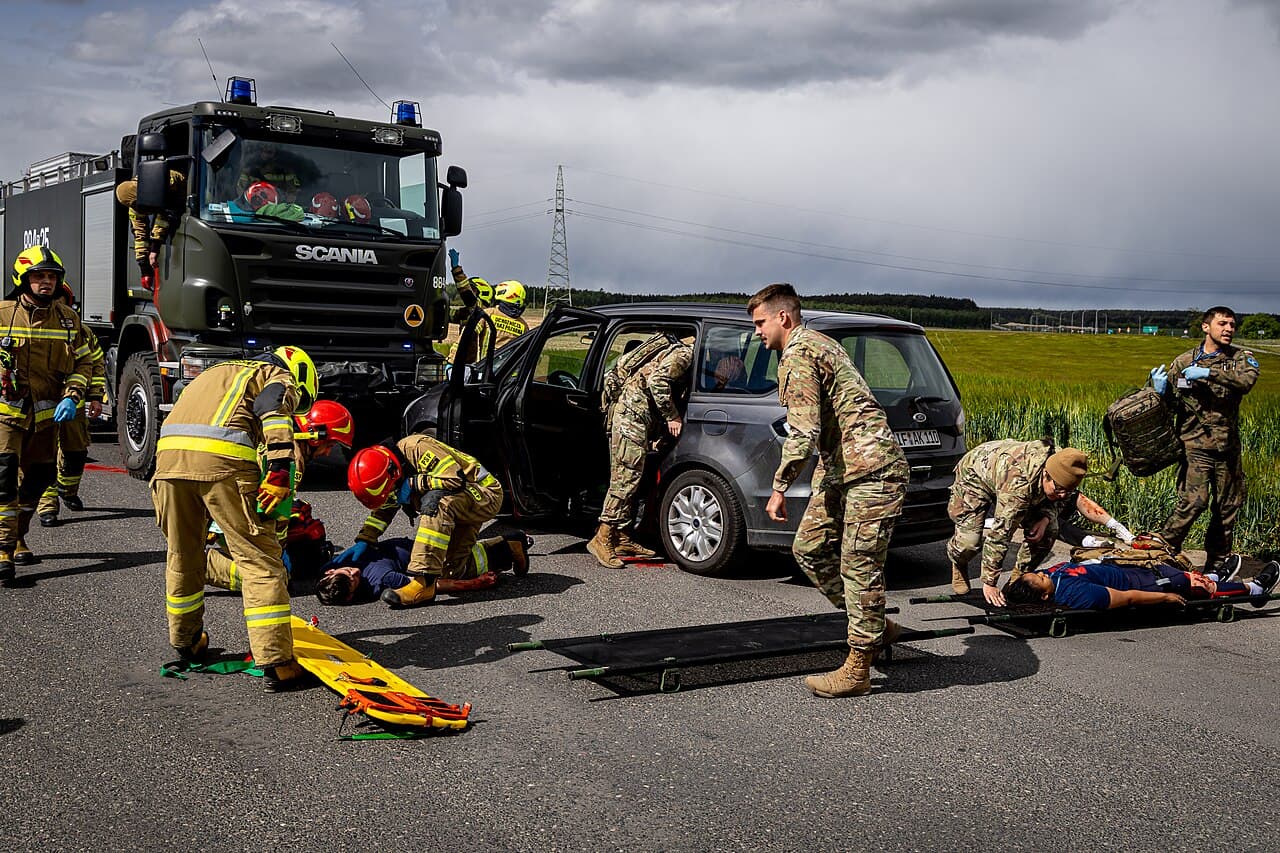
Poland ran ALARM 2026 on July 21, 2026, a nationwide civil defence readiness exercise organized by the Government Centre for Security (Rządowe Centrum Bezpieczeństwa, RCB). Air-raid sirens sounded across all 16 voivodeships from 07:00 to 19:00. Military units had deployed to the Opole, Zawadzkie, and Turawa area in Opole Voivodeship from 20 July, one day before the siren signal went nationwide.
The exercise placed troops, emergency services, and local government authorities on simultaneous readiness footing. ALARM 2026 is a test of coordinated national response under time pressure: not a drill for one agency but a check on whether the full chain mobilizes and holds together.
Military deployment in the Opole area opened the exercise a day early
The military component of ALARM 2026 began on 20 July, before the nationwide siren phase. Units moved through the Opole-Zawadzkie-Turawa area in Opole Voivodeship, southwest Poland. The region has hosted NATO exercise activity in recent years and sits along a logistics route relevant to allied force movement through southern Poland.
The two-day structure is deliberate: military readiness is assessed on its own timetable on day one, the civilian alert system runs separately, and on day two both operate in parallel. The siren going nationwide marks the full-chain test, not the start of the exercise.
Sirens were the public signal; the 12-hour window was the operational test
Air-raid sirens across all 16 Polish voivodeships sounded from 07:00 to 19:00 on 21 July. For the public, the siren is the visible element. The operational test is whether emergency services, local authorities, and military units reach exercise footing simultaneously and sustain coordination through the full 12-hour window.
ALARM 2026 is a named, planned exercise rather than a response to a specific incident. The exercise format has precedent in Poland's civil defence calendar: coordinated nationwide drills have increased in frequency since 2022 as Poland expanded both national civil defence structures and its NATO eastern flank commitments.
Poland's readiness programme runs on NATO's eastern flank timeline
Poland raised defence spending to 4% of GDP in 2024, the highest NATO commitment at the time, and has simultaneously deepened national civil defence capacity. ALARM 2026 is one output of that expansion. The exercise places all 16 voivodeships on the same readiness footing simultaneously, testing whether the national response chain holds under coordinated pressure rather than testing individual agencies in sequence.
The Opole Voivodeship concentration of the military component connects to Poland's role in allied logistics: the region sits on routes relevant to reinforcement of the eastern flank, where Lithuania's Dragoon Fury 26 exercise ran simultaneously through 23 July. Two NATO flank nations running named readiness exercises in the same week is consistent with the posture shift that has defined the flank since 2022.
AirVeto's wind layer covers Polish airspace through the ALARM 2026 exercise window, including the Opole Voivodeship area where the military component was concentrated. Wind conditions over the region throughout 21 July are reconstructed on the live map.