
Gerbera decoy found at Gałczyce mine, undetected since September
A lignite mine worker at Gałczyce, Poland found a Russian Gerbera decoy on March 12, 2026 - undetected since the September 9-10, 2025 mass drone incursion.

On March 12, 2026, a worker at a lignite mine near Gałczyce, Konin County, Greater Poland Voivodeship, reported a drone wreck on the mine grounds. Police teams from Konin and Poznań arrived, secured the area, and recovered the object. Investigators assessed it as a Russian Gerbera decoy drone likely dating from the September 9–10, 2025 mass drone incursion into Poland - approximately six months earlier.
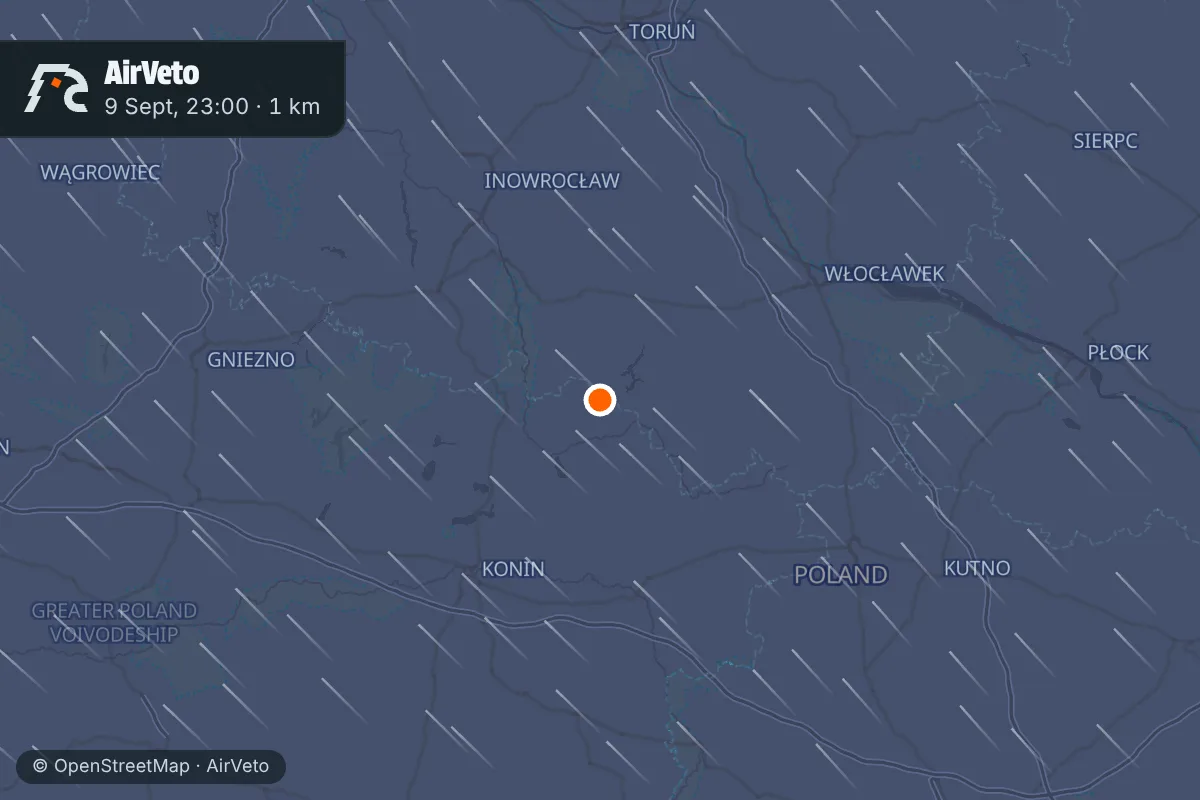
AirVeto's wind-model data for the event window: At 21:00 UTC on September 9, 2025 - the assessed incursion night - the 1,000 m layer over the Konin area showed SE wind at 30.8 km/h.
No one was injured. There was no threat to mine workers.
What was found
The wreck resembled a Gerbera decoy in construction - lightweight foam-and-plywood airframe, no warhead, no live payload. An RMF FM journalist reported the Gerbera identification informally; the formal police confirmation did not dispute the type. Mine workers had not previously noticed the object, indicating it had landed without causing any visible disturbance to the mine grounds.
170 km west of Warsaw, six months after the incursion
The lignite mine near Gałczyce is approximately 170 km west of Warsaw and roughly 700 km west-northwest of where the September incursion entered Polish airspace from the east. That a drone from the incursion could reach this far into Poland before coming down illustrates the range and dispersal of the 9 September wave: at least one drone penetrated to the Warsaw area that night, and recovered wrecks were found across eastern and central Poland.
The six-month gap between the incursion and the find is explained by the mine's surface geography - a large industrial site with restricted access. Drones that come down in agricultural fields or on mine grounds may not be discovered for months.
Part of the September 2025 cluster
The Gałczyce find is the last confirmed node in the September 2025 cluster:
- September 6, 2025 - Majdan Sielec. A Gerbera found in a field near Tomaszów Lubelski, pre-flighted on 2 September - three days before the main incursion. See the Majdan Sielec page.
- September 9–10, 2025 - mass incursion. 19–23 drones entered Poland; 16 recovered by 10 September. A Polish F-16's AIM-120 AMRAAM guidance-failed and struck a house in Wyryki-Wola. See the Wyryki-Wola page.
- March 12, 2026 - Gałczyce. Gerbera found six months later at a lignite mine 170 km west of Warsaw - the incursion's longest-travelled or longest-hidden wreck.
Wind conditions over the Konin area on the incursion night
At 21:00 UTC on September 9, 2025 - the assessed incursion night - the 1,000 m layer over the Konin area showed SE wind at 30.8 km/h. Moderate flow pushing NW at this level was the atmospheric background for the assessed flight. The wind model and its documented limits are set out on the methodology page. This reconstruction is based on reporting by Reuters, Militarnyi, and AP, and on AirVeto's wind-model analysis for the September 2025 incursion window.
The full record of drone and airspace incidents over Polish territory is collected at Dron nad Polską.
Sources
- Reuters / US News - Polish police say drone found at mine in western Poland (12 Mar 2026)
- Militarnyi - Unknown drone found in mine in Poland, presumed to be Russian Gerbera (Mar 2026)
- The Star / AP - Police say drone found at mine in western Poland (12 Mar 2026)
- Wikipedia - 2025 Russian drone incursion into Poland
- Methodology
Last updated: