
Russian Gerbera decoy found in field near Majdan Sielec, Poland
A Russian Gerbera decoy drone was found near Majdan Sielec, Poland, on September 6, 2025, roughly 50 km from the Ukrainian border. Pre-flight markings confirmed Russian origin.
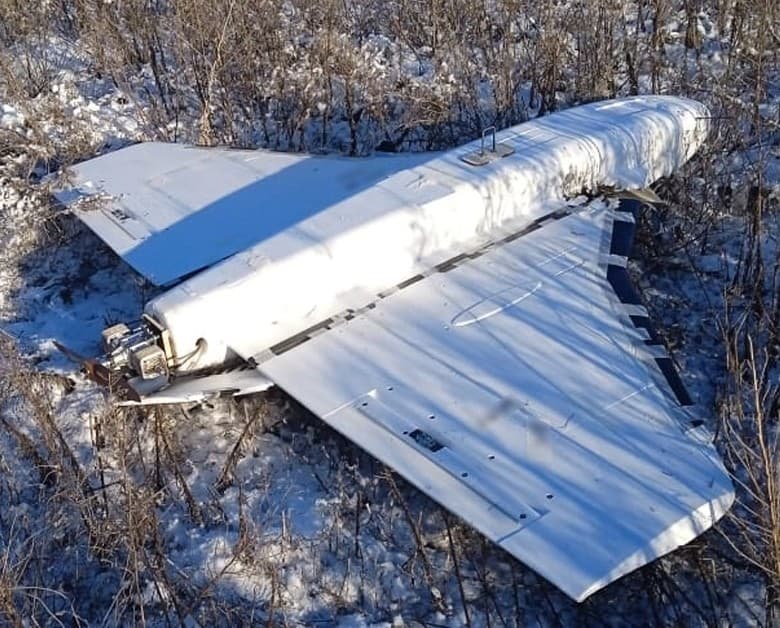
On or about September 5–6, 2025, a Russian Gerbera decoy drone came down in a field near Majdan Sielec (also rendered Majdan-Sełce in early reports), a village in Tomaszów Lubelski County, approximately 50 kilometers from the Ukrainian border. The aircraft landed roughly 500 meters from the nearest residential buildings. No one was injured. Photographs published by Polish broadcaster TVN24 confirmed the wreckage as a Gerbera.
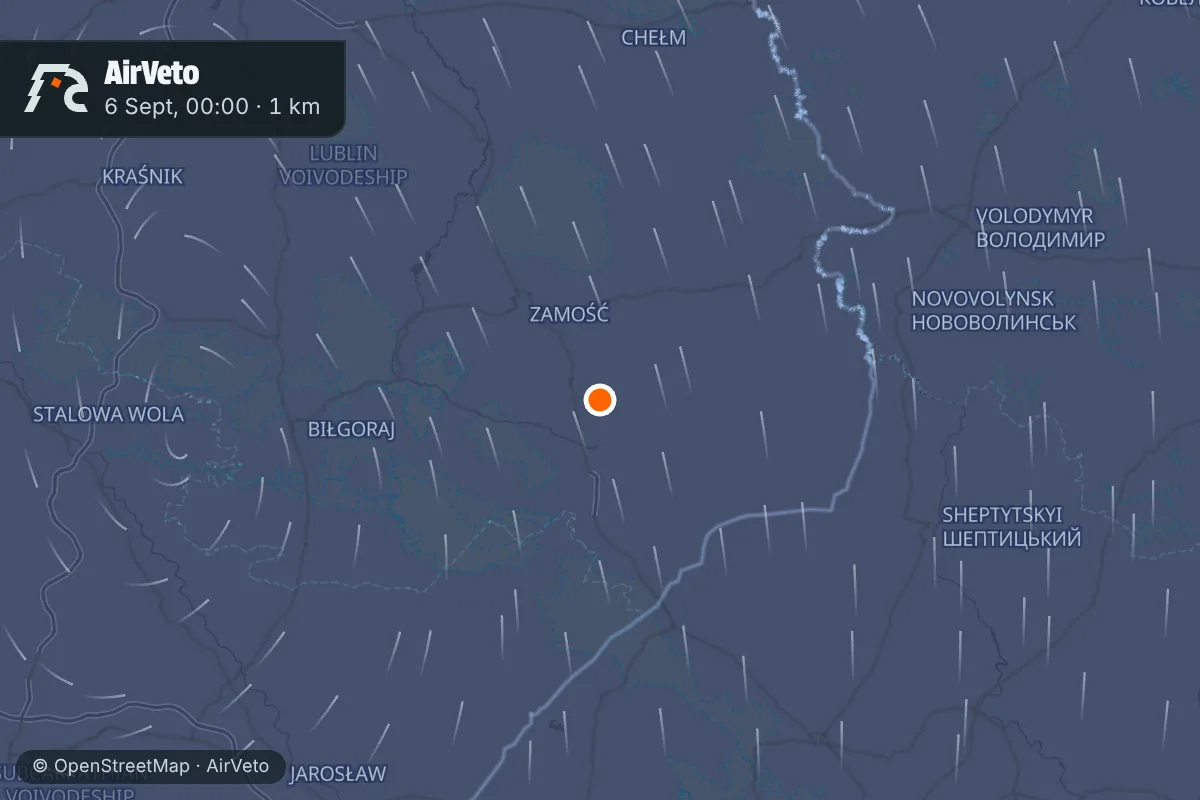
AirVeto's wind-model data for the event window: At 22:00 UTC on September 5, 2025 - on the assessed pre-crash night - the 1,000 m layer over the Tomaszów Lubelski area showed SSE wind at 12.8 km/h.
The crash preceded by three days the mass 19–23 drone incursion on the night of September 9–10, 2025 - the largest single airspace incursion into a NATO member state since Russia's full-scale war on Ukraine began.
What a Gerbera is
The Gerbera (Герань-3 / Geran-3 series) is a Russian-made fixed-wing decoy drone, constructed from foam and plywood. It is designed to fly ahead of or alongside genuine strike packages to overwhelm air-defence radar and force the early expenditure of interceptor missiles. Gerberas carry no warhead and no payload of military significance under their standard configuration. Their function is attrition: each one intercepted by an AMRAAM or IRIS-T is a genuine missile expended on a cheap foam airframe.
What the wreckage showed
Pre-flight inspection markings visible on the recovered airframe included a date: "2.09" - September 2, 2025, one week before the main incursion. The Cyrillic annotation "БГ" (боеготовый - combat-ready) confirmed the drone had passed a Russian military pre-flight check before launch.
The District Prosecutor's Office in Zamość initially described the object as "made of lightweight material resembling foam" with "neither explosives nor contraband." A spokesperson for Poland's Ministry of National Defence claimed the drone "did not have any military characteristics."
The TVN24 photographs published on or after 9 September made this position untenable: the airframe was identifiable as a Gerbera to any observer familiar with its design. The pre-flight markings established Russian military origin beyond reasonable doubt.
Two drone crashes, one week
Polish authorities were simultaneously investigating a second crash site at this time - a separate drone found near the Belarus border crossing at Połatycze in Chełm area, also in early September 2025. The two incidents suggested that Russian drone launches targeting eastern Poland had begun as a pattern before the 9 September mass wave, not as a single improvised event.
Wind conditions over southeastern Lublin Voivodeship
At 22:00 UTC on September 5, 2025 - on the assessed pre-crash night - the 1,000 m layer over the Tomaszów Lubelski area showed SSE wind at 12.8 km/h. Light flow pushing NNW at this level was the atmospheric background for the assessed flight. The wind model and its documented limits are set out on the methodology page.
This reconstruction is sourced from reporting by Militarnyi, AeroTime, and Ukrainska Pravda, and on AirVeto's wind-model data for the September 2025 event window.
Context: the September 2025 cluster
The Majdan Sielec crash is best read as a precursor to the September 9–10 mass incursion. The Gerbera at Majdan Sielec was pre-flighted on 2 September; the 9 September night's wave carried drones of the same type. The cluster shows a sustained, planned pattern of launches rather than a single-night event, and extends forward into 2026: a Gerbera was recovered at a lignite mine in Greater Poland in March 2026, assessed as having lain undetected since the September 2025 incursion.
The full record of drone and airspace incidents over Polish territory is collected at Dron nad Polską.
Sources
- Militarnyi - 'Gerbera' drone crashed in Poland, 50 km from the border. Officials deny it had military features (Sep 2025)
- AeroTime - Poland investigates two drone crashes in eastern region (Sep 2025)
- Ukrainska Pravda - Newly released photos show Russian Gerbera drone that crashed in Poland without exploding (Sep 2025)
- Wikipedia - 2025 Russian drone incursion into Poland
- Methodology
Last updated: