

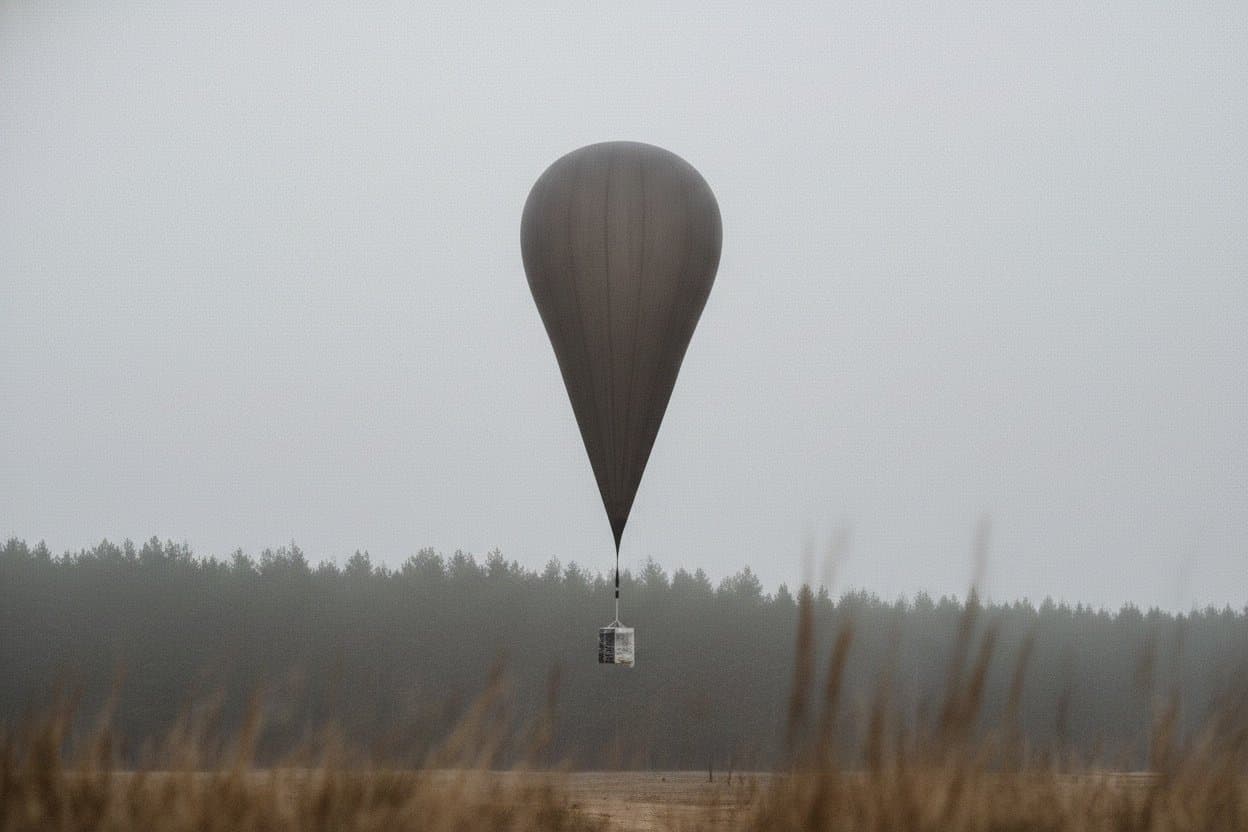
On 18 June 2026, Latvia's Saeima approved amendments to the Criminal Law in a final reading that strengthen criminal liability for offences committed using airborne devices — balloons, drones, and weather probes. According to LSM, Andrejs Judins (New Unity), chairman of the Saeima's Legal Affairs Committee, explained the rationale: "Modern technologies, particularly drones, are increasingly being used for smuggling and the cross-border transport of prohibited substances."
The law is now in force. Using an airborne device to commit a crime counts as an aggravating circumstance.
What the amendments change
Before these amendments, a smuggling conviction looked the same whether the contraband arrived in a car boot or floated in under a weather balloon at 2 km altitude. Courts could consider the method; it was not codified as a factor that automatically pushed sentencing upward.
Now it is. Using any device that moves through airspace — balloon, drone, weather probe — in the commission of a crime involving prohibited substances or cross-border smuggling is explicitly an aggravating circumstance under Latvian criminal law. That matters in sentencing: an aggravating circumstance limits the court's ability to apply minimum sentences and strengthens the prosecutor's hand at every stage.
The corridor this addresses
Latvia's border with Belarus runs 173 km. The balloon corridor from Belarus into Latvia — carrying cigarettes, drugs, and cash — has been documented in AirVeto's archive since the Bialystok events of December 2025 and the Vilnius incursion in January 2026. The pattern is consistent: launches under cover of darkness from the Belarusian side, payloads recovered in farmland or forest on the Latvian and Lithuanian side.
In April 2026, Latvian customs officials told LSM that cigarette smuggling across the Latvian-Belarusian border via balloons remained rampant despite cross-border cooperation. That was two months before the Saeima voted. The legal gap was visible and documented; closing it just took parliamentary time.
Latvia follows Lithuania
Lithuania moved faster. In late 2025, Lithuanian authorities arrested 21 people in a major crackdown on a cigarette smuggling network operating via weather balloons from Belarus. Lithuania had already updated its legal framework to treat the aerial method as a distinct aggravating factor.
Latvia is now aligned. Both countries border Belarus; both face the same operational picture. The legal convergence between the two states is a practical step toward joint prosecution of the networks that run cross-border balloon operations — which, based on what AirVeto's archive shows, don't limit themselves to one country's airspace.
What the archive shows
The Vilnius airport balloon incursion on 28 January 2026 and the Białystok-Podlaskie events on 24 December 2025 document the wind corridors that carry these payloads. The wind layer shows why the launches happen when they do: south-to-north flow at 1–3 km altitude is the operational condition the smugglers wait for. AirVeto's reconstruction places the Vilnius release point across the Belarusian border based on the 700 hPa wind field at the time of recovery.
Stiffer sentences for the people caught with the payloads are one response. The other is understanding the physics of when and where launches are viable — which is what the archive is for.
The full balloon archive is at /incidents, filtered by type.