
Smuggling balloons land across Białystok and Podlaskie, Poland
On December 24, 2025, AirVeto's model showed a Belarus→Poland crossing zone; from that day, Podlaskie police logged four balloon-smuggling reports, one of them about 61 km inside Poland.
AirVeto finding: Goniądz, one of the four reported landing sites, lies about 61 km west of the nearest point on AirVeto's outline of the Belarusian border, a straight-line minimum of about two hours of drift at the 29 km/h flow from the east-northeast that AirVeto's wind data shows at 3,000 m.
- reported Goniądz was one of four places where Podlaskie police logged balloon-smuggling reports from December 24. Radio Białystok Podlaskie24
- modelled Goniądz lies about 61 km west of the nearest point on AirVeto's outline of the Belarusian border. AirVeto methodology
- modelled At the 29 km/h flow from the east-northeast at 3,000 m, that distance takes at least about two hours of drift. Open-Meteo
- unknown Where the balloons were launched and at what altitude they flew.
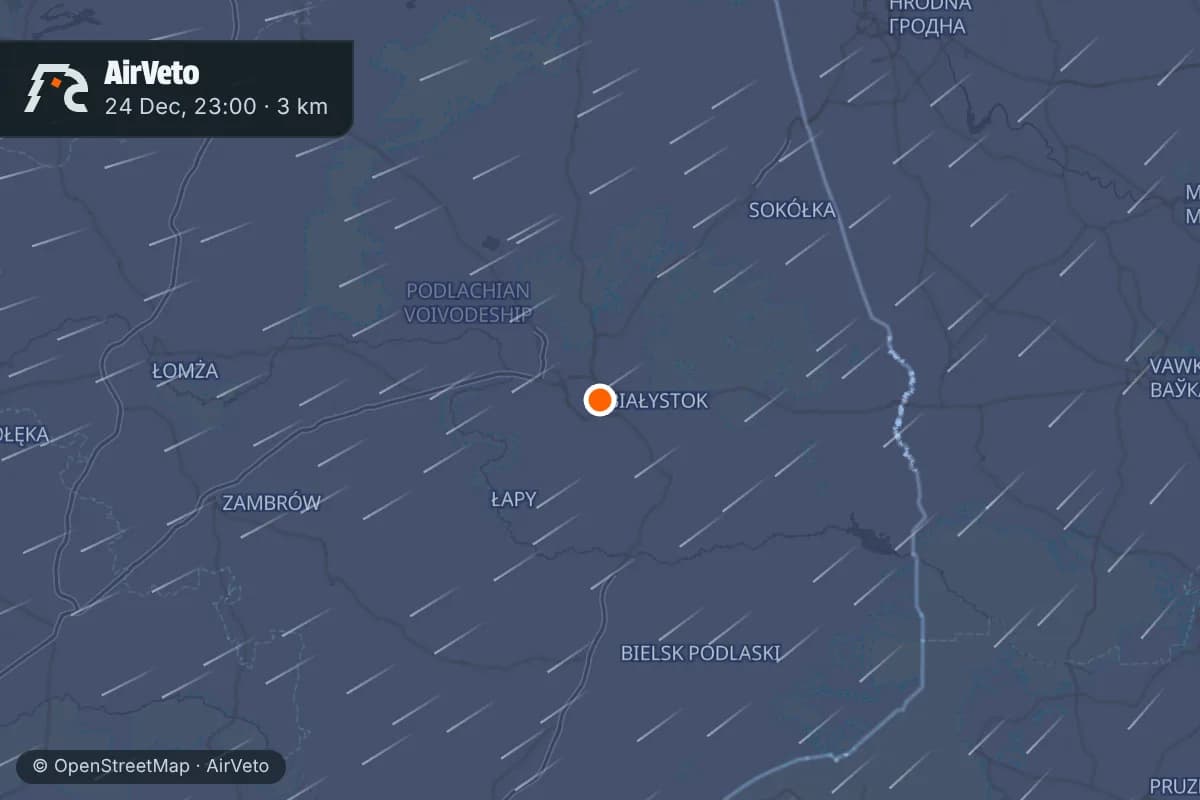
On the evening of December 24, 2025, AirVeto’s wind field over eastern Poland showed air moving from Belarus into the Podlaskie region at 3,000 m, across the area north of Białystok.
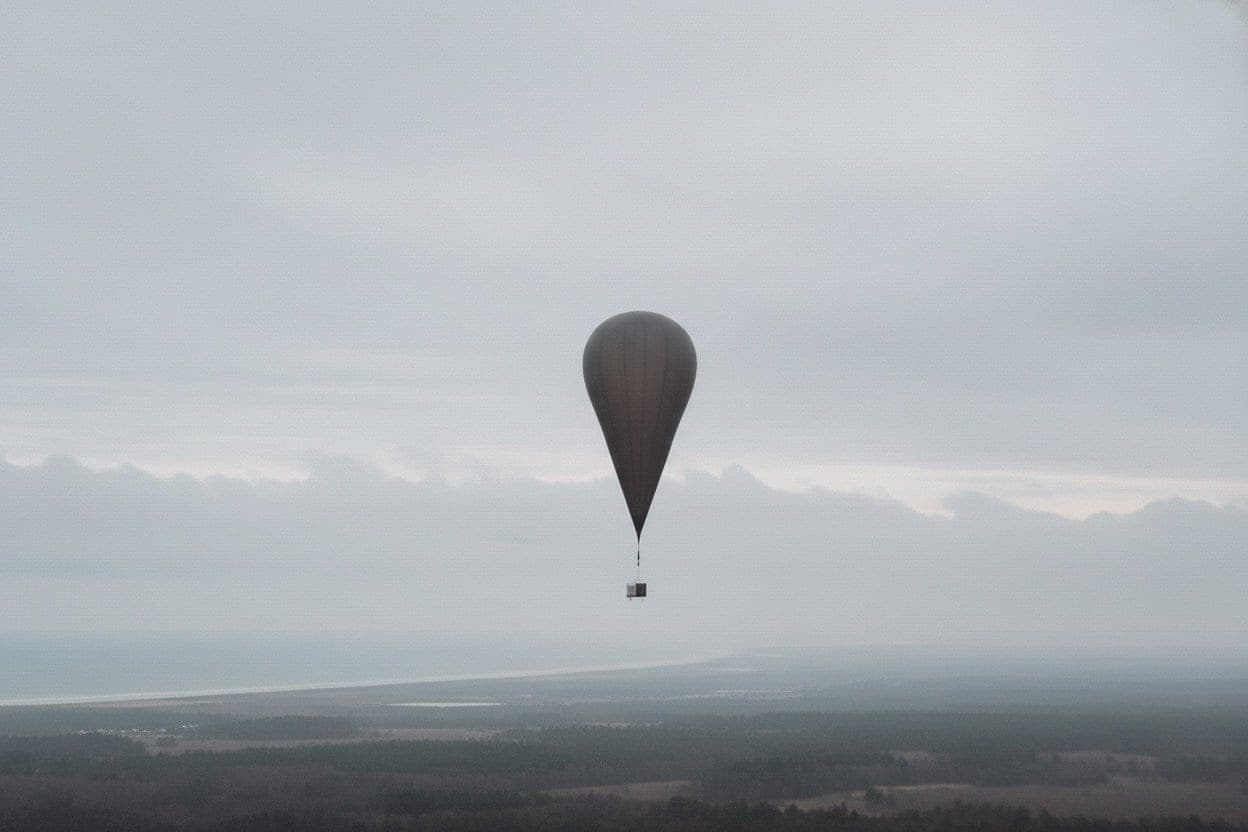
From December 24, Podlaskie police logged four reports of balloon-borne cigarette packages, at Goniądz, Boguszewo, Zaborowo and Łozowo, Radio Białystok and Podlaskie24 reported; at Łozowo only the cigarettes were found. Poland's Operational Command assessed the objects as smuggling balloons, and part of the region's airspace was temporarily closed.
Goniądz lies about 61 km west of the nearest point on AirVeto's outline of the Belarusian border. At the 29 km/h flow from the east-northeast that AirVeto's wind data shows at 3,000 m, that straight line is about two hours of drift. It is a minimum: the balloons' launch points and flight altitude are not public.
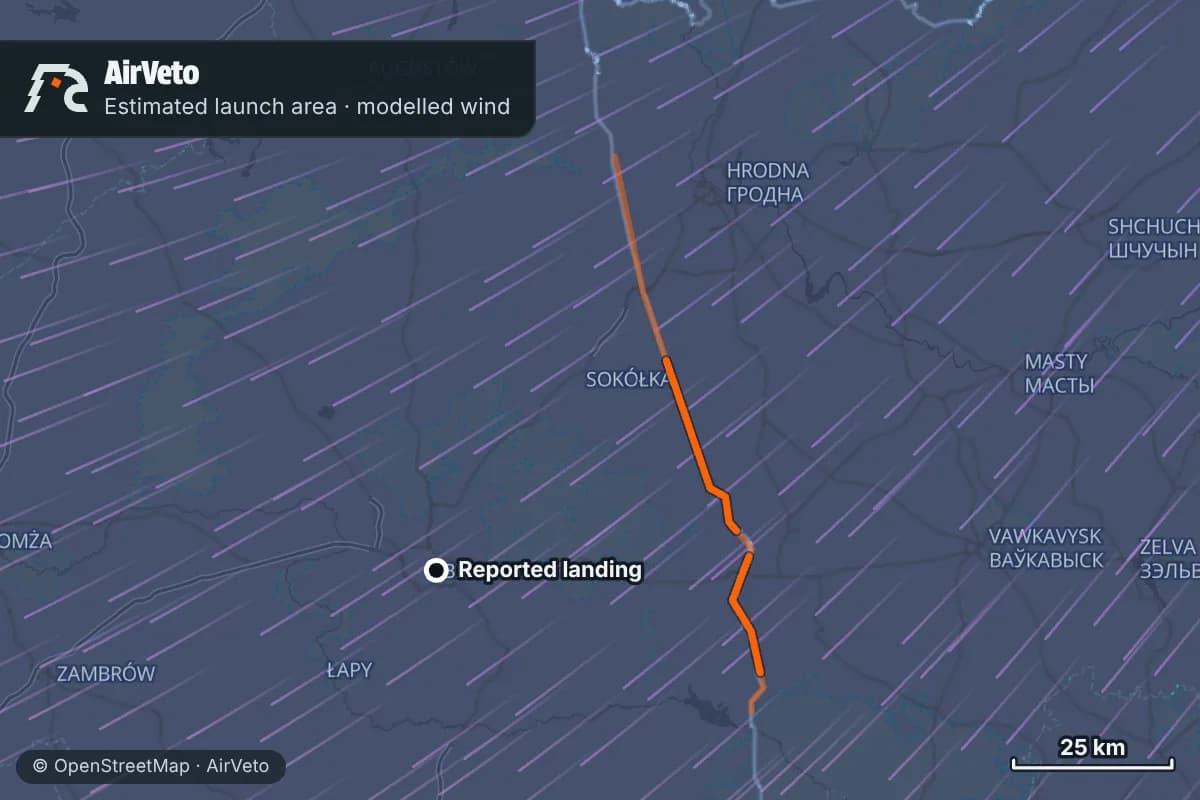
Estimated launch area, consistent with the wind and the reported landing
Core: 50 km of border, where 80% of the wind traces cross
Full spread: 95 km of border
Streaks: model wind at 3 km altitude at 24 Dec, 23:00, the start of the reported window, from this incident's wind data, extended across the frame from the nearest data; they point the way the wind blew, longer means faster (24 to 32 km/h here)
Rests on 63 of 63 back-traces that reached the border within 12 hours, at 7 of 7 heights, from 9 start times across the reported window.
Model wind, unknown launch time and height; the area shows where the wind could have carried the balloon from. How this is estimated
What AirVeto showed at the time
At 22:00 UTC on December 24, AirVeto's wind layer at 3,000 m showed air over the Podlaskie region coming from between the north-east and the east. Near Białystok it came from the east-northeast at about 29 km/h, moving west-southwest. Speeds across the Podlaskie region ranged from 24 to 38 km/h, arriving from NE to E, with the flow pushing more directly west toward the south of the region.
| Wind parameter | Value |
|---|---|
| Altitude | 3,000 m |
| Time | 22:00 UTC, December 24, 2025 |
| Direction, near Białystok | Pushing west-southwest, arriving from the east-northeast (Belarus) |
| Speed, near Białystok | ~29 km/h |
| Direction range (from), Podlaskie grid | 36°–91° (NE to E) |
| Speed range, Podlaskie grid | 24–38 km/h |
| Source | Open-Meteo historical-forecast-api |
How AirVeto models that field, its data sources and its known limits are set out on the methodology page. This reconstruction is based on reporting by TVN24, Radio Białystok, and Podlaskie24, and on AirVeto's wind-model analysis for the 22:00–06:00 UTC event window on December 24–25, 2025.
Related incidents
It is the earliest Polish balloon incident in AirVeto's archive, on the Polish–Belarusian border. Later balloon incidents, including the January 28, 2026 Vilnius Airport incursion, are collected in the incident archive. Polish-side smuggling-balloon incidents and the wind context behind them are collected at Balony przemytnicze.
Related location
- Polish-Belarusian border - Poland's roughly 418 km frontier with Belarus - focal point of migration, airspace, and cross-border incidents.
- NATO eastern flank - The frontier where EU airspace meets Russia and Belarus across five NATO member states - the active zone of drone incursions, smuggling balloon recoveries, and Baltic Air Policing intercepts since 2025.
Corrections
: The 3,000 m wind was first published as 90° (from the east) at 40 km/h. It is now 56° (from east-northeast) at 29 km/h, the value in the wind data for the grid point nearest Białystok at 22:00 UTC on 24 December 2025. The finding, the text and the wind table were revised to match. The first version overstated the easterly component.
Sources
- TVN24 - Podlaskie, Lubelskie. Przemytnicy nie próżnują w święta. Do Polski wleciały balony, znaleziono pięć (December 2025)
- Radio Białystok - Balony z Białorusi nad Podlaskiem. 7 tysięcy paczek przemyconych papierosów (December 2025)
- Podlaskie24 - Przemytnicze balony nad Podlaskiem: zgłoszenia i zamknięcie przestrzeni powietrznej (December 2025)
- AirVeto - Christmas Eve prediction post (December 27, 2025)
- Methodology
Last updated: