
Belarus balloons reach Podlaskie and Lublin, 17 Jan 2026
Border Guard and police recovered smuggling balloons across Podlaskie and Lublin voivodeships on 17 January 2026, after dozens of objects flew in from Belarus overnight.
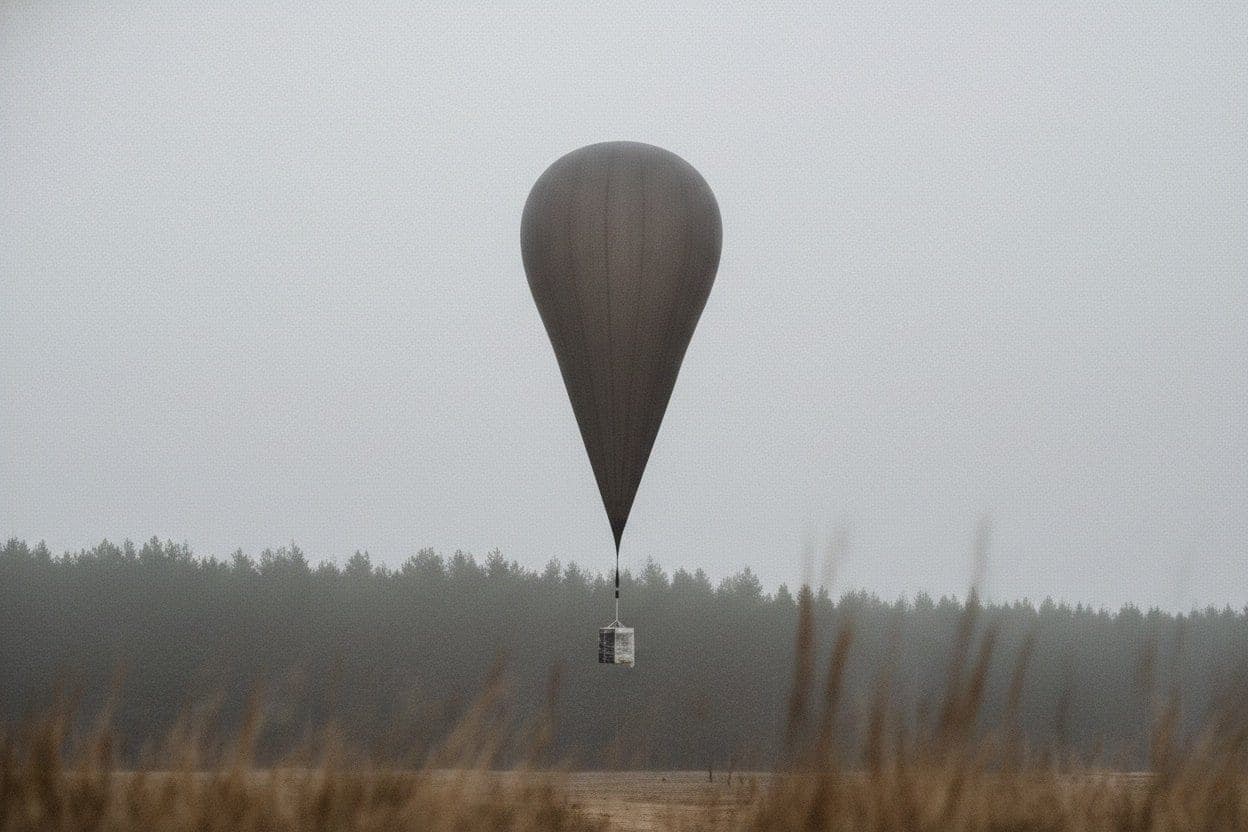
Dozens of objects crossed from Belarus into Poland overnight on January 16-17, 2026, Poland's National Security Bureau said on X. AirVeto's wind data shows the air from the ground to 3,000 m blowing from the south and southeast that night, away from the border; only air at 4,000 m and above flowed in from Belarus.
Polish authorities recovered the balloons the same morning. The Border Guard found seven sets of remains in six villages in Sokółka and Białystok counties. Police and Border Guard units found more in the Lublin region, up to 229 km from the Kuźnica border post by AirVeto's measurement.
Balloons came down across Podlaskie and the Lublin region on 17 January
The National Security Bureau said on Saturday, 17 January, that dozens of objects had flown in from Belarus during the night. Onet recorded about 150 balloon violations of the border, Radio Lublin reported.
The Border Guard said its officers found seven sets of balloon remains overnight, at Kraśniany, Woroniany, Machnacz, Smolanka, Słojniki and Białousy. All are in Sokółka and Białystok counties. The balloons crossed the border in the area of the Border Guard's Kuźnica post.
Police found two more. One hung in a tree on Włókiennicza Street in Białystok, with 1,500 packs of cigarettes on the ground below. The other came down at Wierzchłowce, in Sokółka County, with a parcel of 150 cartons attached.
Farther south, the Nadbużański Border Guard unit found two balloons near Koroszczyn, in Biała Podlaska County. Each carried 1,500 packs, worth 60,000 zloty together. Lublin police received a report of a torn canopy, probably from a smuggling balloon, on a property in the Niedźwiada municipality, Lubartów County.
AirVeto measured the straight-line distance from Kuźnica to three of those places:
| Recovery site | County | Straight line from Kuźnica |
|---|---|---|
| Białousy | Sokółka | 30 km |
| Koroszczyn | Biała Podlaska | 159 km |
| Niedźwiada municipality | Lubartów | 229 km |
The wind below 3,000 m blew away from the border all night
At 20:00 local time on 16 January, AirVeto's wind layer over Kuźnica showed the air at 3,000 m coming from the south at 23 km/h. At 2,000 m it came from the south-southeast at 24 km/h. At 500 m it came from the south at 56 km/h.
That pattern held to 06:00 on 17 January. The wind at 2,000 m stayed between south and south-southeast, and at 3,000 m between south-southwest and southeast. Air from those directions moves north and northwest, toward Belarus.
| Altitude | Wind from | Speed |
|---|---|---|
| 500 m | south | 56 km/h |
| 1,000 m | south | 34 km/h |
| 2,000 m | south-southeast | 24 km/h |
| 3,000 m | south | 23 km/h |
| 4,000 m | east | 16 km/h |
| 5,000 m | east-northeast | 14 km/h |
| 7,000 m | northeast | 51 km/h |
Wind at Kuźnica, 20:00 local time on January 16, 2026, from AirVeto's hourly Open-Meteo series.
Only the layers at 4,000 m and above came from the east or northeast, the direction that carries objects from Belarus into Poland. At 7,000 m a balloon in that flow would cover 229 km in about four and a half hours. That flow pointed southwest, a little west of the south-southwest line from Kuźnica to Niedźwiada. The wind at 20:00 on 16 January shows the same layering as the hours after it, so the reconstruction does not depend on one hour.
The December 24, 2025 crossing looked different. On that night AirVeto's data showed the 3,000 m wind from the east-northeast at 29 km/h, as the Białystok incident page sets out.
Poland's military reported small drones, not balloons, on 21 January
On the evening of 21 January, Poland's Operational Command said it had observed increased activity by small unmanned aerial vehicles over the Polish-Belarusian border. It said no threat to airspace safety was detected, and described the incident as part of hybrid actions by the Belarusian side aimed at testing Poland's air defence, Reuters reported.
Reuters described the drone report as coming after the airspace violation involving suspected smuggling balloons the week before. The 21 January report named drones, not balloons.
Poland summoned Belarus's envoy on 21 January
The Foreign Ministry summoned Belarus's chargé d'affaires on Wednesday, 21 January, over the weekend's balloon smuggling, spokesman Maciej Wewiór told the Polish Press Agency. The diplomat was told that Poland does not consent to such actions and that continuing them will have consequences.
The chargé d'affaires could not answer on Belarus's role in the operations. Wewiór said Poland questions whether the Belarusian side has no knowledge or influence over such a large number of them.
Balloons returned on three nights between 28 January and 1 February
On the night of 28-29 January, Poland's Operational Command reported objects entering from Belarus, and civil air traffic was temporarily restricted over part of Podlaskie Voivodeship. The military assessed the objects as most likely balloons, Militarnyi reported.
On the night of 30-31 January, the command recorded more entries and assessed them with high probability as balloons moving with the weather. The Border Guard said they were probably smuggling balloons. Polsat News reported temporary restrictions on civil aviation over Podlaskie, and Kyiv Independent called it the second such incursion that week.
On the night of 31 January to 1 February, the command said the Belarusian side had made another attempt to test the reaction of Poland's air defence. Radar recorded objects resembling balloons entering Polish airspace, and the Border Guard again said they were probably smuggling balloons. The command recorded no threat to airspace safety on any of the three nights.
Prosecutors charged five men with smuggling cigarettes by balloon on 5 February
On 5 February, the Border Guard announced that its Nadbużański unit, under the supervision of the Siedlce regional prosecutor's office, had broken up an organised group smuggling cigarettes from Belarus by balloon. Prosecutors charged five men: two Polish citizens, two Ukrainians and one Belarusian, Notes From Poland reported, citing Polsat.
They are accused of smuggling at least 48,000 packs, costing the treasury more than 2 million zloty (about €474,000), and of using GPS trackers embedded in the parcels to find them after landing. They were also charged with violating air traffic regulations. The Siedlce district court ordered three months of pretrial detention for all five on Wednesday, 4 February.
This reconstruction is based on reporting by Radio Lublin, Reuters, Defence24, Polsat News, Militarnyi, Kyiv Independent and Notes From Poland, and on AirVeto's wind-model data for the night of January 16-17, 2026. AirVeto's wind method is described on the methodology page. Polish-side smuggling-balloon incidents and their wind context are collected at Balony przemytnicze.
Related location
- Polish-Belarusian border - Poland's roughly 418 km frontier with Belarus - focal point of migration, airspace, and cross-border incidents.
- NATO eastern flank - The frontier where EU airspace meets Russia and Belarus across five NATO member states - the active zone of drone incursions, smuggling balloon recoveries, and Baltic Air Policing intercepts since 2025.
Sources
- Radio Lublin - MSZ wezwało białoruskiego dyplomatę. Chodzi o balony (21 Jan 2026)
- Reuters via Yahoo News - Polish army reports increased small drone activity near Belarus border (22 Jan 2026)
- Militarnyi - Poland Reports Airspace Violation by Objects from Belarus (January 2026)
- Defence24 - Kolejne naruszenie przestrzeni powietrznej przez balony (31 Jan 2026)
- Polsat News - Naruszenie polskiej przestrzeni powietrznej. Pilny komunikat wojska (31 Jan 2026)
- Polsat News - Balony przemytnicze w polskiej przestrzeni powietrznej. Komunikat wojska (1 Feb 2026)
- Kyiv Independent - Poland closes airspace after Belarusian balloon incursion (1 Feb 2026)
- Notes From Poland - Poland charges five men for smuggling cigarettes from Belarus with balloons (6 Feb 2026)
- Methodology
Last updated: