

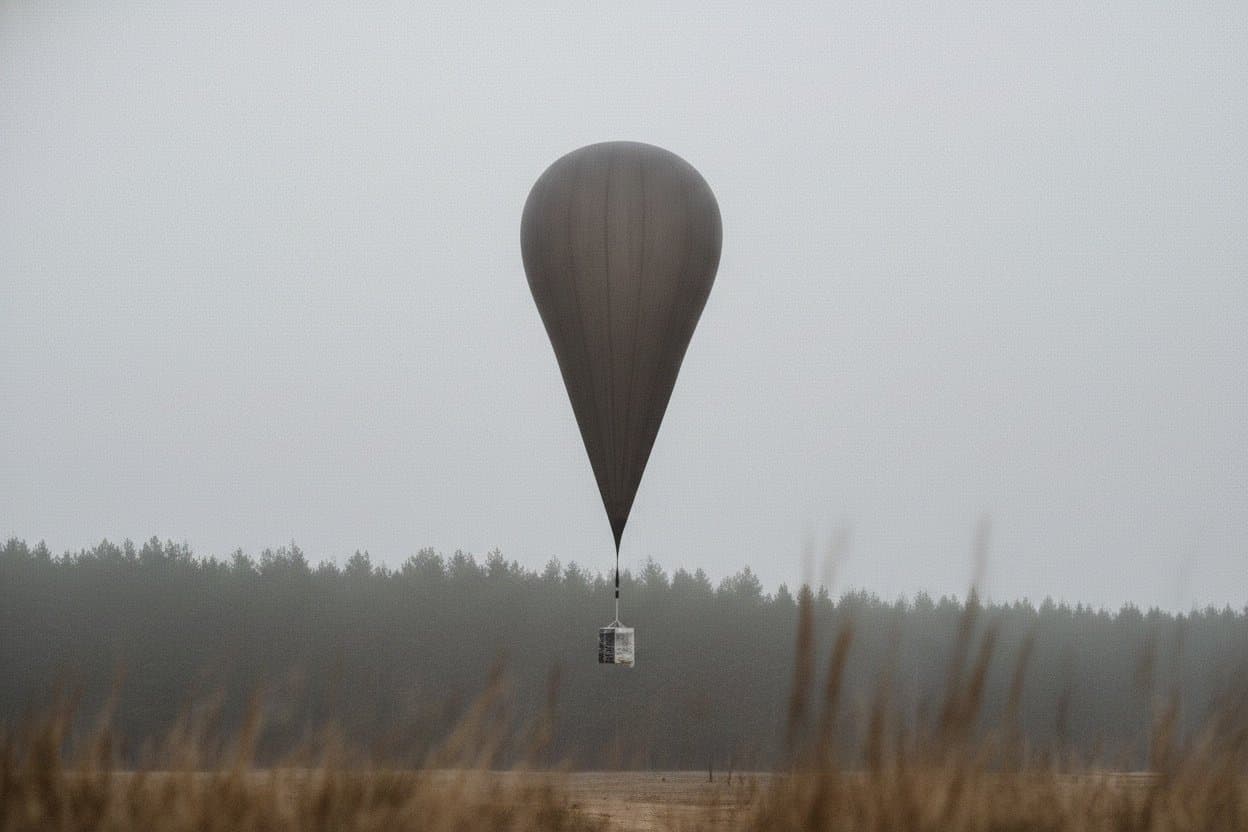
There's a specific problem with contraband meteorological balloons that doesn't get talked about clearly: they aren't random. They follow predictable wind patterns.
Balloons launched from Belarus drift in specific directions when wind at cruising altitude flows a certain way—and it does more often than you'd think over Lithuania in winter and spring. Same altitude layer, same wind direction, same time windows. That's how you get seven balloons over Druskininkai in one night, and Vilnius Airport closing five times in four months, and Lithuanian border guards finding contraband-loaded envelopes in the same forest belt, repeatedly.
Lithuania noticed. And then Lithuania started building something.
The ecosystem: three layers of defence
Contraband balloon incursion isn't a new problem in Eastern Europe. Ukraine has been managing it in an active war for two years. Ukraine's response was to build Delta—a cloud-based battlefield management system that integrates UAV feeds, radar, satellite imagery, and human intelligence into a single operational picture. Thousands of targets processed per day. Over half a million Russian targets destroyed via the system to date.
The United States supplied Ukraine with Palantir Gotham, a commercial intelligence fusion platform. Both systems run simultaneously, filling different roles. Delta excels at frontline data collection; Palantir at deep analytics and visualization. Together they form the C2 backbone of Ukraine's kill chain.
Lithuania is building something different. Not a C2 platform (Lithuania uses NATO's SitaWare), but a dedicated physical response layer for airspace incursion. That's IOEAS—the Smart Airspace Defence System.
IOEAS bundles three specialist subsystems:
- Fixed-wing UAVs for high-altitude coverage
- Laser-optical sensors for day/night detection and in-flight neutralisation
- DOBIS (the Dirigible Balloon Interception System) — an airship platform to intercept and safely retrieve targets
But there's a fourth layer, less visible. Lithuania also has UDS, a domestic company building AI-driven swarm drone integration. UDS supplies drone platforms and swarm coordination software to Lithuanian and Ukrainian forces.
The upstream step: where wind prediction enters the targeting calculus
Here's the critical insight: all of these systems—Delta, Palantir, SitaWare, DOBIS, UDS—require the same upstream input. Where are objects actually going to be?
For contraband balloons, the answer is wind.
A balloon doesn't have a heading. It drifts. If you know the wind at cruising altitude and the release point, you can predict the landing zone within hours. That prediction window is where every response system operates.
DOBIS doesn't need to search the sky. If the wind at 500–3,000 metres is flowing inbound from Belarus, and the geometry is tight (Druskininkai is on the border; Vilnius is 30 km inland), then DOBIS can position itself where balloons are likely to be and wait. The wind field is the targeting variable.
The same principle applies in reverse: Ukraine uses aerostat-launched Hornet strike drones that release at 8,000 metres and glide toward targets up to 400 km out. Operators wait for the right wind at that altitude before releasing—same physics, opposite direction. East-to-west for contraband. West-to-east for strike.
That's what AirVeto surfaces. Not a military system. A public map.
AirVeto tracks wind at 10 altitude layers, updated hourly. The interface marks border segments in orange when wind is flowing into EU airspace at angles that would carry a balloon into Lithuania. You can see, hours ahead, whether tonight's wind direction will push balloons toward Druskininkai, the Vilnius approach, or somewhere else entirely.
The data comes from open atmospheric models (ECMWF, GFS blends via Open-Meteo). The physics are identical to what IOEAS's trajectory algorithms are processing internally. The difference: AirVeto publishes it in real time, and anyone—journalist, analyst, researcher, OSINT team—can read it without specialist training.
The practical architecture
Think of it this way:
Layer 1 — Wind prediction: AirVeto. Hours of lead time. Public data.
Layer 2 — Detection & engagement: IOEAS. UAVs, sensors, lasers. Minutes of response time once a target is in range.
Layer 3 — Safe retrieval or neutralisation: DOBIS. Minutes of precision work once detection triggers.
Ukraine solved this differently. Delta and Palantir integrate all three layers into a single platform. They can ingest real-time wind models, drone feeds, radar tracks, and targeting solutions in one operational picture. The trade-off: system complexity, connectivity requirements, and cost.
Lithuania is solving it with decoupled layers. Wind data is open and public (AirVeto, MeteoAlarm). Detection is IOEAS's UAVs and sensors. Retrieval is DOBIS. Each layer is optimized for its problem. They communicate, but each can function independently.
There's a reason for this architecture. Lithuania is building public resilience as much as military capacity. When your border is thin (the Suwałki Gap is 65 km wide) and the threat is routine (balloons every few weeks), you don't need a US$10-billion integrated C2 system. You need:
- Predictable wind data (public)
- Distributed sensors (IOEAS)
- Rapid response (DOBIS airship)
- Swarm capability for multi-target scenarios (UDS)
AirVeto doesn't integrate with DOBIS. It can't. AirVeto is a public web map; DOBIS is a classified military system. What they share is the same atmosphere.
Why this matters for OSINT and journalism
For anyone tracking airspace security on the EU's eastern frontier, this architecture matters.
When a balloon incident happens—Vilnius Airport closes, a payload is recovered—you can now understand the full sequence:
- Wind prediction (public): AirVeto showed inbound wind. Hours of warning.
- Detection (classified): IOEAS sensors saw the target. Minutes of engagement window.
- Response (classified): DOBIS or another intercept platform engaged. Minutes of precision.
You can't see steps 2–3 from outside. But step 1 is visible. When Vilnius Airport closes for a balloon, check AirVeto at that timestamp. The wind layer is the record of why it was possible.
For defence researchers tracking Lithuania's air-defence development, IOEAS is the visible commitment. For OSINT analysts, AirVeto is the public complement. Together they show the infrastructure and the prediction logic. Separately, each serves its audience.
The AirVeto incident archive has been documenting this since late 2025. Each reconstruction shows the wind field at the moment of crossing. That's the data upstream of every response system on the eastern frontier—Delta, Palantir, DOBIS, or any future platform.
Wind doesn't lie. And now it's transparent.