
Record seven balloon shipments intercepted in southern Lithuania
Lithuanian border guards intercepted seven balloon-borne cigarette shipments in Varėna, Lazdijai and Druskininkai on February 6, 2026, the most in one day that year.
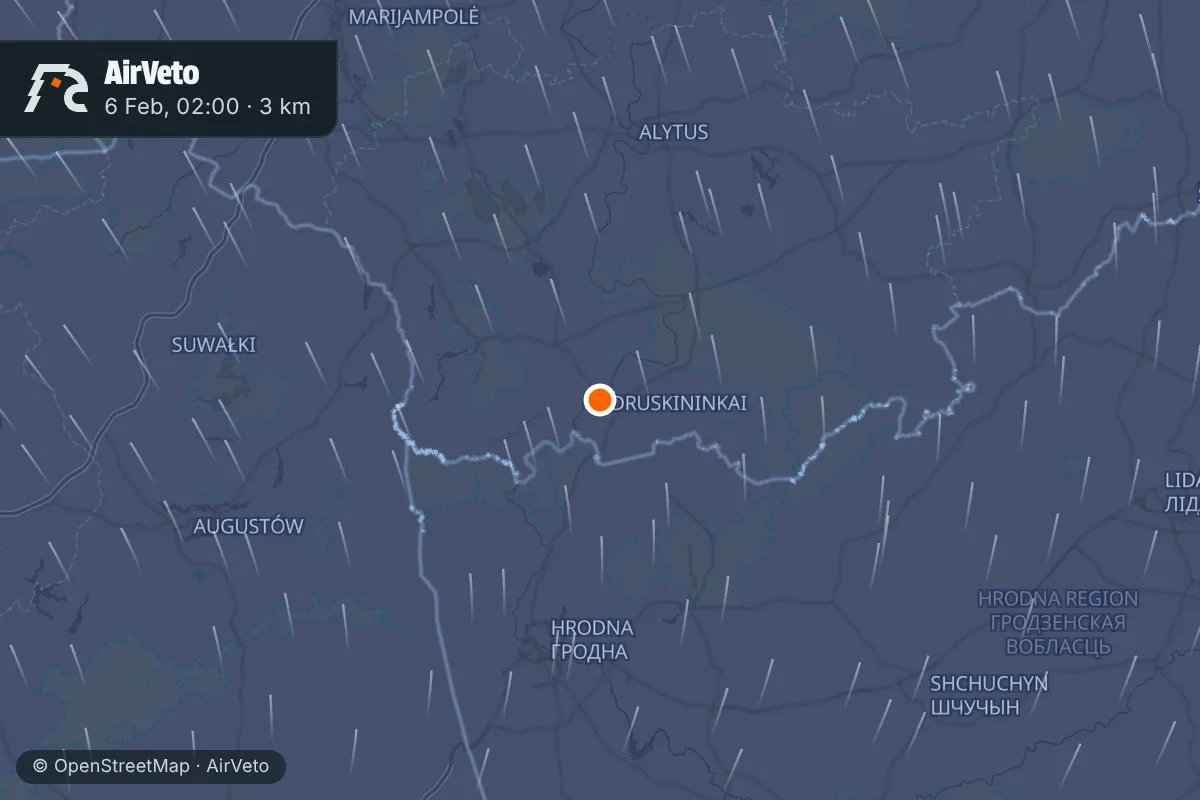
AirVeto finding: At 00:00 UTC on February 6, AirVeto's wind data has the 3,000 m air over Druskininkai moving north-northwest at about 19 km/h, the direction from the Belarusian border into Lithuania there.
- modelled At 00:00 UTC on February 6 the 3,000 m air over Druskininkai moved north-northwest at about 19 km/h, from the Belarusian border into Lithuania. Open-Meteo
- unknown When the seven shipments landed; the sources give no landing times.
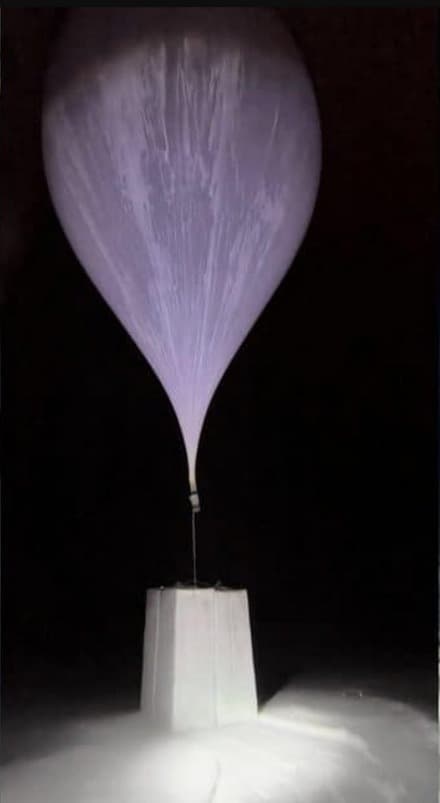
Lithuanian border guards intercepted seven balloon-borne cigarette shipments in southern Lithuania on Friday, February 6, 2026, and detained two people, jp.lt and AINA.lt reported. AirVeto's wind data for the start of that day has the 3,000 m air over Druskininkai moving north-northwest at about 19 km/h, the direction from the Belarusian border into Lithuania there.
The shipments came down in the Varėna and Lazdijai districts and in Druskininkai municipality. The border guards said it was the most such shipments their officers had intercepted in one day in 2026, jp.lt reported. One landed in the Čepkeliai reserve in Varėna district, and officers waded about 3 km through snowdrifts to reach it.
REFORM.news, citing the State Border Guard Service, put the day's seizure at 12,700 packs of cigarettes. It gave the 2026 total so far as 40 airborne shipments, 108,000 packs and 23 suspects detained.
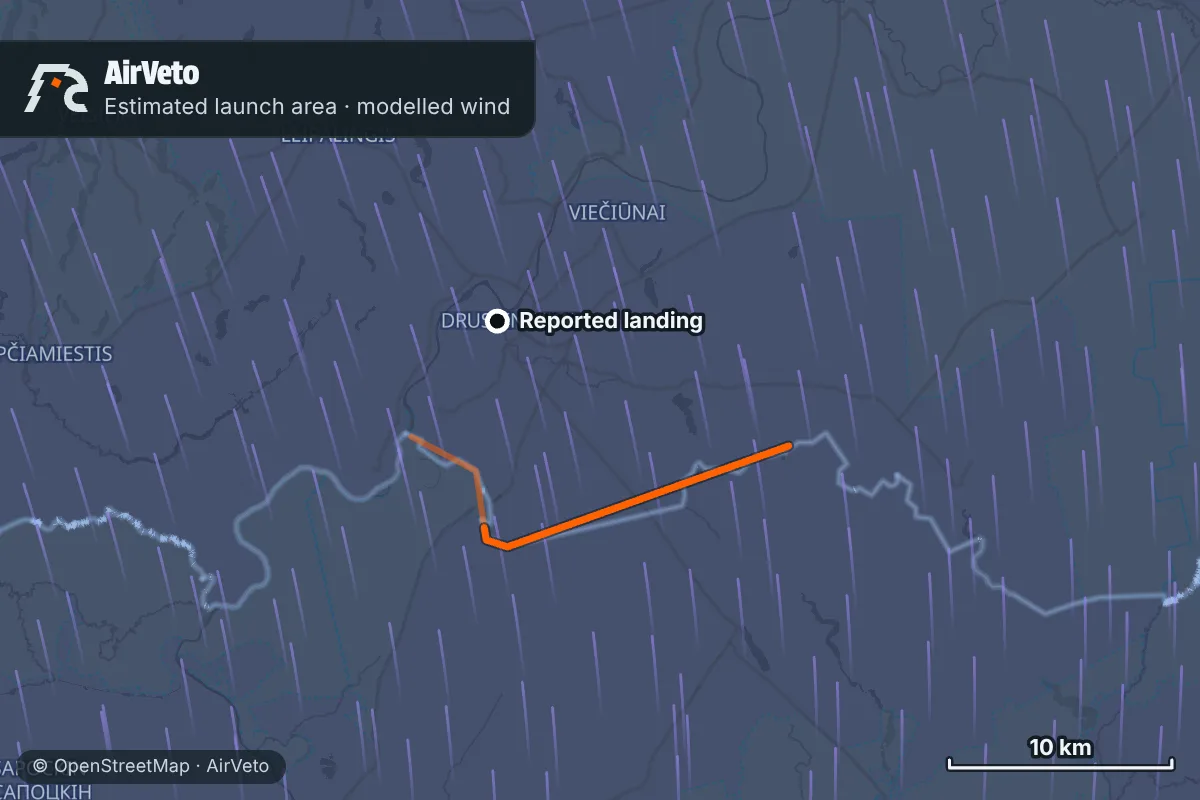
Estimated launch area, consistent with the wind and the reported landing
Core: 15 km of border, where 80% of the wind traces cross
Full spread: 20 km of border
Streaks: model wind at 3 km altitude at 6 Feb, 02:00, the start of the reported window, from this incident's wind data; they point the way the wind blew, longer means faster (17 to 21 km/h here)
Rests on 168 of 168 back-traces that reached the border within 12 hours, at 7 of 7 heights, from 24 start times across the reported window.
Model wind, unknown launch time and height; the area shows where the wind could have carried the balloon from. How this is estimated
Wind over Druskininkai on February 6
The sources give no landing times, so the wind below is the field at the start of the day, not a tracked flight path. At 00:00 UTC the air at 3,000 m over Druskininkai came from the south-southeast at about 19 km/h. Across the surrounding grid it came from between the south-east and the south-west, at 11–30 km/h.
| Wind parameter | Value |
|---|---|
| Altitude | 3,000 m |
| Time | 00:00 UTC, February 6, 2026 (landing times not published) |
| Direction (from), at the Druskininkai grid point | 163° - south-southeast |
| Speed, at the Druskininkai grid point | ~19 km/h |
| Direction range (from), surrounding 5×5 grid | 137°–217° (SE to SW) |
| Speed range, surrounding 5×5 grid | 11–30 km/h |
| Source | Open-Meteo historical-forecast-api |
How AirVeto models the wind at this altitude, and where it is reliable, is on the methodology page. This reconstruction draws on reporting by jp.lt, AINA.lt and REFORM.news, and on AirVeto's wind data for February 6, 2026.
Context
Later Lithuanian balloon incidents in AirVeto's archive include the May 13 Kaunas Šančiai recovery. All Lithuanian smuggling-balloon incidents are collected at Kontrabandos balionai.
Related location
- Suwałki Gap - The 65 km land strip linking Poland to Lithuania - and the EU's only land connection to the Baltic states.
- NATO eastern flank - The frontier where EU airspace meets Russia and Belarus across five NATO member states - the active zone of drone incursions, smuggling balloon recoveries, and Baltic Air Policing intercepts since 2025.
Corrections
: The 3,000 m wind was first published as 90° (from the east) at 35 km/h, an estimate of the prevailing flow along the border. It is now 163° (from south-southeast) at 19 km/h, the wind data for the Druskininkai point at 00:00 UTC on 6 February 2026.
Sources
- jp.lt - VSAT pareigūnai penktadienį perėmė 7 balionais atskraidintus krovinius, sulaikė 2 asmenis (February 6, 2026)
- AINA.lt - Pietų Lietuvoje pasieniečiai perėmė 7 balionais atskraidintus krovinius, sulaikyti 2 asmenys (February 6, 2026)
- REFORM.news - Record Since the Start of the Year: Seven Weather Balloons With Contraband Intercepted in Lithuania in One Day (February 2026)
- Methodology
Last updated: