
Germany Hardened Against Russia on Four Fronts in Under a Week
A shut Russian consulate, two power-grid sabotage attempts, a firebombed defense-industry building, and Germany's first ballistic missile test all landed between 31 Aug and 4 Sep 2026.
Between 31 August and September 4, 2026, Germany closed a Russian consulate over a drone plot at Leipzig/Halle Airport, absorbed two separate sabotage attempts on its power grid, had incendiary devices thrown at a Munich building complex that houses defense contractors, and fired a ballistic missile from a warship for the first time in its history. None of the four events has been officially linked to the other three. Together they cover four different arms of the German state, diplomatic, infrastructure, defense-industrial, and military, all hardening against Russia in the same week.
A ballistic missile test, a shut consulate, two sabotaged substations, and a firebombed defense building arrived within days of each other
Four events landed in the same week, each on a different front:
- 1 September - Germany's government said it had concluded Russia was behind the explosive-laden drone found next to a Ukrainian cargo plane at Leipzig/Halle Airport on 4 August, and closed a Russian consulate in response.
- 1 September - Investigators in Brandenburg found homemade explosive devices at a substation near the Jänschwalde power plant.
- 2 September - Unknown saboteurs damaged five generating units at RWE plants in North Rhine-Westphalia.
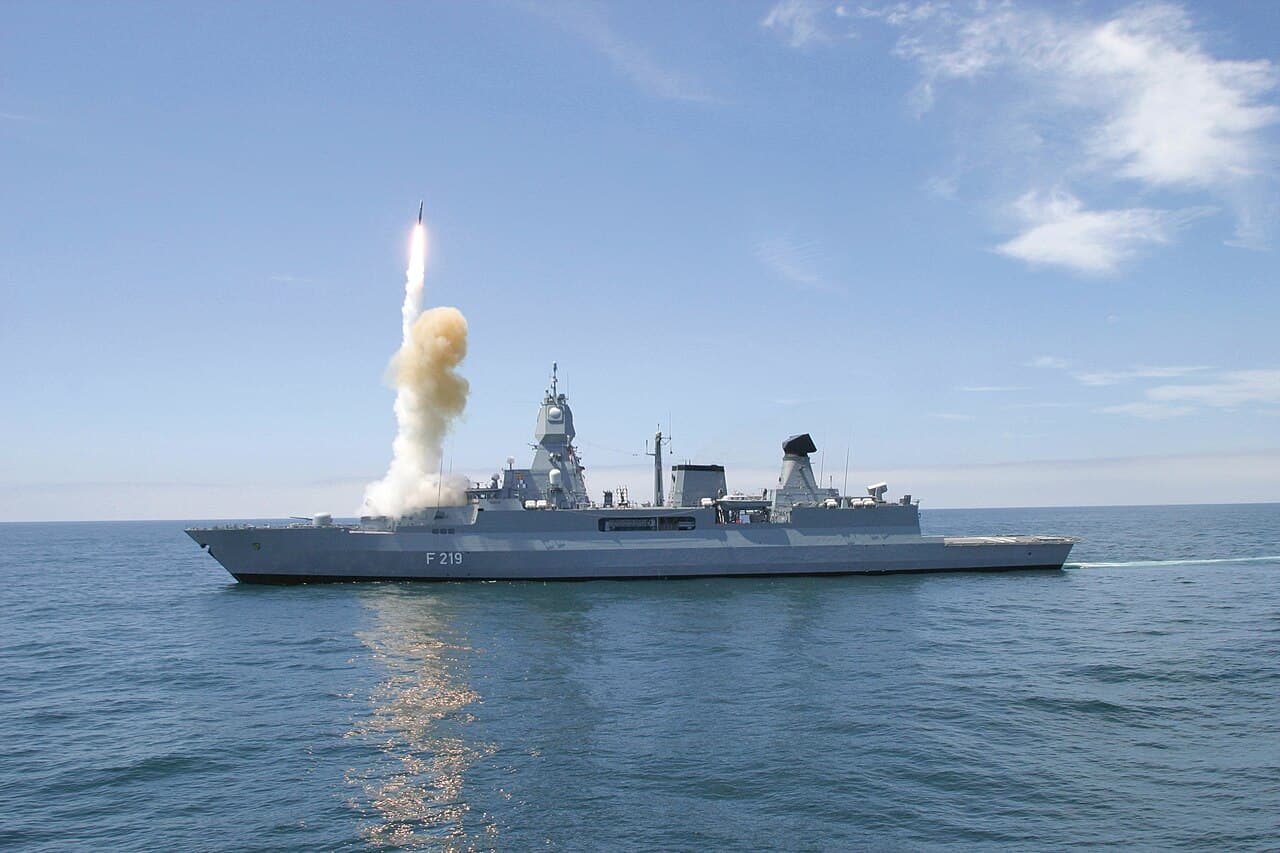
- 2-3 September - Two German frigates fired an Israeli-built ballistic missile in the North Atlantic, Germany's first live test of a weapon class it has never fielded.
- 4 September - Two incendiary devices were thrown at a building complex in Munich that houses defense-industry companies, including Rohde & Schwarz.
Each event was covered by a different outlet: NBC News, United24Media, France24, the Insurance Journal, The Jerusalem Post, Yahoo News / AP, and LRT (via AFP).
Each event has its own investigation, its own agency, and its own evidentiary standard. AirVeto's own reconstruction of the Leipzig/Halle drone already tracks the diplomatic consequence. What connects the four is timing and direction, not a confirmed operational link.
Germany fired a missile class it has never owned, and called the reason Russia
Two German frigates sailed to waters between Ireland and Iceland to fire the LORA, a short-range ballistic missile built by Israel Aerospace Industries with a range beyond 500 km. According to the Jerusalem Post and a Yahoo/AP report, the missile launched, navigated to its target, and hit with what German officials called "utmost precision." Vice-Admiral Jan Christian Kaack, the German Navy's chief, said the test made naval history.
Germany currently fields no ballistic missiles of its own. Officials tied the LORA trial to increased threats from Russia and said Germany now plans to move toward procuring the system. Shipping and air traffic in the test zone had received a 45-day advance warning, but the test itself was kept largely secret until it was announced.
The power grid was hit twice in 24 hours, and investigators have not named a culprit
The first attempt, on 1 September, targeted a substation at Preilack in Brandenburg, roughly 100 km southeast of Berlin and about 5 km from the Jänschwalde lignite plant. Multiple homemade explosive and incendiary devices, resembling model rockets, were found and partly detonated; bomb disposal responded and grid operator 50Hertz said general power supply was not affected. Brandenburg's state premier, Dietmar Woidke, described it as a dry run and pointed to what he called a worryingly high frequency of similar incidents. AirVeto's full reconstruction of the Preilack sabotage attempt covers the device details, the Block B shutdown, and the investigation.
The second, on the evening of 2 September, damaged five generating units, Neurath F and G, Niederaußem G, H, and K, at RWE's lignite plants in the Rhineland, on the opposite side of the country from the first incident. Most of the units were actively feeding the grid at the time. North Rhine-Westphalia's interior minister, Herbert Reul, said authorities are examining whether the two incidents are connected. Investigators are weighing foreign state-directed sabotage against domestic far-left extremism as motives. Neither Germany's federal government nor either state government has publicly named Russia in connection with the grid incidents, a contrast with the Leipzig/Halle case, where the attribution was explicit.
Two Bulgarian nationals are in custody after a defense-industry building was firebombed in Munich
In the early hours of 4 September, someone threw two incendiary devices from a vehicle at a building complex in Munich that houses defense-industry companies, including Rohde & Schwarz. One device was found actively burning and extinguished; the second was neutralized before it ignited. Rohde & Schwarz said its own facilities were undamaged. Munich police detained two Bulgarian nationals, a 38-year-old man and a 28-year-old woman, at a nearby gas station shortly afterward.
Police told reporters the complex houses weapons companies and said that made the firebombing look politically motivated, but stopped short of naming a state actor. No group has claimed responsibility. The use of third-country nationals as the people caught on the ground echoes a pattern AirVeto has already reconstructed elsewhere this week: the wreaths left outside a Vilnius drone maker's office were delivered by a Ukrainian national police say was paid online by a Belarusian citizen, not by anyone with a direct stake in the outcome.
What the pattern shows, and what it does not yet show
Four German institutions, the Foreign Office, the power grid operators and their state governments, Munich police, and the Navy, moved against the same backdrop within days of each other. Only one of the four, the consulate closure, carries an official Russia attribution. The grid sabotage and the Munich firebombing are both still under investigation with an explicitly open motive; police in Munich went as far as "politically motivated" and no further. The missile test was framed by the Navy as a general capability response to a threat environment, not a reply to any single event.
Reading all four as one coordinated campaign would overstate what German authorities have said on the record. Reading them as four unrelated headlines would understate how unusual it is for a NATO member's diplomatic, infrastructure-security, defense-industrial, and military-procurement arms to all escalate against the same country in the same week. The honest read sits between those two: a state visibly moving on every front it has, whether or not the individual triggers are connected.
Track what comes next
AirVeto's incident archive covers the airspace events behind Germany's diplomatic move, including the wind conditions during the Leipzig/Halle drone's window on the ground. Investigations into the Brandenburg and Rhineland sabotage attempts and the Munich firebombing are all open; if any is formally attributed, this brief will be updated.
See the current airspace picture on the live map, and the full incident archive covering EU eastern-border airspace events.
Sources
- NBC News - Germany blames Russia for airport drone plot, shuts down consulate (1 Sep 2026)
- United24Media - Homemade rockets reportedly hit one of Germany's largest power plants in sabotage attempt (1 Sep 2026)
- France24 - Explosives used in sabotage attack on German power lines (1 Sep 2026)
- Insurance Journal - German Power Grid Hit Twice in Latest Suspected Sabotage (2 Sep 2026)
- The Jerusalem Post - German Navy completes firing trial of Israel Aerospace Industries Naval LORA ballistic missile (2 Sep 2026)
- Yahoo News / AP - German Navy successfully tests Israeli LORA missile system (2 Sep 2026)
- LRT (via AFP) - Two incendiary devices thrown at a weapons-company building in Germany (4 Sep 2026)
Last updated: