
Kenas drone found by dog handler, 340 packs, July 18, 2026
VSAT officers at the Kenas outpost heard a drone cross from Belarus on July 17, 2026 but lost it in darkness. A dog handler found it next morning in forest near Šumskų village.
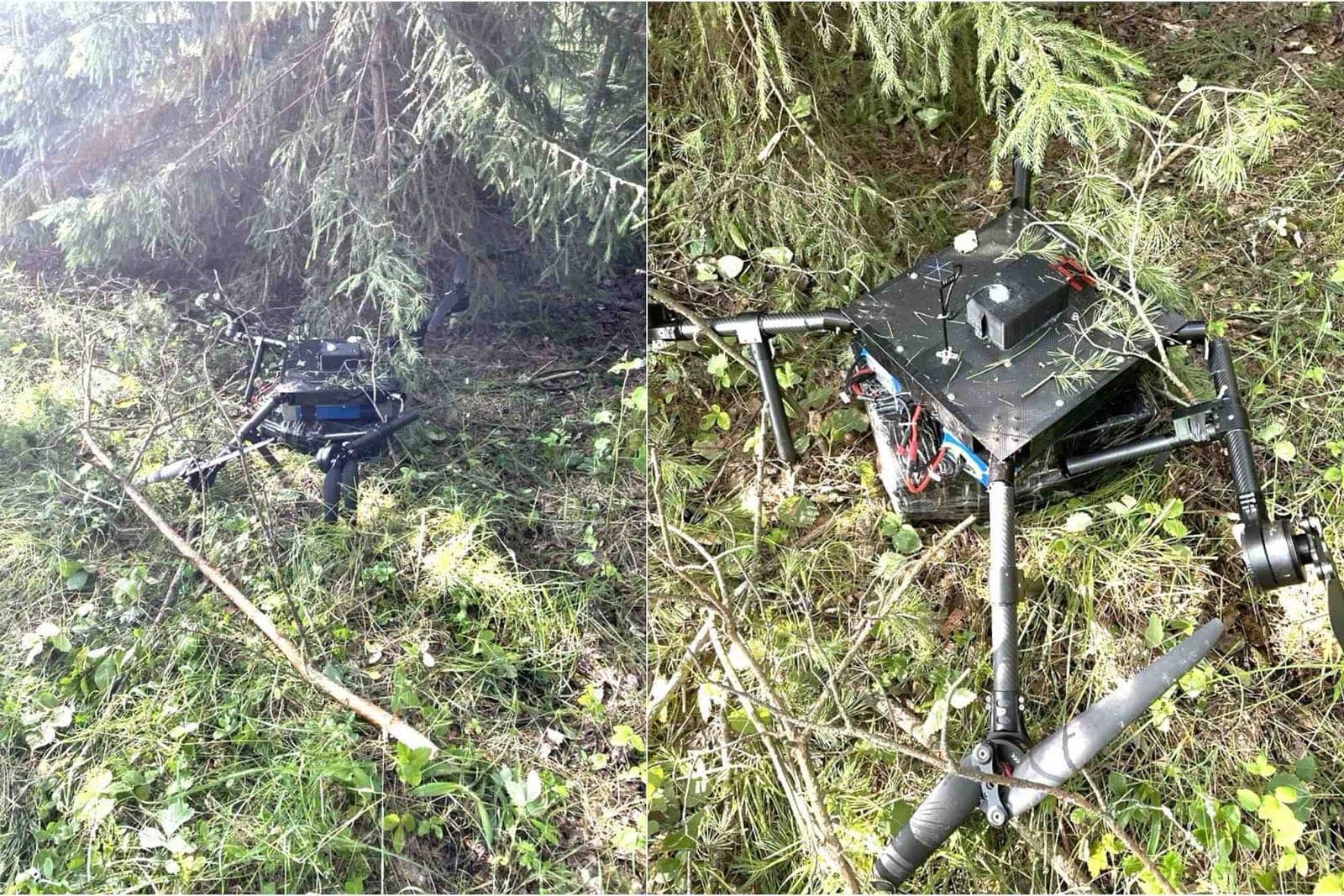
On the night of July 17, 2026, VSAT Vilniaus rinktinė officers at the Kenas border outpost, patrolling the border strip near Šiulgių village in Vilnius district, heard sounds consistent with a drone in flight from Belarus. They immediately deployed anti-drone equipment, with no visual on the aircraft. Seconds later, they heard branches cracking and a loud ground impact in the darkness. A search began, with a dog handler and service dog deployed, but the downed aircraft could not be located before daybreak.
The morning shift took over and continued the search with a dog handler, a fresh service dog, and service drones deployed from the outpost. The dog handler found the aircraft in forest near Šumskų village in Vilnius district. Attached to the drone (damaged from the fall) was a cardboard box wrapped in black polyethylene film. Inside: 340 packs of Minsk Capital QS cigarettes with Belarusian excise stamps, valued at €1,856 under Lithuanian tax liability. Administrative proceedings were opened at the Kenas outpost for violations of excise goods transport regulations.
The drone came down in darkness; a dog handler found it the next morning
The sequence at Kenas (heard but not seen, downed by anti-drone equipment, found after a multi-hour night-to-morning search) reflects the operational challenge on this section of the border. The Kenas outpost covers forested terrain in eastern Vilnius district where the Lithuania-Belarus border runs without significant open ground. Anti-drone equipment disrupted the drone's control link based on the acoustic signature alone. The drone crashed into the tree canopy and forest floor.
The dog handler found the cargo intact in the morning sweep. The box was wrapped to protect the payload from ground impact and to limit visibility: black polythene wrapping is consistent with other drone cargo found on the southern Lithuanian border throughout 2026.
Administrative proceedings, rather than the criminal investigation opened in most southern district cases, are consistent with the smaller cargo value: at €1,856, the Kenas haul falls below the threshold that typically triggers a criminal case under the Lithuanian penal fiscal code.
The 34th drone interception of 2026, on a pace well above the 2025 full-year rate
By the date of the Kenas interception, VSAT had landed 34 smuggler drones from Belarus in just over six months of 2026. The full-year 2025 total was 59 drones; 2024 was 54. At 34 by mid-July, the 2026 pace already exceeded those annual totals' first-half equivalent, consistent with the Druskininkai four-drone night on 7 July, the Padvarioniai double landing and concurrent Prūdelis interception on 9 July, and the Daugidoniai crash on 12 July that had pushed the running count to 33 just before the Kenas event.
The Kenas interception is also noteworthy as Minsk Capital QS, a brand documented repeatedly in 2026 southern Lithuanian intercepts including the 7 May Šalčininkų district drone, was arriving in Vilnius district via the Kenas route rather than the more frequently documented Šalčininkų route.
The Kenas drone was one of four VSAT operations that week on the Lithuanian border
The Kenas intercept opened what VSAT described as a series of operations across the end of the week. On Saturday night, Special Purpose Directorate "Kovas" officers set an ambush near Žvyriai village in Švenčionių district, a few kilometers from the Belarusian border, seizing 29 bundles of cigarettes, a cargo van, and two electric scooters; both suspects were remanded for one month. On Sunday morning, officers stopped a rented Volkswagen Crafter near Švendubė village in Druskininkai municipality and found four bundles totalling nearly 6,000 packs of Neman-brand cigarettes from the Grodno Tobacco Factory, valued at €32,700; balloon remnants and a grey plastic tube were attached to one bundle, consistent with delivery from Belarus by weather balloon. On Monday, Coastal Protection Battalion officers discovered 176,000 packs across two vehicles at a homestead in Kalniškiai village, Kelmė district: Marlboro Gold, NZ Gold, Davidoff Gold, Parliament, and Winston Blue, all without Lithuanian excise stamps, valued at just under €1 million.
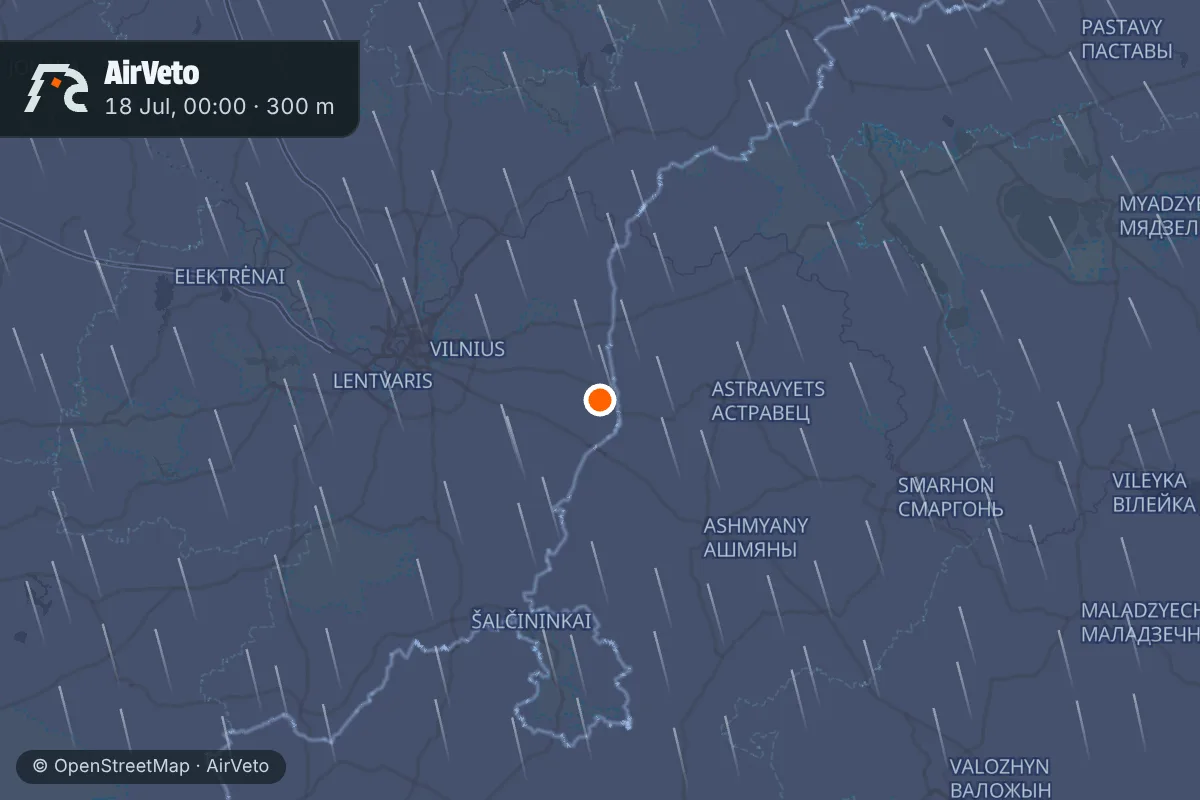
At 21:00 UTC on 17 July - in the hours preceding the intercept - the 500 m layer over the Vilnius district border zone showed SSE wind at 43.1 km/h, pushing flow moderately toward the north-northwest, the atmospheric background for the operation. AirVeto's wind layer covers the Vilnius district border area for the event window; how the model is built and where it is reliable is on the methodology page.
This reconstruction is based on the VSAT press release of July 20, 2026 and on AirVeto's wind-model data for the July 17–18, 2026 event window.
Lithuanian drone and contraband airspace incidents are collected at Dronai Lietuvoje (in Lithuanian). The full incident archive is at incident archive. AirVeto's wind-layer methodology is described at methodology.
Sources
- VSAT - Pasieniečių perimtą skraidyklę su kroviniu miške aptiko kinologas su tarnybiniu šunimi (20 Jul 2026)
- Vilnijos naujienos - Kenos pasieniečiai Vilniaus rajone nutupdė į Lietuvą įskridusį droną su kroviniu (2026)
- Respublika - Pasieniečių operacijų serija: pasala miške, nutupdytas dronas ir rūkalai už milijoną (25 Jul 2026)
- Methodology
Last updated: