

ANSA reported, citing informed sources it did not name, that two Russian military jets violated Lithuanian airspace late in the afternoon of September 17, 2026. Italy's Baltic Thunder III Air Task Force scrambled two Eurofighter F-2000 fighters from Šiauliai Air Base in response, coordinated through NATO's Combined Air Operations Centre in Uedem, Germany. ANSA's report ends there: it does not state what happened to the Russian jets after the scramble, whether they were escorted out, intercepted, or simply departed on their own.
This account rests on a single outlet and is not yet confirmed. Every other outlet carrying the story reproduces ANSA's own wire copy rather than reporting independently - Il Sole 24 Ore's own text states plainly that its information came "from Ansa from informed sources." Other outlets running the identical copy include LaPresse, Il Mattino, Leggo, and LiberoReporter. Lithuania's Armed Forces, Foreign Ministry, NATO, and Russia's Defence Ministry have not issued a statement on it as of this writing, and the exact crossing point and the Russian aircraft type are not disclosed anywhere in that wire copy. The marker on this page sits at Kybartai, a town on Lithuania's Kaliningrad-facing border, as a placeholder location only - it is not a claimed crossing point for this event, and AirVeto will update it the moment a Lithuanian or NATO source discloses the real location.
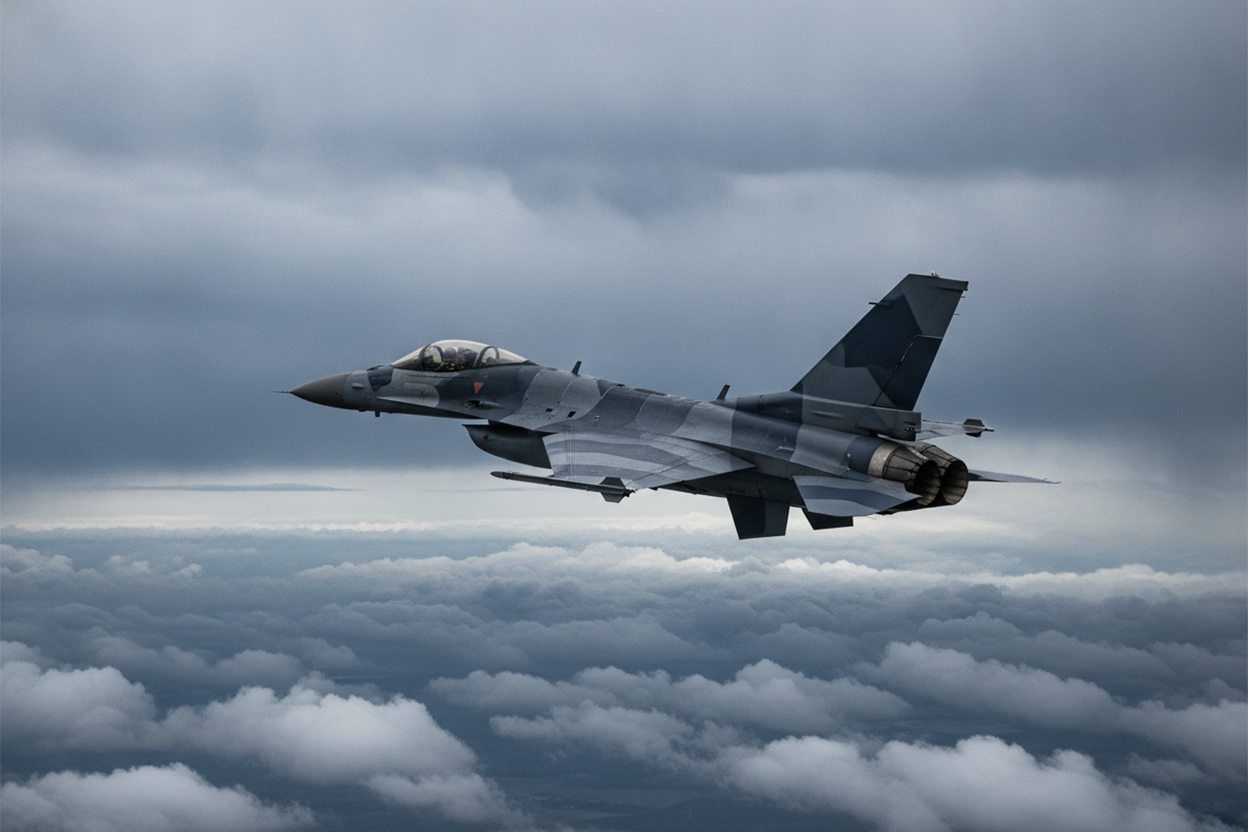 Associative image. NATO fighter jet.
Italy is now the Šiauliai rotation
Baltic Air Policing rotates NATO member air forces through Šiauliai, Lithuania and Ämari, Estonia on roughly four-month cycles. France flew the Šiauliai detachment through the spring and early summer of 2026 with four Rafale fighters, then handed off to Romania. Italy's current deployment, Baltic Thunder III, has since taken over the Lithuanian base with Eurofighter F-2000s. September 17 is the rotation's first publicly reported scramble against a Russian airspace incursion.
The second Baltic incident of the week
The alleged September 17 crossing came two days after NATO fighters destroyed a drone that entered Lithuanian airspace from Belarus near Pratkūnai, Kaišiadorys District - a confirmed event, officially announced, unlike the September 17 report. That drone carried an explosive charge, according to Lithuania's Defence Minister, and was the first drone shot down over Lithuanian territory. The two events are different in kind: one was an uncrewed object NATO destroyed, the other a crewed aircraft NATO scrambled fighters to meet, with the outcome undisclosed. If the September 17 account holds up, both point to the same pattern this kit has tracked through 2026: a rise in Russian military and Russian-linked activity testing Baltic airspace, met by a Baltic Air Policing mission that has grown more willing to act since its rules changed in July.
Lithuania's Kaliningrad-facing border has produced airspace violations before. A Russian Su-30 and an Il-78 tanker crossed roughly 700 metres into Lithuanian territory from the Kaliningrad exclave for about 18 seconds in October 2025, according to the Kyiv Independent, which did not name a specific crossing point. Lithuania summoned Russia's chargé d'affaires over that incident, and President Gitanas Nausėda called it a blatant breach of international law. Whether September 17 fits the same pattern is not yet confirmed.
Wind over the Kaliningrad border
At 13:00 UTC on September 17, within the approximate event window, the 3,000 m layer over Kybartai showed wind pushing east at 40.2 km/h. At 2,000 m the flow held the same eastward direction at 42 km/h. This reading describes conditions at Kybartai, the placeholder point on this page, not necessarily the real crossing point - AirVeto will re-fetch this section once the actual location is confirmed. This reconstruction is based on ANSA's report and AirVeto's wind-model data for the approximate event window on September 17, 2026. AirVeto's model and its documented limits are on the methodology page.
The live map shows current conditions over the Baltic region.