

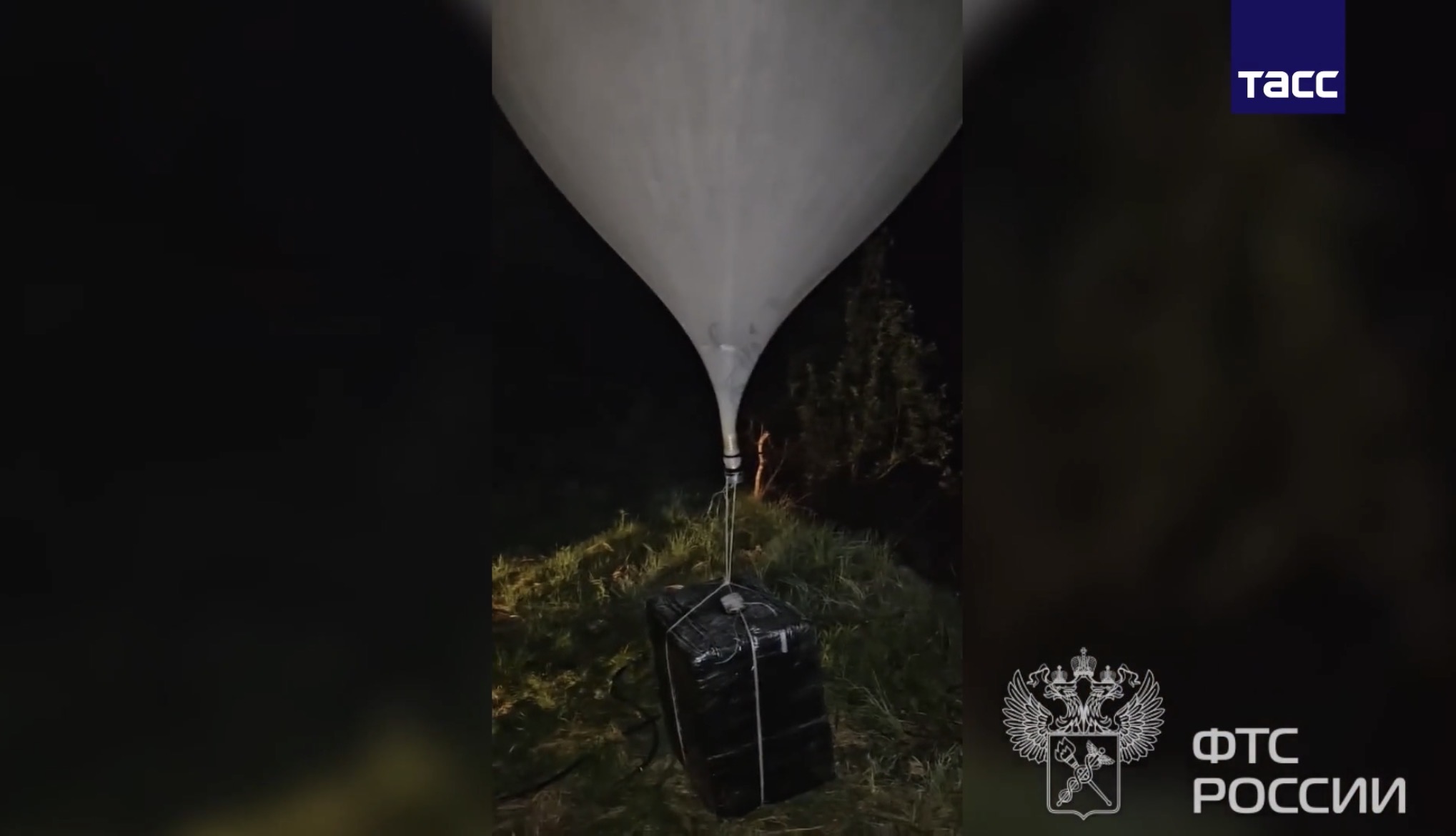
According to Caliber.az citing Russia's Federal Customs Service (FCS), customs officers intercepted two Russian nationals in a forest in Kaliningrad oblast before dawn on July 27, 2026, seizing inflated weather balloons and 3,500 packs of contraband cigarettes packed into GPS-tracked boxes for a planned wind-drift transfer to Lithuania. The suspects told investigators they intended to continue the method with further shipments if the first consignment succeeded. AirVeto's ICON wind reconstruction for the overnight window of July 26-27, 2026 documents the atmospheric conditions the pair had calculated before the interception.
The suspects timed the launch around wind direction and atmospheric pressure
The two Russian nationals drove to a forested area near the Lithuanian border under cover of darkness, bringing weather balloons and gas cylinders for inflation. Before setting out they had checked the weather forecast, wind direction and atmospheric pressure to identify an overnight window when the upper-level flow would carry cargo northward across the border into Lithuania. The cigarettes were Belarusian-made and bore no EU excise stamps; the pair had packed them into cardboard boxes and fitted each box with a GPS tracker to locate the cargo after landing on the Lithuanian side.
Customs officers found the balloons inflated and the cargo ready to attach
Federal Customs Service officers arrived before the launch. They seized the balloons, the gas cylinders and the Volkswagen Transporter van the suspects had used to bring the equipment to the forest. Of the 6,500 packs documented in the case, 3,500 were in the prepared launch boxes. The seized tobacco was valued at nearly one million rubles.
Russian authorities opened a criminal case on charges of attempting to illegally transport strategically important goods across a customs border by a group acting in prior conspiracy. The maximum penalty is ten years' imprisonment and a fine of up to one million rubles.
A second cigarette cache was found at a suspect's home
The FCS reported that an additional 3,000 packs of cigarettes were found at the home of one of the suspects, in a shed. That discovery raised the total seized to 6,500 packs and indicates the operation was in early stages: the suspects had material in reserve for planned subsequent launches.
The ICON wind field shows flow pushing north-northeast into Lithuania
AirVeto's ICON reconstruction for the overnight window of July 26-27, 2026 shows flow pushing north-northeast across the Kaliningrad-Lithuania border. At 3,000 m the wind came from SSW at 62 km/h; at 2,000 m it came from SW at 50 km/h. Both levels produced a consistent drift toward Lithuania's western region, across the short land boundary between the Russian exclave and the EU.
At 62 km/h a balloon crossing the short Kaliningrad-Lithuania land border would clear it within minutes of release. FCS officers found the balloons already inflated and the cargo boxes ready to attach. The launch was stopped only by the pre-dawn arrival of customs units.
The Kaliningrad route is rare, and the arrest happened on Russian soil
The Belarusian route has been the dominant smuggling path since 2025. Lithuanian customs, the State Border Guard Service (VSAT), and the Military Police have logged well over a hundred balloon interceptions along the forested southern approach into central and eastern Lithuania. Kaliningrad is a different geometry: the exclave borders Lithuania to the north and Poland to the south, and the northward crossing into Lithuania's western region is shorter and more direct than the Belarusian route.
The arrest is also unusual in a second respect. Most interceptions in this campaign happen on the Lithuanian side, after a balloon has crossed the frontier and landed. Lithuanian officials recover the payload, and the launch team is never identified.
In the Kaliningrad case, FCS officers reached the site before the launch. The suspects were caught on Russian territory, with the balloons still in their hands. The case opened as a Russian criminal matter rather than a Lithuanian customs file.
The same date brought a separate interception on the Nemunas water approach: see the Neris cigarette raft investigation for the parallel operation. The Belarusian balloon campaign that Lithuanian authorities have been tracking is documented at Kontrabandos balionai. The wind-reconstruction methodology AirVeto uses for balloon incidents is at the methodology page.
This reconstruction draws on reporting by Caliber.az and Kagan Dunlap, and on AirVeto's ICON wind-model data for the overnight window of July 26-27, 2026.