
Burning Russian ship drifts into Finnish waters, 21 Nov 2026
Drones hit the Russian cargo ship Sparta II in the Gulf of Finland on November 21, 2026; it drifted into Finnish waters off Loviisa, and a Russian helicopter is suspected of entering Finnish airspace.
AirVeto finding: The suspected Russian helicopter went up to 4.1 km into Finnish airspace, about half the 8.7 km a Russian Il-20 reached on 20 August.
Evidence behind the finding2 confirmed3 modelled1 unknown
- confirmedEstonia's border board says the ship drifted north out of Estonia's economic zone at about 10:00, and Finland's Border Guard says it drifted into Finnish territorial waters.ERR News
- confirmedYle reports the burning ship anchored off Loviisa.Yle
- modelledThe wind near the surface blew from the south-southeast at about 21 km/h at 10:00 local time.Open-Meteo
- modelledThe helicopter's reported depth of 4.1 km is about half the 8.7 km of the Il-20 crossing on 20 August.AirVeto methodologyTV3
- modelledLoviisa lies 51 km north of the position Estonia's border board gave for the explosions.AirVeto methodologyERR News
- unknownThe minute of the strike, and who launched the drones. Finland's Defence Forces say Ukraine is probably behind it; no source gives the launch point.
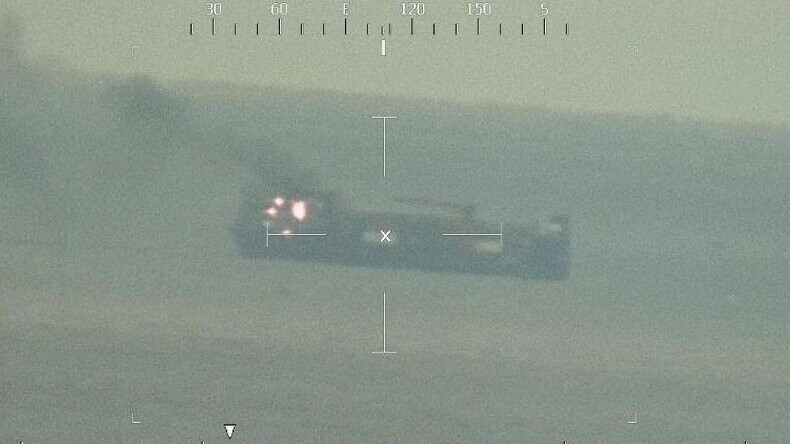
Drones hit the Russian dry cargo ship Sparta II in the Gulf of Finland on the morning of November 21, 2026, and the burning vessel drifted north into Finnish territorial waters, Finland's Border Guard said. The Defence Ministry in Helsinki later reported that a Russian helicopter was suspected of entering Finnish airspace off Loviisa at 12:34 local time.
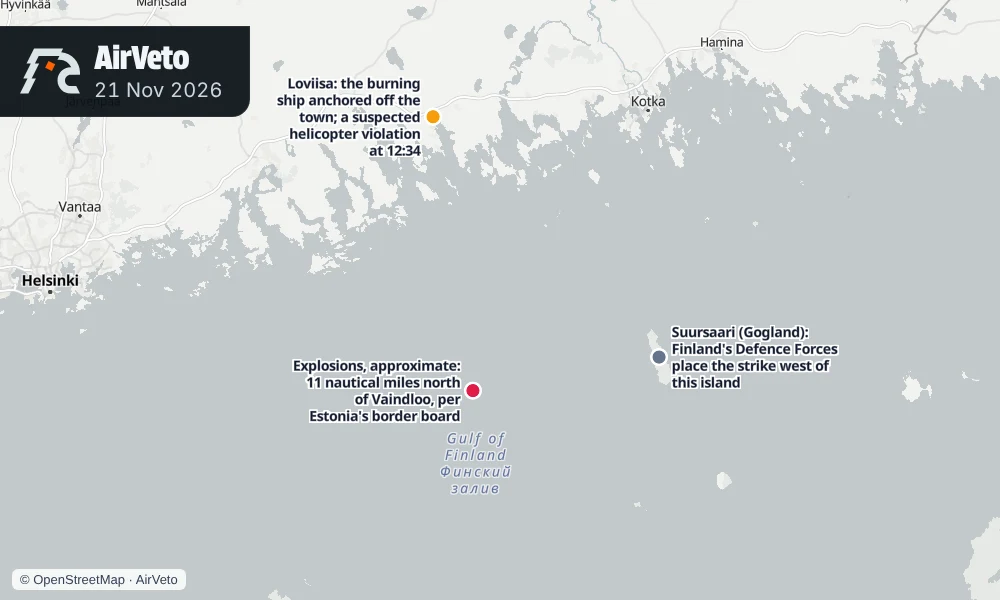
The ship caught fire on the Estonian side and drifted north into Finland
The Sparta II had left St Petersburg, according to Estonia's Police and Border Guard Board (PPA), quoted by Yle through ERR. The board's rescue centre first heard of a fire and explosions at 09:35 local time. It put the vessel 11 nautical miles north of Vaindloo, an Estonian island, in a shipping lane open to international traffic (ERR News).
By about 10:00 the ship had drifted out of Estonia's economic zone. Finland's Border Guard said it then crossed from international waters into Finnish territorial waters in the eastern gulf, and took charge of rescue and oil-spill preparation. Finland's Defence Ministry had described the strike as happening west of Suursaari, in international waters (HotNews).
Russian officials gave a third description. The governor of Russia's Leningrad region said two drones hit a Kaliningrad-bound ship in neutral waters, three nautical miles from the Russian border, ERR reported. Finnish times and Estonian times are the same here, so all clock times below are local.
| Time | Event | Source |
|---|---|---|
| Early morning | Finland's Defence Forces close the eastern gulf to air and sea traffic until 07:43; an EE-ALARM warning goes out in north-east Estonia | ERR News |
| About 09:30 | Finland reimposes the restrictions, as a precaution against Ukrainian drones straying into NATO airspace | ERR News |
| 09:35 | Estonia's rescue centre receives the first report of fire and explosions | ERR News |
| About 10:00 | The ship drifts out of Estonia's economic zone | ERR News |
| 12:34 | Suspected Russian helicopter violation off Loviisa, up to 4.1 km deep | Ukrinform, TV3 |
| Overnight | Crews fight the fire; the ship is anchored off Loviisa and its crew is taken off by a Russian rescue vessel | Yle |
No source gives the minute of the strike itself.
The wind that morning blew from the south-southeast
The position Estonia gave for the explosions and the anchorage off Loviisa are 51 km apart, by AirVeto's measurement from Vaindloo's coordinates and Loviisa town. The anchorage point is not published, so that figure is a straight-line reading to the town, not the ship's track.
At 10:00 local time on November 21, the wind near the surface came from the SSE at 21 km/h. At 500 m at 07:00 it blew from the S at 20 km/h. At 2,000 m it came from the S at 26 km/h. At 3,000 m it came from the SSE at 37 km/h. The ship drifted north, and no source says what moved it.
A Russian helicopter is suspected of entering Finnish airspace three hours later
Finland's Defence Ministry said the suspected violation happened at 12:34 off Loviisa, and that the helicopter may have flown up to 4.1 km into Finnish territory. Defence Minister Antti Hakkanen said it could be linked to rescue or monitoring operations around the damaged ship, and the Border Guard is investigating (Ukrinform, TV3).
The depth is about half of the 8.7 km a Russian Il-20 reached south of Uto on 20 August. Finland's Border Guard has also dealt with a drifting Russian object: a Geoscan 701 mapping drone washed up near Porvoo on 1 September, 34 km from Loviisa.
Finland's Defence Forces say Ukraine is probably behind the strike
Prime Minister Petteri Orpo wrote on X that the war is spilling into Finland's immediate surroundings and that Ukraine has the right to fight back against the aggressor. According to the Defence Forces, Ukraine is probably behind the strike (Yle). President Alexander Stubb called the events serious.
Ukrainian military intelligence has classed the Sparta II as a vessel that carried weapons and military equipment, and the ship is on the US sanctions list, ERR reported. The Border Guard asked a Russian rescue vessel, the Murman, to join the operation, and the plan is to tow the ship into Russia's search-and-rescue area (Yle).
On Sunday, 22 November, the ship was towed into Russian territorial waters after the fire was stabilised, Finnish officials said, according to 15min. The Gulf of Finland coast guard unit said on X that thermal cameras showed some containers still warm but the ship stable enough to tow. The ship had anchored about 90 km east of Helsinki while Finnish crews, helped by Estonian and Russian rescue vessels, fought the fire.
This reconstruction is based on reporting by ERR News, Yle, Ukrinform, HotNews, Digi24 and TV3, and on AirVeto's wind-model data for the event window. More on the gulf is in the Gulf of Finland hub and on the methodology page.
Related location
- Gulf of Finland - Baltic Sea arm separating Estonia from Finland, bounded to the east by Russia - GPS-spoofing reports and stray drones.
Sources
- 15min - Suomija: rusu krovininis laivas nutemptas i Rusijos vandenis (22 Nov 2026)
- ERR News - Russian cargo ship on fire in Gulf of Finland after reported drone strike (21 Nov 2026)
- Yle - Venalaisen Sparta II -aluksen sammutus jatkunut lapi yon (22 Nov 2026)
- Ukrinform - Finland suspects Russian helicopter of violating its airspace (21 Nov 2026)
- HotNews - O nava ruseasca a fost lovita de drone, Finlanda spune ca arde in apele sale teritoriale (21 Nov 2026)
- Digi24 - Vapor care se indrepta spre Kaliningrad, lovit de drone (21 Nov 2026)
- TV3 - Itariama, kad Rusijos sraigtasparnis pazeide Suomijos oro erdve (21 Nov 2026)
- Methodology
Last updated: