
Russian Geoscan drone washes up on Finland's coast, 1 Sep 2026
A Russian-made Geoscan 701 mapping drone washed up near Porvoo, Finland, on September 1, 2026; Russia had already warned Finland that a civilian mapping drone had gone missing.
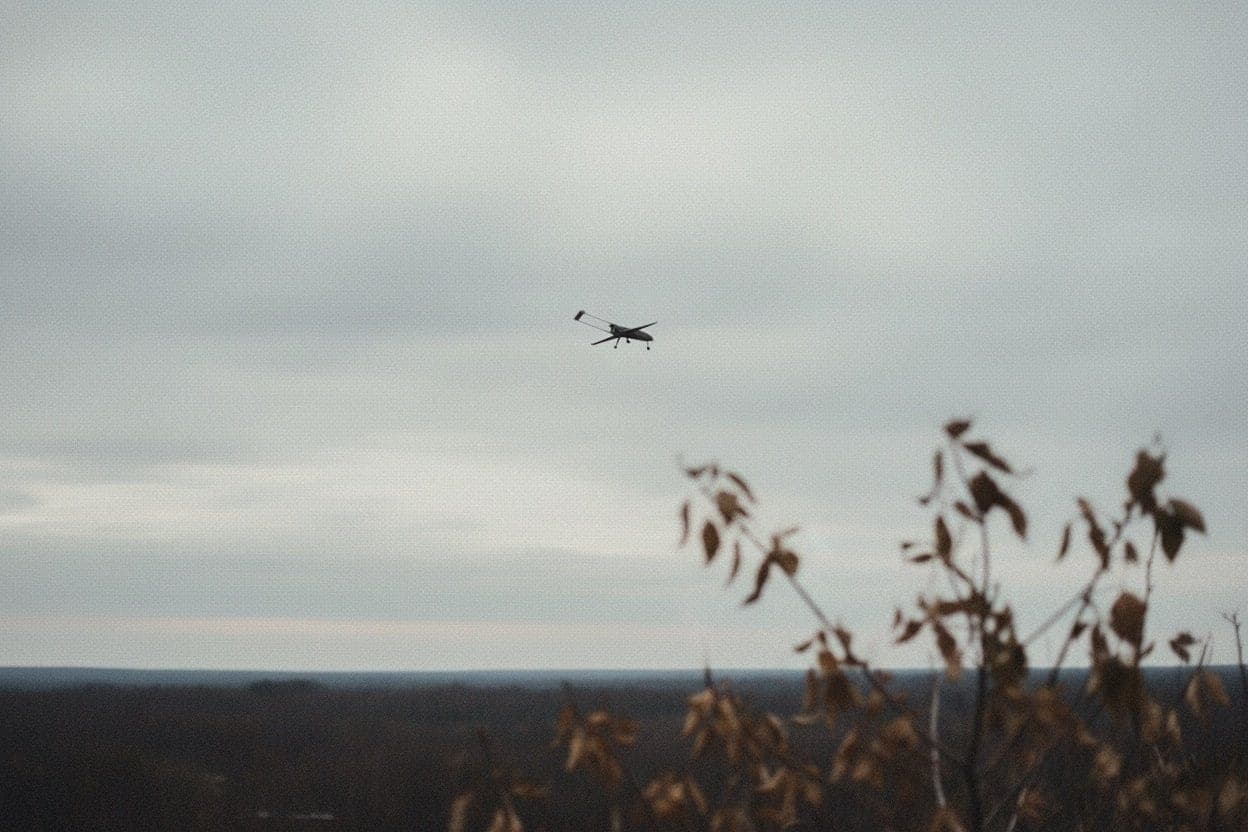
A fisherman found a drone washed up in the Pellinki archipelago near Porvoo, southern Finland, on the afternoon of September 1, 2026, according to Yle News. The Finnish Ministry of Defence said two days later, on 2 September, that the discovery was being investigated as a possible violation of Finnish territory, alongside police; the Border Guard confirmed on 4 September that the device is a Geoscan 701, a Russian-made mapping and surveying aircraft, per Yle and Militarnyi.
Russia had already told Finland a civilian mapping drone was missing
Finnish Defence Minister Antti Häkkänen said on 4 September that Finland had been informed in advance by Russian civilian air traffic control that a mapping drone operated by Russian civilian authorities had gone missing, relayed "in accordance with air traffic safety procedures," per Yle. Häkkänen said he could not specify exactly when the warning arrived, and that authorities were still confirming whether it referred to the drone found at Pellinki; investigators, he said, need to establish carefully who was operating it. President Alexander Stubb, speaking the same day, said the discovery did not represent a direct threat: "It is part of the new normal that we should simply be prepared for. We are not worried, we need to remain calm."
The drone carried no explosives and likely reached shore by sea current
The Geoscan 701 found at Pellinki carried no explosives and measured a few meters across, per Yle. Militarnyi reports the model weighs 20 to 25 kilograms, has a 3.3-meter wingspan, and can fly for up to ten hours across nearly 1,000 kilometers on a single charge. Its hull was heavily waterlogged but still afloat when found, and Finnish border guards told Militarnyi they believe it drifted to the Finnish coast on the sea current rather than under its own power at the point of discovery; the nearest Russian territory lies roughly 120 kilometers away. Investigators intend to examine the drone's onboard memory cards, which record flight coordinates and video, to establish its actual flight path if the data can be recovered.
Geoscan markets the model as civilian, but it is sanctioned and used in Ukraine
Geoscan, the St. Petersburg-based manufacturer, markets the 701 for civilian aerial survey and mapping work, but the company is under both US and EU sanctions, and the model has been repeatedly documented on the front line in Ukraine, where Russian forces use it for aerial reconnaissance and terrain mapping, per Militarnyi.
Finnish officials have not said whether the Pellinki drone was operating in a military or civilian capacity, or whether its presence in Finnish waters was intentional. Häkkänen said investigators are examining whether the drone's arrival happened unintentionally, after losing contact with its operator.
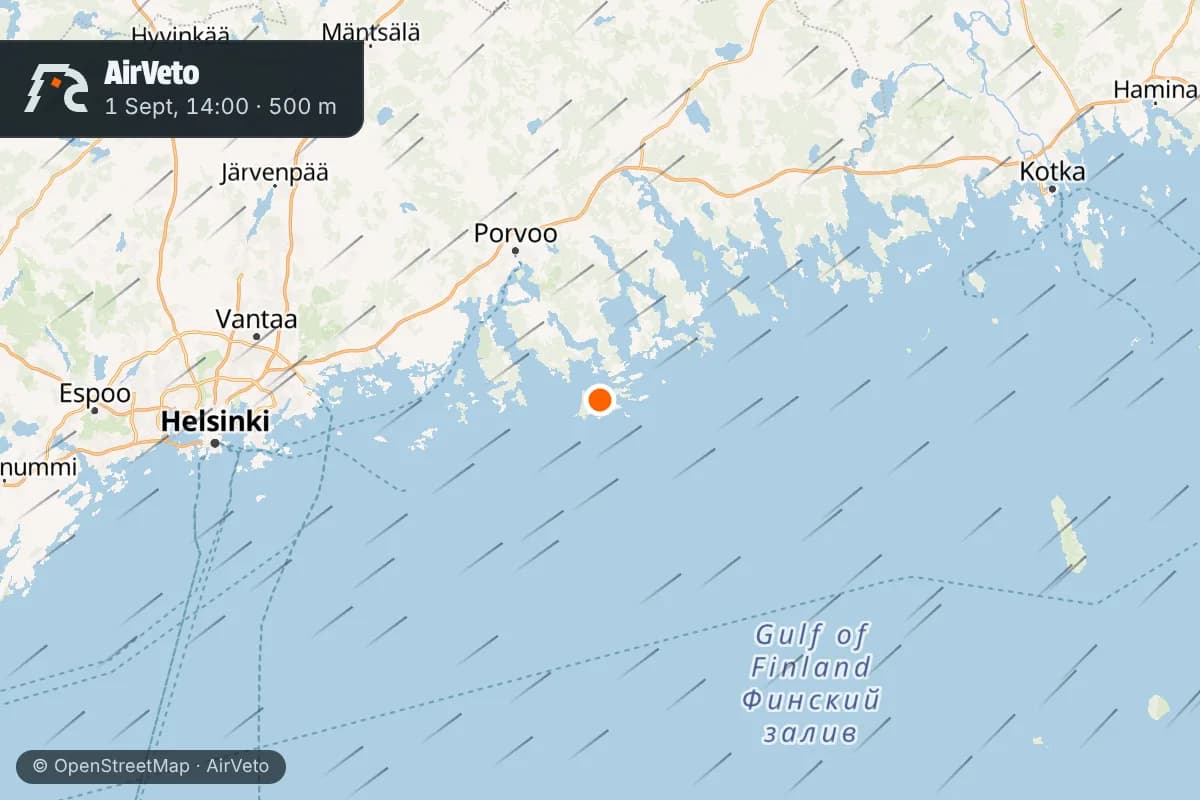
Wind conditions over the Pellinki archipelago
No source has established the drone's flight path or the location where it went missing before reaching the coast, and Finnish border guards themselves attribute its arrival to sea-current drift rather than powered flight - a mechanism this reconstruction cannot model, since AirVeto's wind layer tracks atmospheric wind, not maritime currents. At 11:00 UTC on 1 September, inside the reported discovery window, the 500 m layer over the Pellinki archipelago showed SW wind at 32.9 km/h - offered as context for conditions at the site, not as a reconstruction of how the drone got there. This reconstruction is based on reporting by Yle News, Militarnyi, and Defence Blog, and on AirVeto's wind-model data for the 11:00-15:00 UTC window on September 1, 2026. AirVeto's model and its documented limits are on the methodology page.
Related location
- Gulf of Finland - Baltic Sea arm separating Estonia from Finland, bounded to the east by Russia - GPS-spoofing reports and stray drones.
- Finland - Finland shares a 1,340-kilometer border with Russia and recorded four drone finds in spring 2026 - the densest EW-diverted drone cluster in any NATO member state that period.