
Tausiūnai drone, July 26, 2026 - 35th intercept of 2026
VSAT Purvėnai post downed a fixed-wing drone near Tausiūnai, Šalčininkai district, on July 26, 2026. Cargo: 200 packs NZ Gold cigarettes, €1,092. The 35th drone interception of 2026.
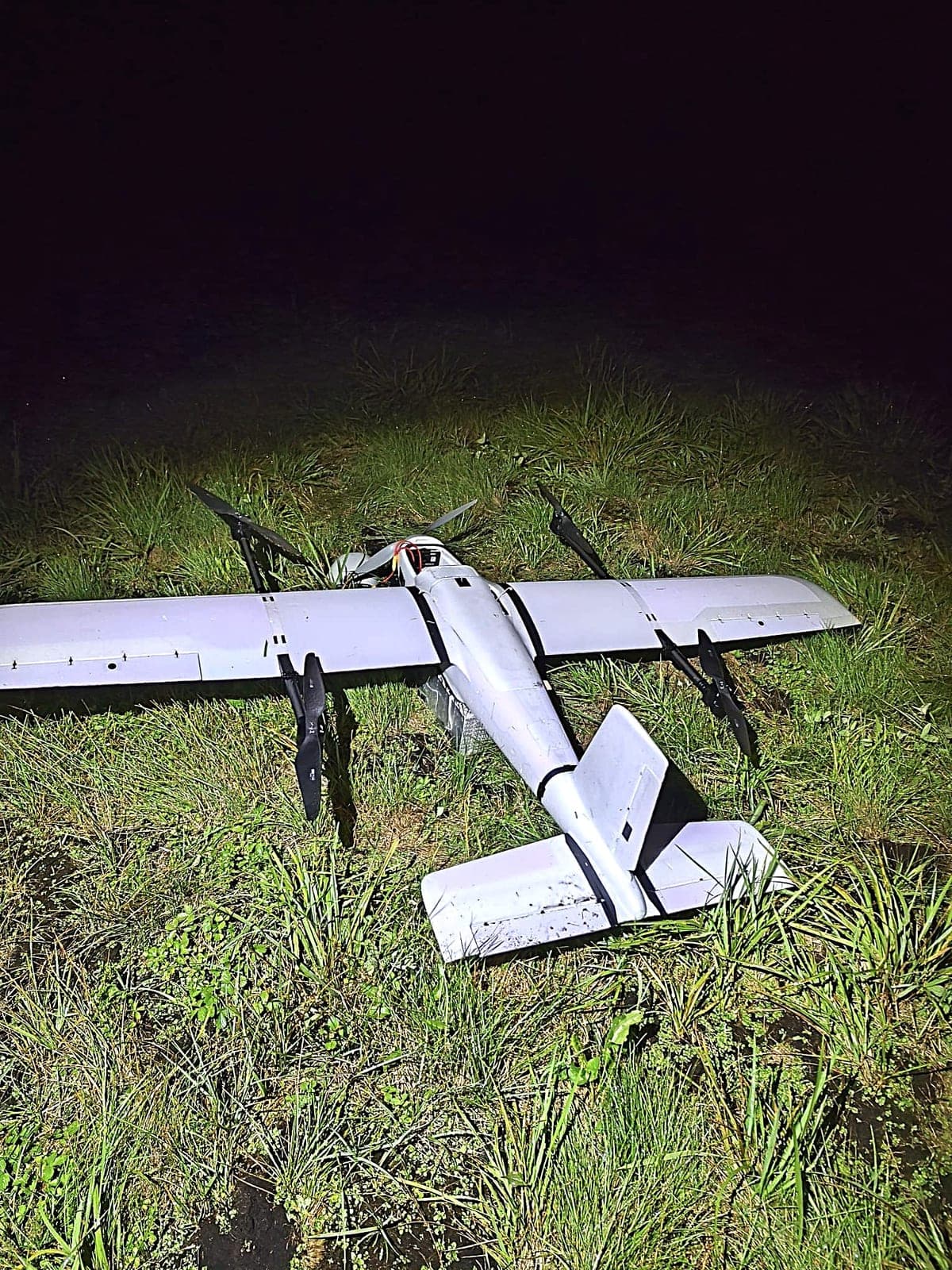
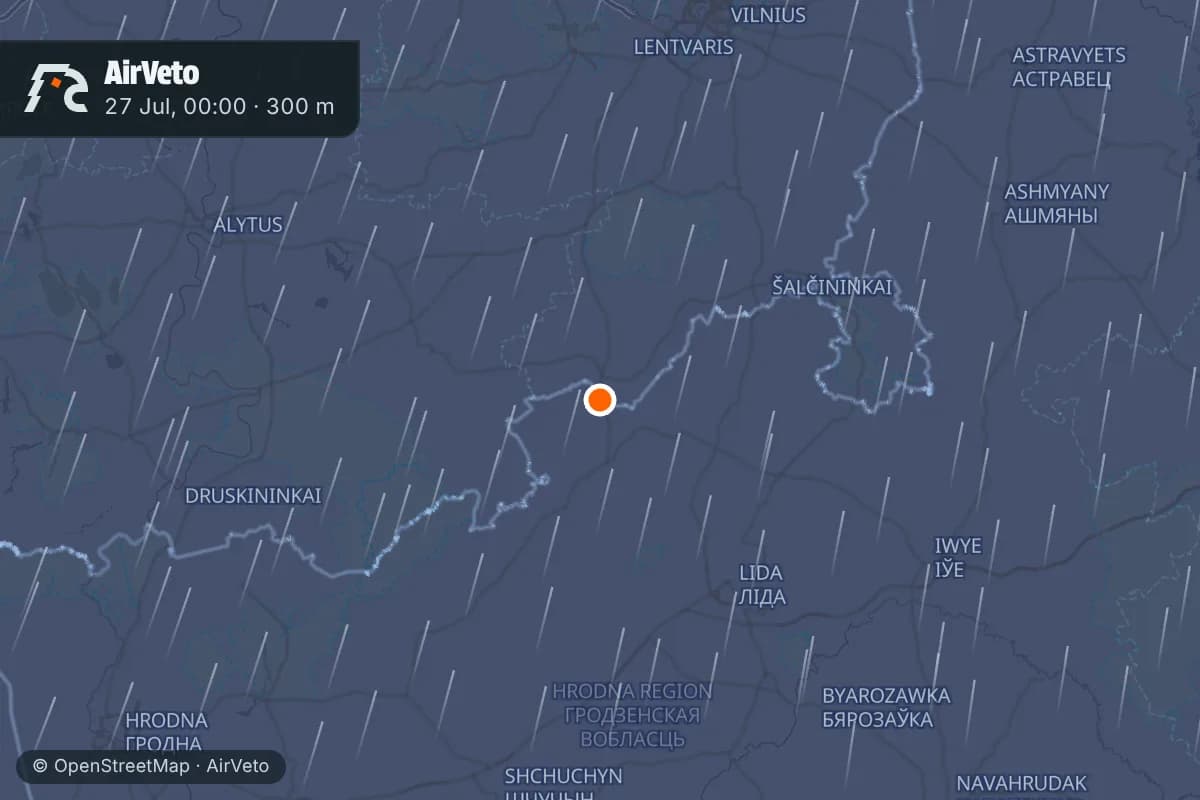
On the night of Saturday July 26, 2026, according to the VSAT press release of July 27, 2026, officers from the Purvėnai Border Post of the Lithuanian State Border Guard Service (VSAT) Varėna Border District were patrolling near Tausiūnai village in Šalčininkų district when they heard sounds consistent with a drone crossing from the Belarusian border into Lithuanian territory. Anti-drone equipment was deployed and the acoustic signal stopped. A search located a fixed-wing aircraft in open grass 500 meters from the state border, its four propellers still turning. Attached to the airframe: 200 packs of NZ Gold cigarettes with Belarusian excise stamps, valued at €1,092 under Lithuanian tax liability. The interception is the 35th drone brought down by VSAT on the Lithuania-Belarus border in less than seven months of 2026. AirVeto's wind-layer data shows the atmospheric conditions over the southern Lithuanian border during the event window.
Anti-drone equipment brought the aircraft down 500 meters from the border with cargo still attached
Officers from the Purvėnai Border Post, part of VSAT's Varėna Border District, were on patrol in the Tausiūnai area when they detected the acoustic signature of a drone in flight from the direction of the state border. Additional border guard units were called to block the zone without delay.
After the anti-drone equipment engaged, the sound stopped. A search of the area located the aircraft in open grass. The drone's four propellers were still rotating when found, indicating a recent and controlled ground contact rather than a high-speed crash.
The airframe measured 175 centimeters from nose to tail, with a wingspan of 230 centimeters. Its configuration is consistent with the fixed-wing designs documented throughout 2026 on the southern Lithuanian border: a fuselage-length cargo pod, four propellers on outrigger arms, and a T-tail or H-tail stabiliser.
The four outrigger propellers make this a VTOL fixed-wing hybrid rather than a conventional fixed-wing aircraft. The rotors handle vertical takeoff and landing, eliminating any need for a runway or open ground; once airborne, the fixed wing generates lift and the motors throttle down to cruise power. A pure quadcopter must hold altitude by rotor thrust for the full flight - a continuous energy draw that caps practical range under load to a few kilometers. The fixed wing removes that cost during cruise. The design class is sold commercially for agricultural survey and mapping work precisely because endurance over distance is the primary requirement. On the southern Lithuanian border, the operational implication is a launch point well inside Belarus, a border crossing at altitude, and a glide-assisted approach to the recovery zone - a more capable profile than the low-altitude, short-range quadcopter runs that characterised the earlier phase of this smuggling route.
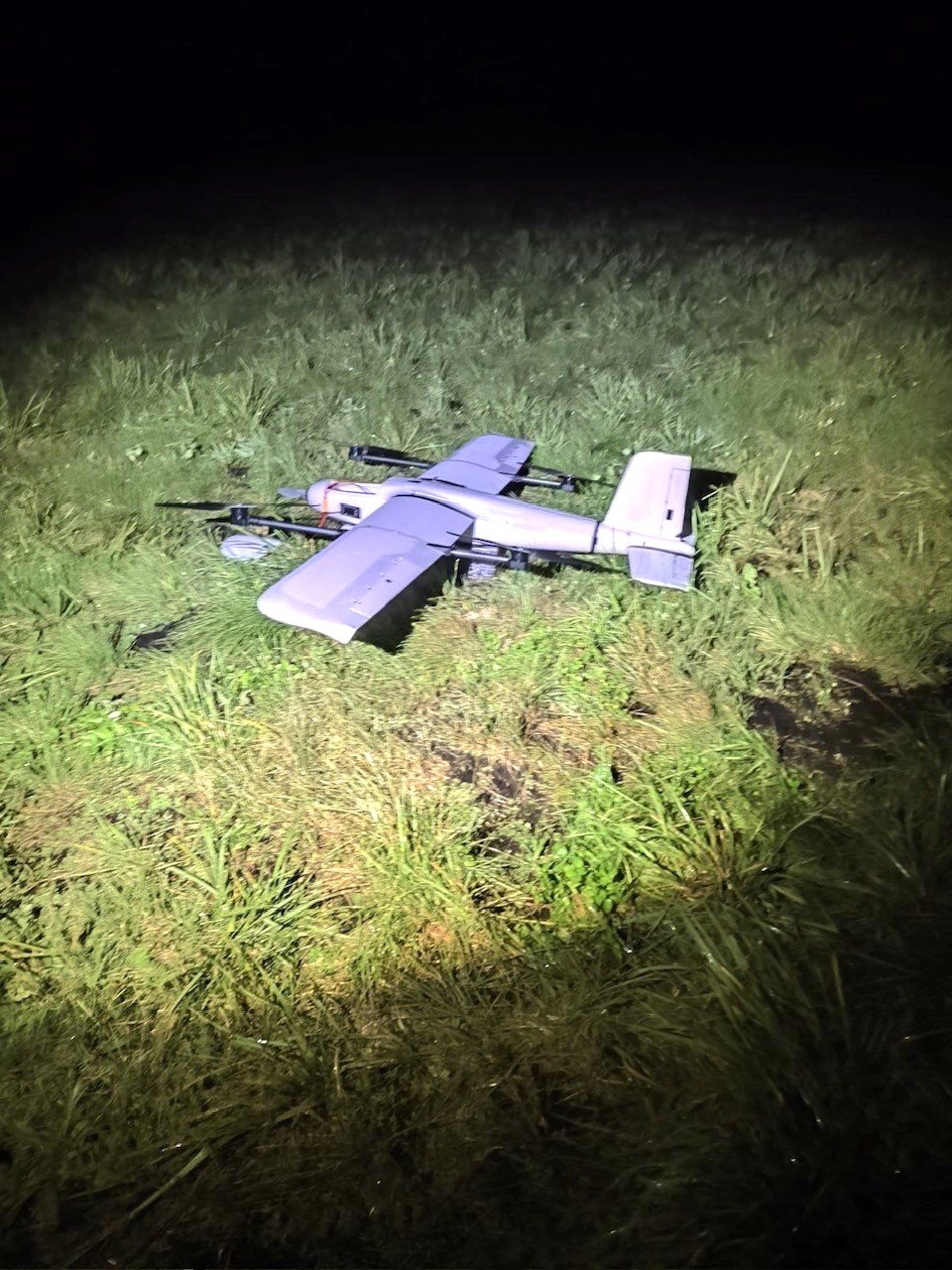
Two hundred packs of NZ Gold cigarettes were recovered from a polythene-wrapped bundle
A package wrapped in transparent polyethylene film was strapped to the drone's underside. Inside: 200 packs of NZ Gold cigarettes carrying Belarusian excise stamps, which are not accepted under Lithuanian customs law. At full Lithuanian excise liability the cargo is valued at €1,092.
Administrative proceedings were opened at the Purvėnai Border Post for violations of regulations governing the acquisition and transport of excise goods. Both the aircraft and the cigarettes are held at the post.
NZ Gold is one of the more frequently recovered brands on the southern Lithuanian border. The brand appeared earlier in the Druskininkai four-drone night on July 7, 2026, while Minsk Capital QS dominated the May intercepts in the same district, and the Kenas outpost drone on 18 July also carried Minsk Capital QS. The rotation in brands is consistent with multiple smuggling groups operating the same crossing area independently.
The 35th interception of 2026 continues a pace running well above the 2025 full-year rate
By the Tausiūnai interception, VSAT had brought down 35 contraband drones from Belarus in under seven months of 2026. The full-year 2025 total was 59 drone interceptions; 2024 was 54. At 35 in under seven months, 2026 is running at about five per month (35 drones in the 207 days to July 26, 5.1 a month) - above the average of either prior year.
The most recent prior interception was at the Kenas outpost on July 18, 2026, the 34th drone of the year. Before that, a four-drone night at Druskininkai on 7 July pushed the count by four in a single operation, the first time in VSAT history four aircraft had been intercepted at one location simultaneously. Šalčininkų district specifically has been a consistent site: a drone came down here on 7 May, the 17th interception of the year.
At 21:00 UTC on 26 July - during the intercept window - the 500 m layer over the southern Lithuanian border showed SSW wind at 41.3 km/h. At 2,000 m the wind backed to SW at 30.8 km/h; at 3,000 m WSW at 21.8 km/h. Flow pushed moderately toward the north-northeast at low altitude, shifting toward the east-northeast with height, the atmospheric background for this intercept. AirVeto's wind layer covers the Tausiūnai border zone for the event window; how the model is built and where it is reliable is on the methodology page.
This reconstruction is based on the VSAT press release of July 27, 2026 and AirVeto's wind-model data for the July 26-27, 2026 event window.
Lithuanian drone and contraband airspace incidents are collected at Dronai Lietuvoje (in Lithuanian). The full incident archive is at incident archive. AirVeto's wind-layer methodology is described at methodology.
Sources
Last updated: