

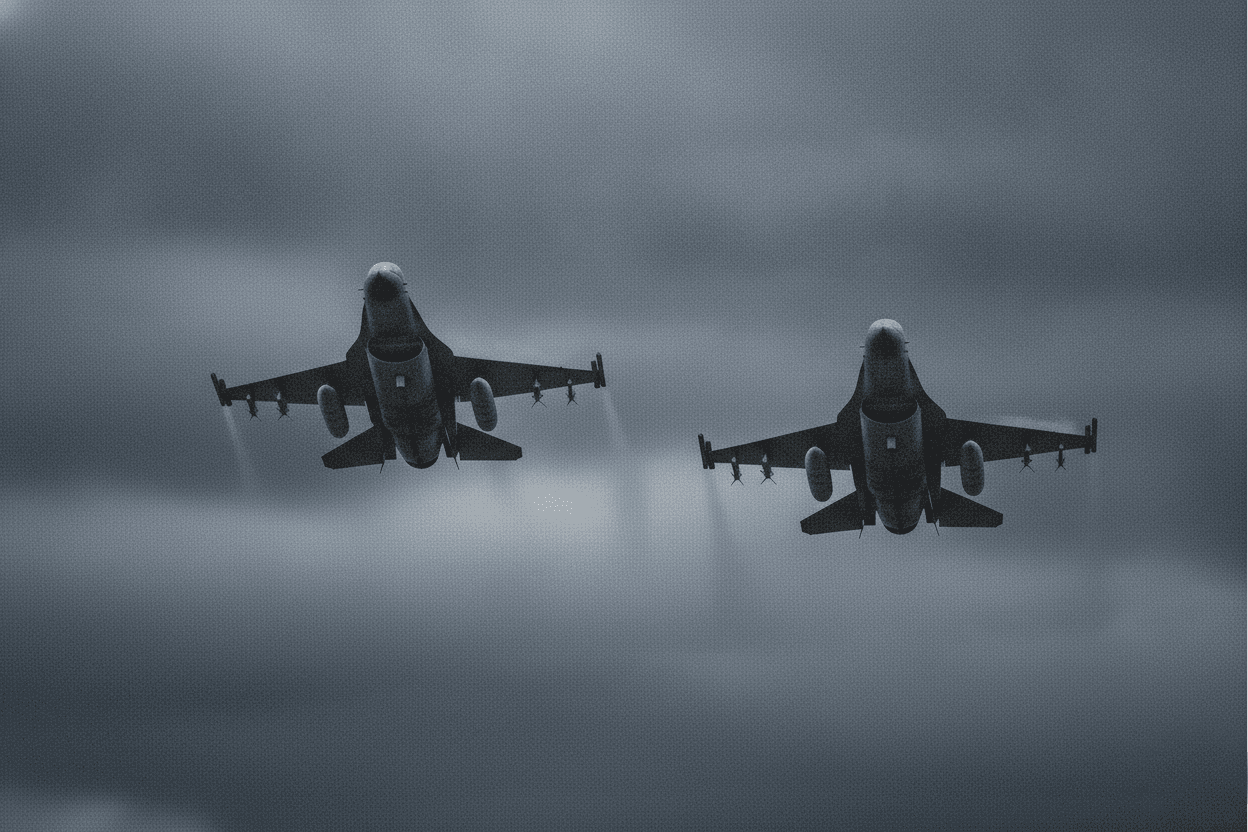
Two things happened in the Baltic states in spring 2026 that changed how NATO Baltic Air Policing actually works in practice. On 7 May, French Rafales on BAP duty were scrambled after three drones entered Latvian airspace — and didn't shoot. On 8 June, French Rafales on BAP duty were scrambled after a drone entered Latvian airspace — and did.
Between those two dates, Latvia's Defence Minister and Prime Minister both resigned. The decision chain between scramble and shoot-down isn't automatic. It involves real political accountability, and 2026 is the year that became visible.
What Baltic Air Policing is
NATO has policed Baltic airspace continuously since 2004, when Estonia, Latvia, and Lithuania joined the alliance. None of the three Baltic states operate combat aircraft of their own. Baltic Air Policing fills that gap: NATO member nations contribute fighter jets on rotating deployments to provide the air sovereignty function that Estonia, Latvia, and Lithuania can't provide themselves.
Two main bases run the mission. Šiauliai Air Base in Lithuania is the primary hub — it has hosted BAP rotations since 2004. Ämari Air Base in Estonia came online as a second BAP base in 2014, after Russia's annexation of Crimea prompted NATO to expand the mission. In a typical cycle, one nation deploys at each base on roughly four-month rotations, though the alliance has surged to additional bases and larger detachments since 2022.
The jets are always there. The question is what they're authorised to do when something crosses the border.
Who was flying in 2026
AirVeto's incident archive gives a direct read on the 2026 rotation — not from official NATO announcements, but from the shoot-downs themselves.
The 19 May Estonia shoot-down over Kablaküla, Lake Võrtsjärv, was carried out by a Romanian F-16. Romania was at Ämari — the Estonian base — on that rotation. The 8 June Nautrēni shoot-down in Latvia was carried out by French Rafale B aircraft flying from Šiauliai. France was at the Lithuanian base.
Two nations, two bases, two intercepts within three weeks of each other. That's not a coincidence of timing — it reflects a policy shift that happened between 7 May and 19 May.
The Rēzekne episode: when the jets came but didn't fire
On 7 May 2026, three drones entered Latvian airspace. French BAP jets from Šiauliai were scrambled. The drones came down on Latvian territory — one struck an oil storage facility in Rēzekne, causing a fire. None were shot down.
Latvia's NBS commander Kaspars Pudāns and then-Defence Minister Andris Sprūds explained afterward that the safety criteria for engagement had not been met. No assurance that debris would clear civilians or critical infrastructure. The jets tracked the drones; they didn't fire.
The political fallout was severe. The Rēzekne strikes triggered a crisis that forced Sprūds's resignation on 10 May and Prime Minister Evika Siliņa's resignation on 14 May. Latvia's new Defence Minister stated clearly that going forward, drones entering Latvian airspace must be shot down.
That statement is the policy change. Everything after it flows from it.
Inside the scramble-to-shoot-down decision
The shoot-down decision sits at the intersection of three things: detection, authorisation, and safety.
Detection is the starting point. National radar systems in Estonia, Latvia, and Lithuania feed data to national military headquarters. When an unidentified object is detected entering or approaching NATO airspace, the national armed forces issue an alert and scramble BAP jets. The alert levels — yellow, orange, red — are public-facing too; Latvia uses cell-broadcast notifications that go to every phone in affected municipalities.
Authorisation is the national decision. Baltic Air Policing jets operate under the host nation's authority. When a French Rafale shoots down a drone over Latvia, it does so because Latvia's national command has authorised it. The pilot executes; the legal and political accountability rests with the host nation. This is why Latvian government decisions matter so directly to the mission's use of force.
Safety criteria are the operational layer. Even with authorisation, the engaging crew needs confidence that debris won't create secondary casualties. Over Nautrēni Parish — open farmland in eastern Latgale — that confidence existed. Over a Rēzekne oil depot surrounded by industrial infrastructure, it apparently didn't on 7 May.
The combination of all three is what produces an intercept. Missing any one means the jets track and don't fire.
Two intercepts, three weeks apart
The 19 May Estonia shoot-down was NATO's first aerial intercept over Baltic airspace. A Romanian F-16 from Ämari shot down a drone over Lake Võrtsjärv, Estonia — remote lake terrain, good debris clearance. First ever.
The 8 June Nautrēni intercept was Latvia's first — and came twelve days after Latvia's new government had stated its shoot-down policy publicly. French Rafales from Šiauliai engaged a drone over open farmland in Latgale. The alert ran from 06:20 to 07:30 UTC; wreckage was recovered on the ground.
The contrast with 7 May is the story. Same jets, same mission, different political authorisation threshold. The Rēzekne episode created the political conditions that made Nautrēni possible.
Why this matters for the wind layer
I track these incidents because the wind layer at 900 hPa during a BAP scramble tells you something about the operational environment the pilots were flying into.
A powered military drone doesn't drift with the wind the way a contraband balloon does. But the corridor it crossed to reach Nautrēni or Kablaküla runs through an air mass. That track, from Russian EW jamming to final approach, is shaped by the wind field at altitude. The 06:20 UTC wind field over eastern Latgale on 8 June shows the regional weather conditions during the intercept window. For the specific drones in these events, see the embedded wind layers on each incident page.
The broader picture: every shoot-down in AirVeto's archive happened over open terrain with good debris clearance. No intercept has yet been carried out over a populated area or a major transport corridor. Whether that reflects deliberate operational doctrine or the coincidence of where EW-diverted drones tend to come down is an open question — and one the wind layer at least helps frame.
The full intercept archive is at /incidents, filtered by type: explosion events are the shoot-downs. The live map at /map shows current conditions over the Baltic corridor.