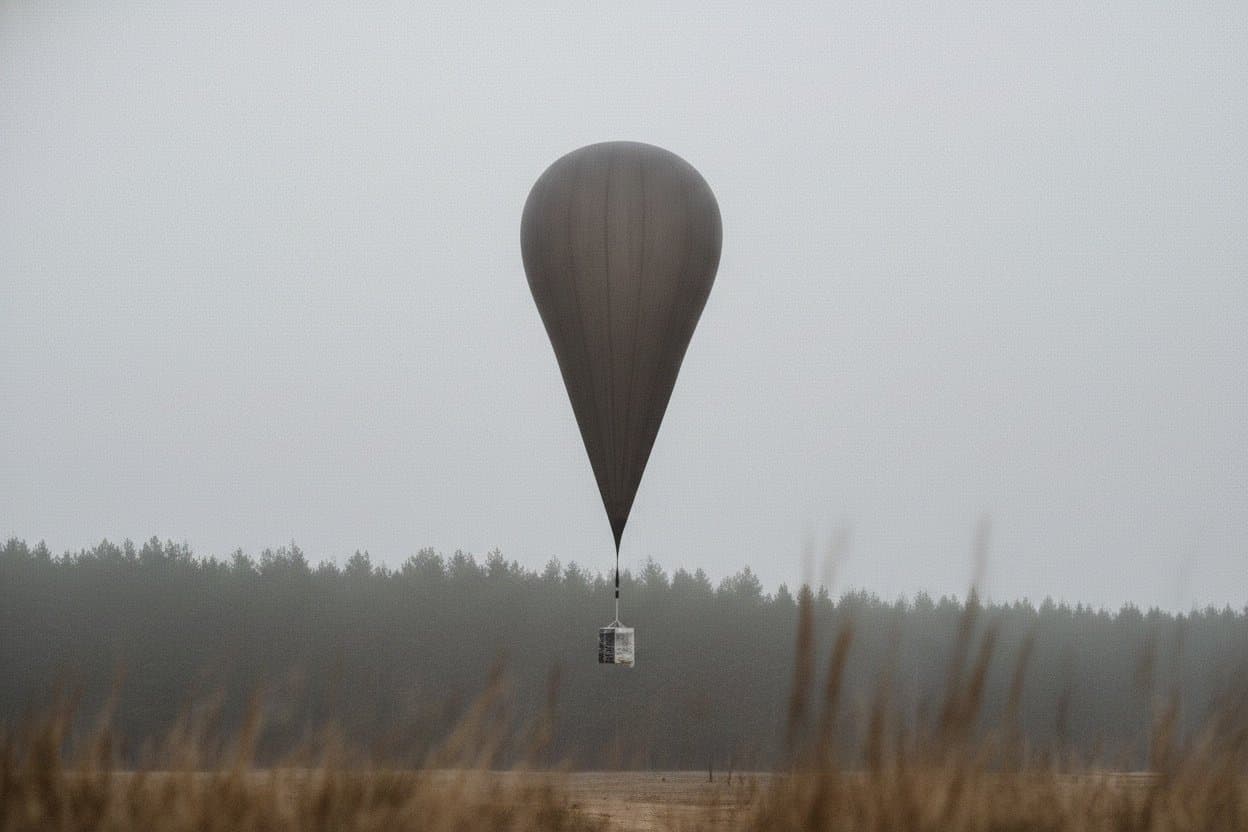
Between late December 2025 and mid-April 2026, AirVeto published five reconstructions of specific airspace events along the EU’s eastern frontier with Belarus. Each reconstruction pairs the event’s time, place, and reported meteorological observations (direction and speed, as logged by AirVeto and corroborated against public reporting) with a wind-field visualisation consistent with those observations. Individually they are event records; together they surface some patterns that a country-by-country weather service simply cannot show.
This post walks through three of them and names the patterns.
Pattern 1 — Altitude is doing most of the work
The 28 January 2026 Vilnius incursion is the clearest example in the archive. At the time of the recovery, AirVeto’s log recorded 55 km/h from the south at 7 km altitude over Lithuania — squarely inside the inflow envelope on the Lithuanian-Belarusian frontier at mid-troposphere. At 3 km (a more typical balloon cruise) the wind was weaker but still directionally compatible; at 500 m the boundary-layer field was lighter and partially decoupled from the synoptic flow.
For smuggling-balloon events along this border in 2025–2026, the wind reading at 3,000–7,000 m is the one that matters. Surface wind is misleading — it reflects near-ground friction and local topography rather than the atmosphere that actually carries balloons after release. AirVeto’s altitude selector is not a nicety; it is the difference between the right answer and a wrong one.
The Šventoji coast twin-envelope contraption on 31 January 2026 is the inverse test case. Observers reported ground speed of ~30 km/h at 1–3 km altitude. AirVeto’s 2,000 m wind log for that morning showed ~30 km/h easterly — a direct match. The 500 m field was lighter and variable. This is a dataset of exactly two cases, but the altitude-sensitivity pattern is robust across the whole archive.
Pattern 2 — Predictions work, but only because the geometry is tight
On 24 December 2025 AirVeto flagged a crossing corridor from Belarus into the Podlaskie region near Białystok. The Polish Ministry of National Defence reported dozens of airspace violations overnight; four smuggling balloons were recovered on Christmas morning in the same area.
This looks like magic until you recognise the geometry. The Polish-Belarusian border runs broadly north-south in Podlaskie; easterly wind components are automatically inflow. When a single synoptic system drives an easterly flow across the region for several hours, any release on the Belarusian side has a drift envelope pointing into Poland. “Predicting” this is the same kind of prediction as predicting that a rock dropped over a roof will land on the roof. The value is not in the physical novelty — it is in publishing the image before the event lands in the news, so that subsequent reporting can anchor on a specific visualisation that already exists.
The corollary is that AirVeto can’t usefully forecast events where the geometry isn’t tight. On a cyclonic passage that rotates the wind 180° in 12 hours, there is no useful inflow claim. The prediction cases cluster around stable synoptic patterns that last hours.
Pattern 3 — The Vilnius approach and Druskininkai are different problems
Vilnius International Airport sits 30 km west of the Belarusian border. Druskininkai sits on the border. The January 28 Vilnius incursion and the 6 February Druskininkai seven-balloon day look similar in a news headline — Lithuanian-Belarusian border, balloons, interceptions — but they are different operational problems.
Vilnius events have a single time-of-arrival window: 30 km at ~30 km/h mid-level wind is a one-hour flight, which is why Vilnius closures cluster in narrow overnight windows after a specific release. Druskininkai events are diffuse across the whole day, because any release at the border needs only minutes to cross. The archive’s wind reconstructions reflect this. Vilnius pages have precise hourly wind readings at a single altitude; the Druskininkai reconstruction necessarily speaks about prevailing flow across the entire day.
For journalists covering these events, the distinction matters: asking “what time was the wind from the south?” is the right question for Vilnius and the wrong question for Druskininkai.
Why this kind of synthesis is uncopyable
AirVeto is the public archive of event-timestamped wind snapshots along the EU’s eastern frontier: each incident independently cross-referenced to primary reporting, each one embeddable as an iframe at the altitude and minute of the event. Weather services answer "what is the wind?" Flight trackers answer "where is the plane?" AirVeto answers "what did the air actually do, at this place, at this time, when this event happened?" — and lets you cite the answer. Every additional reconstruction compounds the value of the archive, because the next quarter’s weather rendering doesn’t.
If you cover the EU’s eastern frontier and you want to pre-check a claim or anchor a story against a specific wind situation, the incident archive is the index.
What comes next
Cadence target for the archive is every new publicly-reported Vilnius/Warsaw/Riga/Tallinn balloon closure or drone incursion, published within ~24 hours of the event, with a short reconstruction and a static wind snapshot. Feed it from the RSS feed, follow on Facebook, or open the live map directly.