
Germany Deploys to Poland's East Shield: 61 km Completed
Bundeswehr engineers in Poland since June 2026 digging anti-tank ditches under the 10 billion PLN East Shield programme on the Belarus and Kaliningrad frontier.
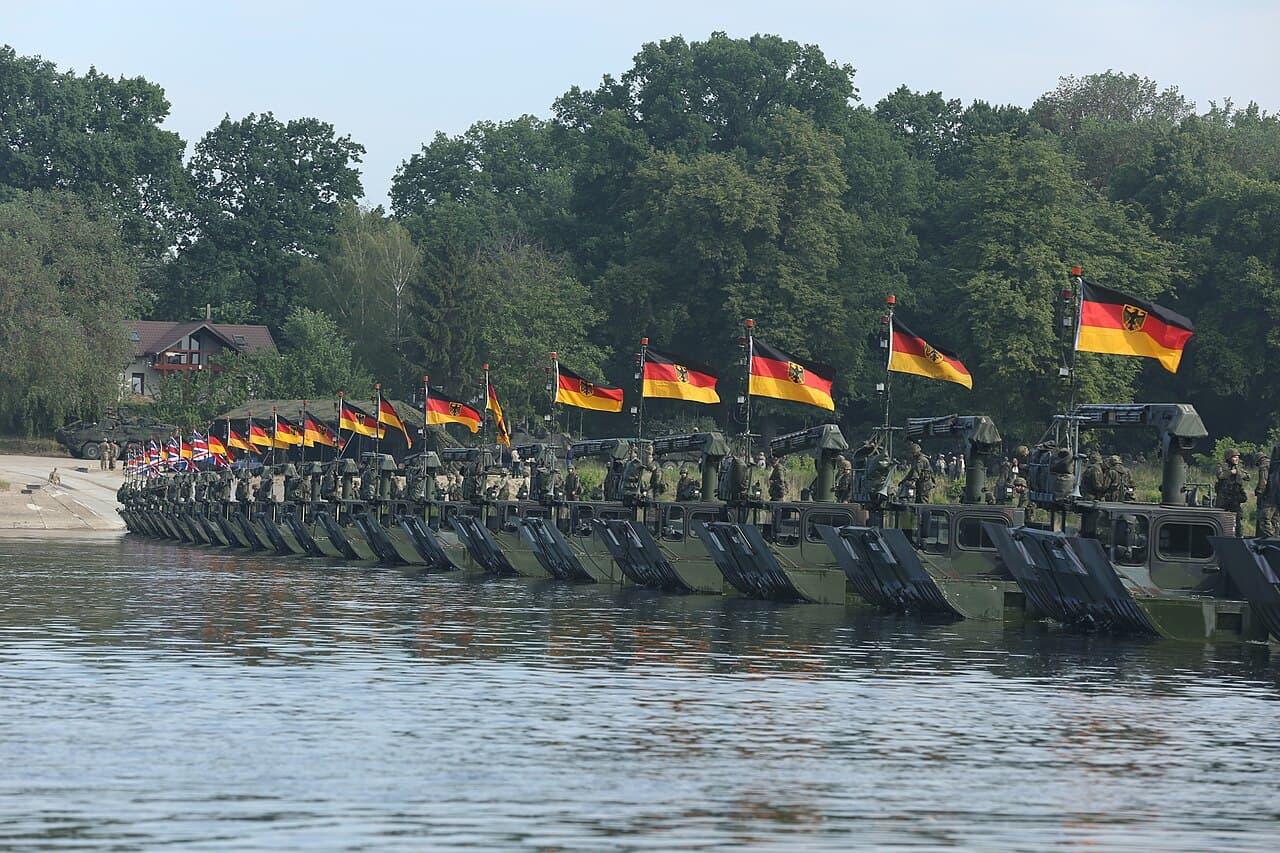
Germany's Bundeswehr command arrived in Poland on June 22, 2026 to begin engineering work under Poland's East Shield fortification programme, becoming the first allied nation to commit troops to the project's construction phase. As of mid-July 2026, Polish and German engineers together have completed 61 kilometers of defensive lines along the border with Russia and Belarus, of which approximately 10 kilometers are completed fortification lines. The broader programme targets 400-500 km of fortifications across a frontier of nearly 700 km, against a total budget of 10 billion PLN (approximately €2.4 billion).
East Shield is Poland's national project to harden its land border against potential Russian aggression. It covers the 210-kilometer frontier with Russia's Kaliningrad exclave to the north, and the longer stretch with Belarus to the east. The Suwałki Gap - the roughly 65-km land link between Poland and Lithuania, bounded by Kaliningrad to the west and Belarus to the east - is the strategic focus: it is the only overland connection between the Baltic states and the rest of NATO, and it is the segment East Shield's planners have prioritised for early fortification.
What German engineers are building
Bundeswehr troops were described as "highly specialised engineering forces" by Polish authorities, who declined to disclose their specific deployment location. PM Donald Tusk indicated positioning along the border with Kaliningrad. Reports from the Militarnyi defence outlet place the German engineering contingent at the Polish Army training centre in Bemowo Piszka, in the Masurian region of northeastern Poland - the area directly adjacent to the Suwałki Gap.
The construction work covers three elements: anti-tank ditches, engineering and barbed-wire barriers, and field fortifications including firing positions. The German troops are unarmed; the deployment carries no combat component. Polish authorities described the objective as creating obstacles designed to "hinder and delay an aggressor's actions" rather than constitute a static defensive wall.
The initial contingent numbers "several dozen" (the December 2025 agreement referenced a "mid-double-digit number"). The deployment is authorised through the end of 2027.
Lt. Gen. Alexander Sollfrank, the Bundeswehr officer overseeing the engagement, said in a published statement: "Through our engagement in Poland, we are strengthening NATO's defence capabilities."
The Polish General Staff's public response was: "United, we will prevail."
A programme running behind its own targets
The 61 km figure reported in mid-July represents a small fraction of the programme's stated ambition. East Shield's declared coverage targets 400-500 km of fortified line along a frontier of nearly 700 km, with the remainder relying on natural terrain obstacles (rivers, forests, marsh). At the mid-July construction rate, completing the fortified sections would take multiple years from the current baseline.
Polish officials have not published a revised completion schedule. The December 2025 budget figure of 10 billion PLN was set before German engineering support was formally engaged; the Bundeswehr contribution accelerates the construction rate but does not change the funding envelope, which remains a Polish national programme.
The Suwałki Gap: what it means to lose or hold it
The Suwałki Gap's strategic logic is straightforward and regularly cited in Polish and NATO planning documents. A force controlling both Kaliningrad and Belarus - or capable of coordinating action from both - could theoretically cut the gap and sever the land connection between the Baltic states and NATO's central European mass. East Shield's fortification priority on this segment reflects that assessment.
The gap is also the zone with the highest cross-border monitoring activity on AirVeto. Both the Polish-Russian frontier at Kaliningrad and the Polish-Belarusian frontier feed into the same narrow geography. The contraband balloon campaign from Belarus - which has delivered hundreds of thousands of packs of cigarettes into Lithuania, Latvia, and Poland since 2025 - crosses this same border segment under inflow conditions; the Suwałki Gap hub documents the wind patterns and incident record.
East Shield addresses the ground and near-ground layer: trenches, barriers, and positions. The airspace layer above the same frontier - where cross-border drift objects, drones, and military aviation operate - is a separate domain, but the same geography. AirVeto's live wind layer shows when the geometry above these fortified segments would carry an airborne object from one side to the other.
What the Bundeswehr contribution signals
Germany's decision to commit engineering troops to East Shield is notable less for its immediate construction output than for what it represents diplomatically: an allied government sending soldiers onto Polish soil to build border fortifications against a shared threat assessment. The troops are unarmed and their presence is publicly acknowledged, which distinguishes this from intelligence or advisory support that typically remains undisclosed.
For NATO's eastern flank posture, it establishes a precedent: allied engineering contributions to national fortification programmes are an option, not merely a theoretical one. Poland has the most extensive land border with potential adversaries of any NATO member east of Germany; its ability to draw in allied engineering capacity has implications for the Baltic states, Finland, and any other frontier member managing its own fortification requirements.
The Suwałki Gap location hub covers the geography East Shield is working to harden. The full incident archive for drone and airspace events across the Polish frontier is at incident archive.
This brief draws on reporting by Notes from Poland (July 22, 2026) and Militarnyi, and on the East Shield programme documentation for scale and budget figures.