
Ukraine's Independence Day Parade Was Robots, Not Soldiers
Kyiv's 35th Independence Day parade on 24 August put uncrewed ground, air and sea systems in front of formations for the first time, with no marching troops or crewed armor.
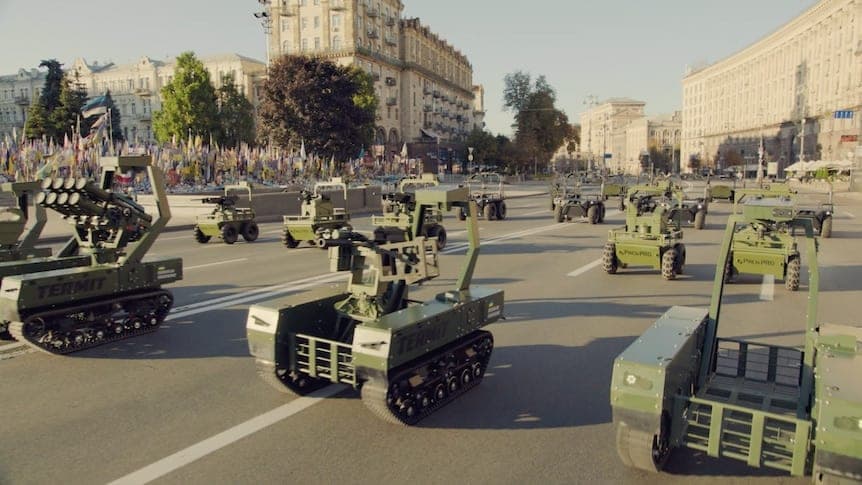
Ukraine marked the 35th anniversary of its independence from the Soviet Union on 24 August with a military parade built entirely around uncrewed systems, according to ABC News. Thirty unmanned ground vehicles (UGVs) moved in formation down Kyiv's Khreshchatyk avenue, nine unmanned surface vessels traveled the Dnipro River, and aerial bomber drones and interceptors flew overhead. President Volodymyr Zelenskyy called it the country's first-ever aerial, ground and naval drone parade.
No marching troops, no crewed armor
Nearly 100 pieces of Ukrainian-made weaponry featured in the display, ABC reported. What was missing carried its own weight: no marching infantry formations, no tanks. It was the first parade in Ukraine since Russia's full-scale war began in February 2022, and the country used it to put an uncrewed force in front of formations for the first time.
Oleksandra Molloy, a senior lecturer in aviation at the University of New South Wales and an expert in Ukraine's drone programme, told ABC the parade signaled "an emerging, multi-domain uncrewed force" and "Ukraine's military transformation over the last four-and-a-half years." She added that it also sends a message to allies: "Ukraine is an invaluable partner to them in terms of knowledge, experience and technology developed during the war."
The UGV fleet is already running tens of thousands of missions a year
The 30 UGVs on Khreshchatyk were not showpieces. The Ukrainian President's Office said UGVs carried out more than 66,000 missions in 2026 alone, covering reconnaissance, mine-laying and clearance, ammunition and supply delivery, and casualty evacuation, and that defence forces have contracted more than 22,000 UGVs for domestic production this year. Some of the vehicles on display carried heavy machine guns.
The naval and aerial systems shown alongside them, drone boats capable of reconnaissance, patrol and strike missions, plus bomber drones and aerial-target interceptors, extend the same doctrine into other domains. Dr. Molloy described the combination as an "ecosystem," pointing to Ukraine's decision in 2024 to stand up the Unmanned Systems Forces as a dedicated branch, the first country to organize its military that way.
European leaders were in Kyiv for the anniversary
The parade coincided with a visit from European leaders to mark the anniversary. The United Kingdom and France pledged stronger military support and continued pressure on Russia, ABC reported. Talks led by the United States aimed at ending the war stalled earlier in the year after Ukraine rejected Russian demands to cede territory. Fighting continues along a roughly 1,200-kilometer front line; Ukraine has slowed Russian advances there this year while expanding long-range strikes on Russian refineries and logistics infrastructure.
Russia has hit Ukrainian troops massed for a ceremony before
Formations of soldiers standing in the open, in one place, at a predictable time, are a demonstrated target. In November 2023, a Russian Iskander missile struck an awards ceremony held by Ukraine's 128th Brigade in Zarichne, Zaporizhzhia Oblast, killing at least 19 soldiers, according to The New Voice of Ukraine; officials ordered an investigation, and those who organized the ceremony faced possible criminal liability. Kyiv Independent reported a second case on November 1, 2025, when a Russian missile hit a Ukrainian military base in Dnipropetrovsk Oblast where troops of the 35th Separate Marine Brigade had reportedly gathered for another awards ceremony.
A parade built from formations of unmanned systems does not carry that exposure. The vehicles on Khreshchatyk stood in ranks the same way soldiers would have; nothing at the site had to survive contact to make the display work.
Dr. Molloy's framing of the parade as "a glimpse" rather than a finished picture matches what AirVeto has tracked in Ukraine's uncrewed-systems programme through 2026: heavy-lift drones delivering armed ground robots to Russian positions and an unmanned surface vessel landing a robot on occupied territory. The parade was the public, formation-scale version of a doctrine Ukraine has already been running in combat for months.
The live map shows current wind conditions over the eastern Ukraine front, where these systems operate.
Sources
- ABC News - Ukraine's first drone parade shows its 'military transformation' and glimpse of modern warfare (25 Aug 2026)
- The New Voice of Ukraine - Local residents react to Russian missile attack on 128th Brigade award ceremony (6 Nov 2023)
- Kyiv Independent - Ukraine opens probe after Russian missile strike on base where awards ceremony was reportedly held (Nov 2025)