

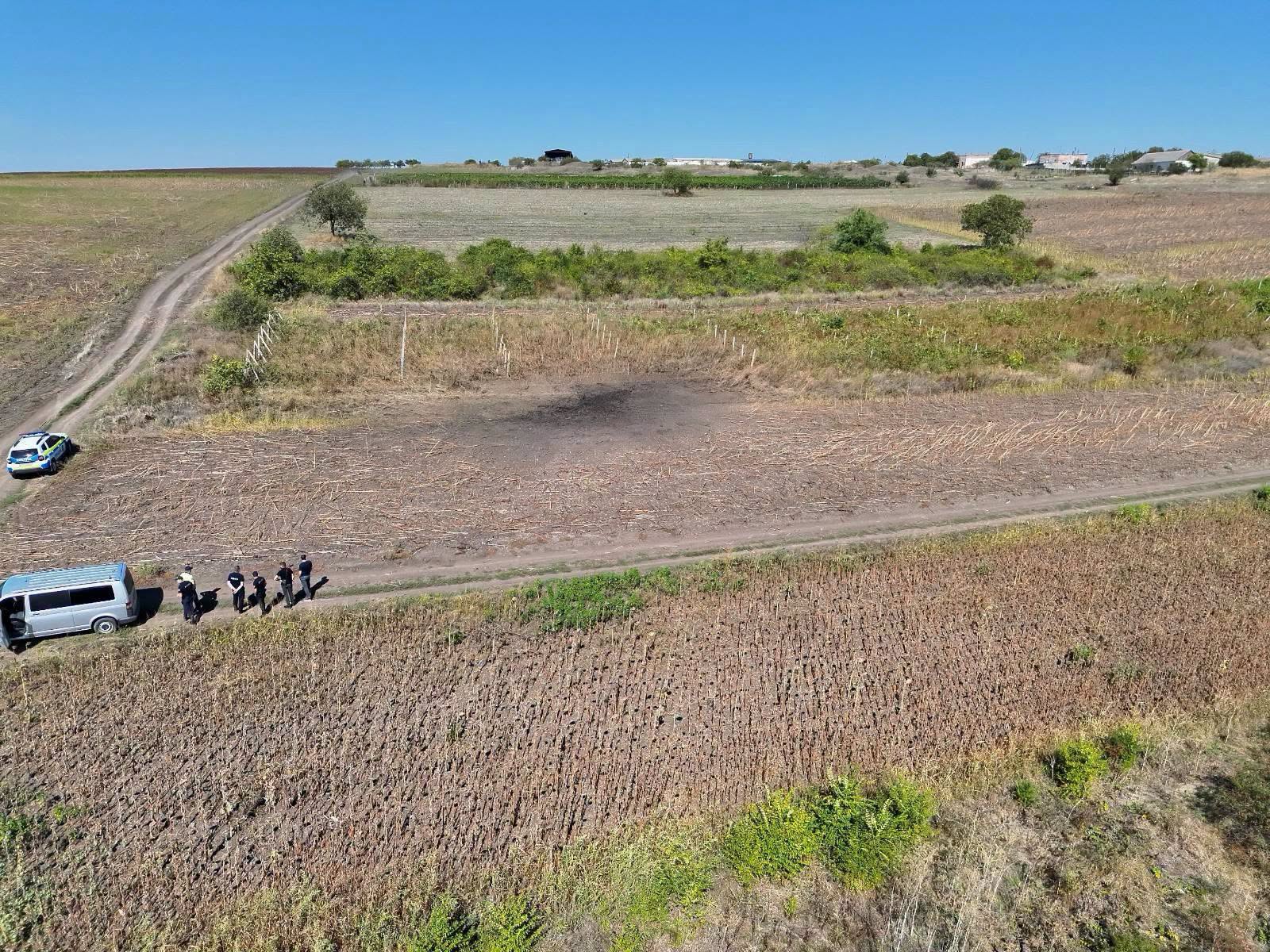
An explosion woke residents near Colonița village, on the southwestern edge of Chișinău municipality, at approximately 04:20 local time (01:20 UTC) on September 18, 2026. Police found debris consistent with a jet-powered drone scattered across roughly 100 meters of farmland near the neighboring village of Tohatin, including an engine and a fragment carrying a Russian-language warning marking, "do not touch." Moldova's General Inspectorate of Police, led by Viorel Cernăuțeanu, secured the site and brought in bomb-disposal and forensic teams; no injuries were reported.
Bomb-squad examiners linked the wreckage to a turbojet-powered strike drone
According to Militarnyi, police explosives experts examined the recovered parts and determined they belonged to an unmanned aircraft with a turbojet powerplant. The exact drone type was not officially confirmed, but given the distance from Russian-controlled positions, the force of the blast, and the pattern of drone types Russia has used against Ukraine, the fragments are consistent with a jet-powered variant of the Geran family of long-range strike drones. Moldovan investigators deployed six additional teams and drones of their own to search the surrounding area and reconstruct the aircraft's likely trajectory.
Moldova's Defence Ministry says it recorded no crossing that night
Despite the debris on the ground, Moldova's Ministry of Defence said it had recorded no unauthorized overflight of Moldovan airspace that night. Ministry spokesperson Marin Butuc attributed the gap to the drone's own "technical and tactical characteristics, its speed and altitude," said unspecified other factors could also explain why the aircraft went undetected, and confirmed an investigation is under way to identify the aircraft type and determine whether it carried an explosive payload. The ministry did not say whether it had consulted Ukrainian or Romanian counterparts on the flight path.
The closest confirmed drone-debris site to Chișinău AirVeto has reconstructed
By AirVeto's own measurement from its archive of verified incident coordinates, Colonița sits roughly 8 km from central Chișinău. That is closer to the Moldovan capital than any of the four other Moldovan drone incidents AirVeto has reconstructed this year: Kopanka (13 July, about 66 km away), Palanca (26 August, about 115 km away), the Mihăileni Vechi crash covered in AirVeto's Zelenskyy-drone-delay reconstruction (about 148 km away), and Tudora (17 September, about 110 km away). That September 17 Tudora transit was, per NewsMaker, the third confirmed Moldovan airspace violation in four days, a tally that started with a pair of crossings on the night of September 14. Colonița's debris field followed it by less than 24 hours.
Wind over Colonița
At 01:00 UTC on September 18, close to the blast, the 2,000 m layer over Colonița showed a light NW wind at 5.7 km/h, pushing toward the southeast. At 3,000 m the NW flow strengthened to 9.2 km/h, still pushing toward the southeast. This reconstruction is based on reporting by Militarnyi, Moldova Live, Mezha, LIGA.net, and European Pravda, and on AirVeto's wind-model data for the 01:15-01:35 UTC window on September 18, 2026. Full methodology is on the AirVeto methodology page. A full archive of drone and airspace incidents across the EU's eastern border is at the incident archive.
A debris field with a live warhead fragment, an official denial that anything crossed, and a blast site closer to a national capital than any prior confirmed case on this border, this one raises more questions about detection than it answers.