
Russian Geran-2 strikes apartment block in Galați, Romania
A Russian Geran-2 drone hit a Galați apartment block on May 29, 2026, injuring two residents - the first Russian drone to injure civilians on NATO territory.
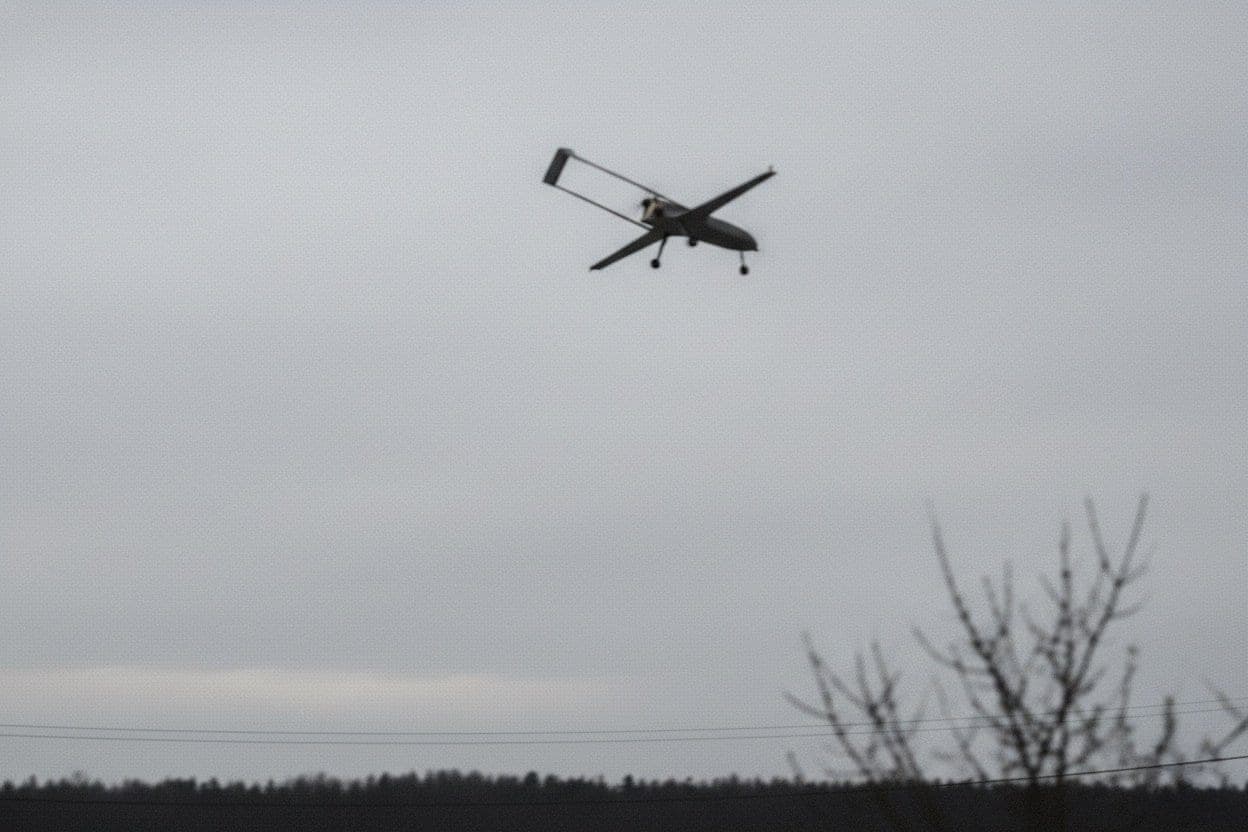
At approximately 02:00 local time (00:00 UTC) on Friday, May 29, 2026, a Russian Geran-2 loitering munition crashed into the roof of a 10-storey apartment building on Bulevardul Brăilei in Galați, southeastern Romania, and detonated its full warhead on impact. The explosion ignited a fire on the tenth floor that injured two residents: a 53-year-old woman and a 14-year-old boy, both hospitalised at Galați County Emergency Clinical Hospital with burns. 70 residents were evacuated from the building. According to Romania's Ministry of National Defence, at 01:54 CEST (23:54 UTC on 28 May) the drone crossed into Romanian airspace from the direction of Reni during a broader Russian overnight strike on the Danube port cities of Izmail and Reni, and covered the roughly 15 km to central Galați in four minutes. The strike is the first documented case of a Russian drone injuring civilians on NATO territory.
AirVeto's wind-model data for the event window: At 23:00 UTC on 28 May - at the start of the overnight approach window - the 1,000 m layer over the Danube Delta region showed wind pushing south at 35.8 km/h.
Romania had four minutes between airspace entry and impact
The Geran-2 entered Romanian airspace at 01:54 CEST (23:54 UTC on 28 May), descending from approximately 600 meters as it crossed from Ukrainian territory near Reni. Romanian Air Force Base 86 "Locotenent aviator Gheorghe Mociorniță" at Feteşti had already scrambled two F-16AM Fighting Falcons at 01:19 CEST (23:19 UTC) on pre-alert, along with an IAR 330 SOCAT support helicopter. The aircraft were airborne and tracking - but at close to 200 km/h, the drone covered the distance to central Galați before any intercept was possible.
Romanian Brigadier-General Gheorghe Maxim, acting commander of the joint staff, told a press conference that the drone flew at low altitude throughout, which reduced its radar cross-section and compressed the available response time: "The time was extremely short." Romania's military operates under strict rules of engagement that govern when firing over a populated city is authorised. Both the four-minute window and the urban engagement constraints meant the F-16s did not fire.
Serial numbers confirmed Russian origin; Putin denied it
Romania's defence ministry stated that forensic examination of debris recovered from the roof confirmed the drone's serial numbers were "undoubtedly" Russian-made: a Geran-2, Russia's designation for the Iranian-designed Shahed-136 delta-wing loitering munition. The Geran-2 carries a 50 kg warhead and is the same type Russia deploys in volume against Ukrainian port infrastructure along the Danube. Romania's defence ministry confirmed that the entire explosive payload detonated at the moment of impact - not a partial or delayed detonation.
Russian President Vladimir Putin publicly dismissed the attribution at a press appearance, saying "no one can say" the drone was Russian rather than Ukrainian. Russia's foreign ministry, in its first official statement on the incident, denied involvement.
Romania summoned the Russian ambassador and closed a consulate
Romanian President Nicușor Dan convened an emergency session of the Supreme Council of National Defense (CSAT), calling the strike the most serious security incident affecting Romanian territory since Russia launched its full-scale war against Ukraine in 2022. Dan announced that the Russian consul general in Constanța had been declared persona non grata and that the Russian consulate in Constanța, on the Black Sea coast, would be closed. Romania also summoned the Russian ambassador to the Foreign Affairs Ministry.
Romania's Foreign Affairs Ministry described the incident as "a grave and irresponsible escalation on the part of the Russian Federation" and said Romania would take the necessary diplomatic measures in response to this serious violation of international law.
A RO-Alert cell-broadcast warning was issued to residents in Brăila, Tulcea, and Galați counties during the night. 178 apartments in the building lost natural gas supply as a result of the strike; reconnection was underway within 24 hours.
The 28th airspace breach - the first to injure anyone
Romania's defence ministry confirmed this was the 28th occasion on which a Russian drone has breached Romanian airspace since Russia began attacking Ukrainian Danube-river port infrastructure. In the 27 prior incursions, no drone had struck a populated building or injured anyone. Debris from Russian drone activity had been found on Romanian soil 47 times in that period.
The Galați strike ended that pattern. It is the first documented case of a Russian drone striking a residential building on NATO territory, detonating its warhead on NATO soil, and injuring civilians on the territory of a NATO member state.
The crossing point was the Danube delta and the Reni–Galați zone - the most-used path for errant or diverted drones entering Romania. Galați sits at the confluence of the Siret and Prut rivers with the Danube, less than 15 km from the Ukrainian town of Reni.
NATO condemned Russia's "reckless behavior"
International reaction was swift. NATO condemned what it called Russia's "reckless behavior." US Ambassador to NATO Matthew Whitaker called the strike a "reckless incursion" into the territory of a NATO ally. European Commission President Ursula von der Leyen said Russia's war of aggression had "crossed yet another line." German Chancellor Friedrich Merz said the strike demonstrated Russia's "willingness to escalate." EU Foreign Policy Chief Kaja Kallas called the event "a serious violation of Romania's sovereignty" and said the EU stands in full solidarity with Romania.
Romanian legislators raised the prospect of invoking Article 4 of the North Atlantic Treaty - the consultation mechanism available when an ally believes its security is threatened. As of the date of publication, Romania had not formally triggered the procedure.
Wind conditions over the Danube Delta approach
At 23:00 UTC on 28 May - at the start of the overnight approach window - the 1,000 m layer over the Danube Delta region showed wind pushing south at 35.8 km/h. Moderate flow at this level was the atmospheric background for the crossing and apartment-block impact. For the full methodological framework, see methodology.
For the airspace context in the wider region that same week, see the Dridža Lake drone crash in Latvia, May 23, 2026 and the NATO F-16 shootdown over Estonia, May 19, 2026. A comparable crossing later struck Copanca, Moldova, on July 13, 2026, where Russia's denial followed the same pattern. This reconstruction draws on reporting by CNN, Euronews, NPR, the Kyiv Independent, and Digi24, and on AirVeto's wind-model analysis for the 23:30–01:00 UTC window on May 28–29, 2026.
Methodology: see methodology. Page published 2026-05-30 by AirVeto.
Related location
- Romania - Romania, a NATO member since 2004, shares a Danube-river border with Ukraine at the Black Sea delta and has repeatedly recorded drone debris, intercepts, and naval-drone incidents along that frontier and its Black Sea coast since September 2025.
Sources
- CNN - NATO members condemn Russia after drone slams into Romania apartment building, wounding two (May 28, 2026)
- Euronews - Explosive-laden Russian drone hits residential building in Romania, authorities say (May 29, 2026)
- NPR - Russian drone launched against Ukraine crashes in Romania, injuring 2 (May 29, 2026)
- CBS News - Romania says Russian drone hit apartment building, lightly wounding 2 people near Ukraine border (May 29, 2026)
- Kyiv Independent - NATO condemns Russia's 'reckless behavior' after drone strike in Romania injures two (May 29, 2026)
- ABC News - Russian drone hits Romanian apartment building near Ukraine border, officials say (May 29, 2026)
- Censor.net - Russian drone crashes into residential building in Romania: casualties reported (May 29, 2026)
- Digi24 - MApN explică de ce nu a doborât drona care a lovit un bloc de 10 etaje din Galați (May 29, 2026)
- Methodology
Last updated: