
Balloons, drones, Ust-Luga: the Baltic night of 10 Nov 2026
Balloons closed two Lithuanian airports, drones set off alerts in Lithuania, Latvia and Estonia, and Ukraine struck Ust-Luga. One drone crossed Lithuania unshot.
AirVeto finding: The drone that crossed Lithuania flew at about 170 km/h, judging by where and when phone sensors heard it.
Evidence behind the finding1 confirmed1 reported1 modelled1 unknown
- confirmedLithuania declared a red alert for Kaunas city, Kaunas district and Prienai district at 01:29.alkas.lt
- reportedThe civilian Drone Radar network logged a drone at Uzliedziai in Kaunas district at about 01:31 and at Aristava in Kedainiai district at about 01:45.TV3
- modelledIf both places hold the same drone, they are 40.0 km apart, so about 14 minutes is about 170 km/h.TV3
- unknownWhose drone it was, its type, its altitude and whether it carried explosives; Lithuania's army says it has no reliable data and no wreckage.alkas.lt
Balloons from Belarus closed two Lithuanian airports on the evening of November 10, 2026. Drones then set off air alerts in Lithuania, Latvia and Estonia, and Ukraine struck the Russian port of Ust-Luga, near St. Petersburg. One drone crossed Lithuania and Latvia without being shot down. This page lists the events in order, in local time (UTC+2).
Lithuania's red alert for Kaunas district went out at 01:29. A civilian phone-sensor network heard a drone there about two minutes later, and if its two signals are the same drone, it flew near 170 km/h. Lithuania's army says it has no reliable data on whose drones they were.
Part 1: Balloons from Belarus restricted Vilnius and Kaunas airports before the first drone alert
| Time | Event | Source |
|---|---|---|
| 21:21 to 21:56 | Vilnius airport restricted because of balloons from Belarus; three flights and 465 passengers affected | alkas.lt |
| about 21:30 | The national crisis centre (NKVC) warned of possible balloons | LRT live blog |
| 21:47 to 23:45 | Kaunas airport restricted | alkas.lt |
alkas.lt says a multitude of navigation signals typical of balloons were recorded in Lithuanian airspace that evening. The first drone alert came at 22:53, 92 minutes after the Vilnius restriction began and 66 minutes after Kaunas's. Earlier balloon closures are in the October 24 Kaunas airport page.
Part 2: Three drones, then a fourth, set off alerts in three countries
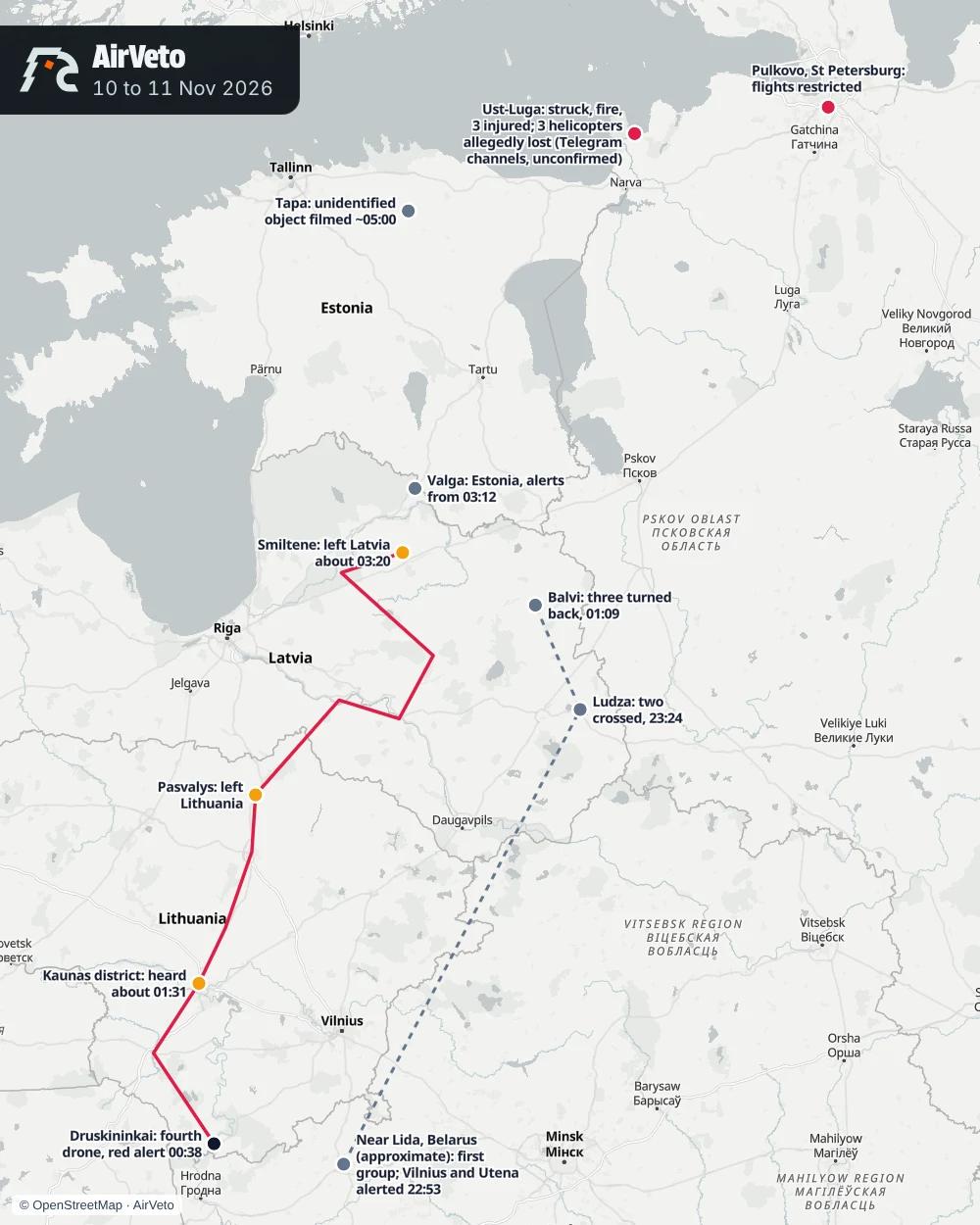
The map on this page marks the places warned. The red line joins them in alert order for the fourth drone. The grey dotted line starts at an approximate point near Lida in Belarus and joins the Latvian alert areas in alert order. The Lida point is AirVeto's approximation of the army's description, about 30 km from the border, and not a reported position. Which object set off which alert in the first group is not published. Tapa marks a reported sighting, not a warning. Neither line is a radar track.
The first group never entered Lithuania and set off alerts in Latvia
| Time | Event | Source |
|---|---|---|
| 22:47 | Belarus tells Lithuania, over a technical line, that unidentified objects are flying toward it and says it is trying to neutralise them | alkas.lt, Louna-Postimees |
| 22:53 | Yellow alert, Vilnius and Utena counties | alkas.lt |
| about 23:00 | NKVC first reports one drone toward Svencionys and Ignalina, 30 to 50 km from the border | LRT live blog |
| 23:24 | Latvia: orange alert in Ludza municipality; two aircraft entered Latvia | LSM |
| 23:39 | Latvia: yellow alert in Kraslava and Augsdaugava for an aircraft from Belarus | LSM |
| 23:50 and 00:28 | Vilnius alert lifted, then Utena | alkas.lt |
| 00:33 | Kraslava and Augsdaugava alerts end; the aircraft never reached Latvia and never showed on radar | LSM |
| 01:09 | Latvia: yellow alert in Balvi, orange ten minutes later; three aircraft approached and turned north into Russia | LSM |
| 02:17 | Balvi alert ends | LSM |
The count is disputed. NKVC first reported one drone. The army's chief of defence staff, Rear Admiral Giedrius Premeneckas, later said three were tracked over Belarus, heading northeast. None crossed the Lithuanian border. LRT carries the same account.
Latvia's final account says two aircraft crossed its eastern border for one to two minutes each. Naval Captain Seldzis Grasmanis described the Balvi alert as three aircraft that turned back without crossing. No army says which Lithuanian-tracked object matches which Latvian alert.
The fourth drone crossed Lithuania from Druskininkai to Pasvalys
| Time | Event | Source |
|---|---|---|
| 00:32 | Yellow alert, Alytus county | alkas.lt |
| 00:35 | NKVC: a new object over Belarus, 20 to 30 km from the border near Druskininkai | LRT live blog |
| 00:38 | Red alert, Druskininkai and Lazdijai districts | alkas.lt |
| 01:01 | Yellow alert, Marijampole county | alkas.lt |
| 01:14 | NKVC: the object left Lithuania into Poland; the red alert stays | LRT live blog |
| 01:18 | Red alert, Marijampole county | alkas.lt |
| 01:29 | Red alert, Kaunas city, Kaunas district and Prienai district | alkas.lt |
| about 01:31 | Drone Radar phone-sensor signal at Uzliedziai, Kaunas district | TV3 |
| about 01:45 | Drone Radar signal at Aristava, Kedainiai district; red alert in Kedainiai | TV3, LRT live blog |
| 01:51 | Red alert, Panevezys district; later Pasvalys and Birzai | LRT live blog |
| 02:24 | Latvia: yellow alert in Aizkraukle, then orange; one aircraft approaching from Lithuania | LSM |
| 02:30 | Lithuania-wide all-clear | LRT, Louna-Postimees, ERR |
| 02:36 | NKVC: the object has left Lithuania and is tracked over Latvia | LRT live blog |
| 02:24 to about 03:20 | Latvia: the drone crosses Jekabpils, Madona, Cesis, Smiltene and Gulbene municipalities, where warnings were temporarily in force | LSM |
| 03:12 | Estonia: alert for Valga, Voru, Polva, Tartu, Jogeva and Viljandi counties | ERR |
| about 03:20 | The drone leaves Latvia toward Estonia, and the Latvian army loses contact | LSM |
| 03:30 | Latvian warnings lifted | LSM |
| about 03:30 | Estonia: one drone briefly enters Estonian airspace from the direction of Latvia, then continues toward Russia; the minister does not say it is the drone that crossed Lithuania (defence minister) | ERR News |
| 03:45 | Estonia adds Ida-Viru and Laane-Viru counties | ERR |
| about 05:00 | Estonia: an unidentified object is filmed over Tapa, flying from east to northwest; NATO jets circle the town | Virumaa Teataja |
| 05:50 and 06:33 | Estonian alerts lifted, south then north | ERR |
The Poland entry rests on Lithuanian army data; no Polish source was checked.
On Estonia, alkas.lt says the drone reached Estonia and probably entered Russia. Estonia's defence minister, Martin Herem, confirmed on November 12 that one drone briefly entered Estonian airspace from the direction of Latvia at about 03:30 and then continued toward Russia, ERR News reports. He added that some of the drones that reached Ust-Luga turned west, circled over the Gulf of Finland in Russian airspace and briefly crossed into Estonian airspace over the gulf. Herem said Estonia had not authorized Ukraine or any other country to use its airspace, that Ukraine had never asked, and that Estonia had asked Ukraine for an explanation.
In its Estonian-language report on the alerts, ERR says a Kohtla-Jarve resident counted more than ten fighter overflights in half an hour, and that Tallinn Airport was not disrupted.
Virumaa Teataja reports that the object over Tapa at about 05:00 was not identified. No source ties it to the drone that left Latvia at 03:20.
Officials give three different times for the fourth drone's arrival
Minister Robertas Kaunas said on the morning of November 11 that an object heading toward Druskininkai had briefly entered Lithuania at about 23:00. Premeneckas tied the fourth drone's sighting to about 01:20. The official LT72 register shows the first red alert for Druskininkai and Lazdijai at 00:38.
alkas.lt says these figures may describe different stages of the flight. It adds that no consistent chronology has been published. This page therefore gives alert times, which are on record, and not a crossing time.
Fighters did not fire over Kaunas, and a missile that missed came down in Birzai district
Two attempts to shoot the fourth drone down failed, Premeneckas said. alkas.lt reports that one missile missed, destroyed itself and left debris in Birzai district. Two failed attempts do not necessarily mean two missiles, and the army has not said what weapon it was or why it missed.
Prime Minister Mindaugas Sinkevicius said on November 11 that, by preliminary crisis centre data, the debris near Birzai is of a missile launched from a NATO fighter, LRT's live blog reports. Defence Minister Robertas Kaunas asked people not to draw conclusions yet, because the details were still being checked.
Latvia's army said conditions and civilian safety did not allow a shot when the drone crossed Latvia. alkas.lt adds that holding fire over densely populated Kaunas areas had a clear safety reason.
Phone sensors heard a drone at two places 14 minutes and 40 km apart
The civilian initiative Drone Radar uses smartphones as acoustic sensors. Its press release, carried by TV3, logs a drone at three points: Uzliedziai at about 01:31, another a moment later elsewhere in that area, and Aristava at about 01:45. TV3 says only "a drone". This page reads both as the fourth drone because its route and timing fit, which TV3 does not state.
The two places are 40.0 km apart in a straight line. If both signals are the same drone, covering that in about 14 minutes is about 170 km/h. If each time is off by two minutes, the speed is 130 to 240 km/h. The red alert for Kaunas district came at 01:29, so the drone was heard about two minutes after the alert. The LT72 alert site was slow or unreachable around 23:15, alkas.lt says, citing TV3.
Part 3: Ukraine struck Ust-Luga the same night, and 150 drones were reported over Leningrad Oblast
ABC News reports a significant Ukrainian drone strike on the port of Ust-Luga, a key hub for Russian energy exports near St. Petersburg. Leningrad's governor, Aleksandr Drozdenko, said 150 Ukrainian drones were shot down over the region and that the port area was the target. Drones hit the area, a fire broke out and three workers were injured, he said.
ERR puts Ust-Luga about 36 km in a straight line from the Estonian border, and says the fire could be seen from Narva, Sinimae and Sillamae. It gives Russia's count as 146 drones over Leningrad Oblast, against the governor's 150 in ABC's report.
Aeronaut.media adds that NASA's FIRMS satellite system recorded thermal anomalies in the port area and the nearby waters on November 11.
Russia's defence ministry said at least 627 drones were shot down overnight over 22 regions, including Moscow. The federal air transport agency set temporary flight restrictions at more than 20 airports, among them Pulkovo in St. Petersburg.
Finland's defence forces set a temporary flight restriction over the eastern Gulf of Finland, ERR reports, citing Yle. Louna-Postimees says it was lifted after 07:00.
Ust-Luga is 681 km from Druskininkai, where the fourth drone approached Lithuania. It is 285 km from Smiltene, in the last Latvian area warned, and 490 km from Utena, one of the first counties alerted. These are straight-line distances from the Ust-Luga settlement, not from the port berths.
Russian Telegram channels claim three helicopters were lost, unconfirmed
Russian Telegram channels, among them Voevoda Veshchaet, report that three Russian helicopters were lost with their crews while the strike was repelled, Aeronaut.media reports, citing Militarnyi. Aeronaut.media's reading of two channels, Ya i moy drug vertolet and Na predele, is that they were two Ka-52s and one Mi-8, with seven servicemen killed.
The reports give no cause. Aeronaut.media says there is no data on it and that it could have been Russian air defence or a mid-air collision. ABC reports the governor mentioning three injured port workers. The helicopter losses rest on the channels alone.
Nobody has said whose drones they were
Latvia's army commander Kaspars Pudans said the alerts were most likely tied to Ukraine's drone strike on Leningrad Oblast. He also said it is hard to name which aircraft entered Latvia, because there is no physical evidence and radar does not always show a drone's origin. Lithuania's crisis centre head suggested the fourth drone may have been Ukrainian. Premeneckas said the army has no data to say.
LRT's live blog reports that Minister Kaunas called it likely that some drones were hit by electronic warfare. They strayed over NATO territory, he said, while the Ust-Luga terminal was being struck. alkas.lt also lists navigation disturbance or electronic warfare as one possible version.
ABC adds that Latvian, Lithuanian and Estonian authorities all warned of possible incursions without naming an origin, and that Ukrainian drones have strayed into all three countries before.
At 1,000 m the wind was weak and at 3,000 m it explains little of the speed
At 01:00 local time on November 11, around the Drone Radar signals, the wind over Kaunas at 1,000 m blew from the ESE at 10 km/h. At 2,000 m it came from the SSE at 22 km/h and at 3,000 m from the SSE at 32 km/h.
The fourth drone flew north, so that wind pushed it from behind. Even a full 3,000 m tailwind accounts for less than a fifth of 170 km/h. Its altitude has not been reported.
The wider picture for the border is on the NATO eastern flank hub. An earlier alert in the same region is the October 18 Panevezys and Siauliai page.
This reconstruction is based on alkas.lt, LRT, LSM, ERR, Louna-Postimees, Virumaa Teataja, TV3, ABC News and Aeronaut.media, and on AirVeto's wind-model data for the event window. How the model is built and where it is reliable is on the methodology page.
Corrections
: The page said ERR did not report a drone entering Estonia. On 12 November ERR quoted Estonia's defence minister, Martin Herem, saying one drone briefly entered Estonian airspace from the direction of Latvia at about 03:30 local time, and that some drones that reached Ust-Luga briefly crossed into Estonian airspace over the Gulf of Finland. The Estonia paragraph and the timeline were revised.
Sources
- alkas.lt - Lietuvą perskrido dronas: naikintuvams jo numušti nepavyko (11 Nov 2026)
- LRT - „Neramiausia naktis“: naikintuvai droną bandė numušti du kartus, tačiau nepavyko (11 Nov 2026)
- LRT live blog - Raudonas oro pavojaus signalas – Panevėžyje, Prienų, Pasvalio, Biržų rajonuose (10-11 Nov 2026; copied 11 Nov, early entries no longer on the live page)
- LSM - Atcelti brīdinājumi saistībā ar gaisa telpas apdraudējumu – trīs droni pametuši Latvijas gaisa telpu (11 Nov 2026)
- Louna-Postimees - Kaheksa maakonda said droonihoiatuse (11 Nov 2026)
- ERR - Kaheksa maakonda said öösel võimaliku õhuohu hoiatuse (11 Nov 2026)
- ERR News - Defense minister: Drones entered Estonian airspace from northeast and southeast (12 Nov 2026)
- Virumaa Teataja - Virumaa ja veel mitu maakonda said öösel õhuohu teate. Tapal nähti tundmatut lennumasinat (11 Nov 2026)
- TV3 - Dronui skrendant per Lietuvą, jo signalus fiksavo ir gyventojų telefonai: „Drone Radar“ aptiko droną trijose vietose (11 Nov 2026)
- Aeronaut.media - Russia lost three helicopters while repelling a Ukrainian attack (11 Nov 2026; citing Militarnyi)
- ABC News - Russia-Ukraine talks end without breakthrough announcement amid barrage of drones (11 Nov 2026)
- Methodology
Last updated: