
Drones trigger alerts across six counties in Estonia and Latvia
Overnight drone alerts across six Estonian counties and Latvia's Alūksne municipality on the night of June 2–3, 2026 - NATO air policing scrambled; no drone was confirmed destroyed.
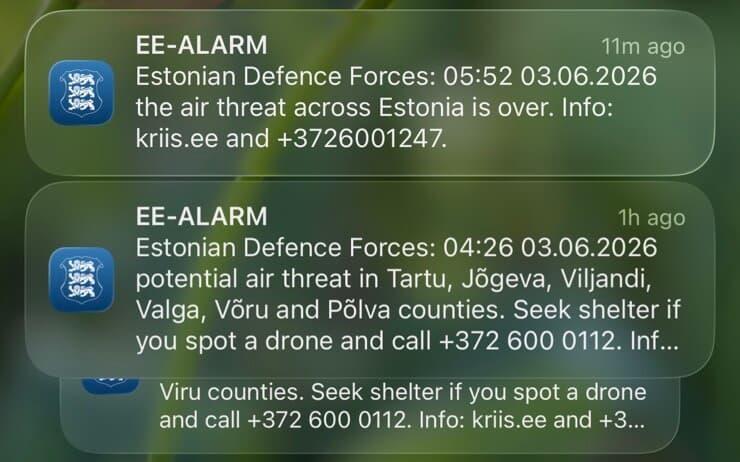
In the early hours of Wednesday, June 3, 2026, Estonia and Latvia issued simultaneous airspace alerts after threat sensors picked up drone activity moving across the region. Estonia's EE-Alarm system broadcast warnings across six counties (Tartu, Jõgeva, Viljandi, Valga, Võru, and Põlva), covering much of the country's south and east. Latvia issued a yellow-level warning for Alūksne municipality in the country's northeast. NATO Baltic Air Policing jets were scrambled. Lithuania reportedly launched overnight reinforcement sorties to support the response.
AirVeto's wind-model data for the event window: At 02:00 UTC on 3 June - during the alert window - the 1,000 m layer over the southeastern Estonia–northeastern Latvia border zone showed wind pushing NE at 15.2 km/h.
The alerts were lifted by around 06:20 local time (03:20 UTC). No drone was confirmed shot down or found on the ground. The episode fits the now-familiar Baltic pattern of spring 2026: Ukrainian long-range strike operations against Russian oil infrastructure near the Finnish Gulf pushing drones off course and into NATO airspace.
The alert - six Estonian counties and one Latvian municipality
The first EE-Alarm messages reached phones in affected counties at approximately 04:37–05:00 local time, covering a band of territory running from Jõgeva and Tartu in central Estonia southward to Võru and Põlva near the Latvian and Russian borders. The instruction was the standard Baltic drone alert formula:
"If you see a drone, take shelter and call 112."
Latvia's message, issued for Alūksne municipality at around 04:59 local time, was a yellow-level advisory: the lower tier of Latvia's alert hierarchy, indicating a possible threat that does not require residents to shelter immediately. NATO air policing fighters were reported active over both countries' airspace.
By 06:00 local time Estonian defence authorities declared the threat over. Latvia's all-clear for Alūksne followed shortly after at around 06:20. The episode lasted roughly an hour and a half from first alert to final all-clear.
Residents in Võru reported hearing a drone
Unlike most Baltic spring alerts, where the public record consists entirely of radar tracks and official statements, the Võru county alert produced at least one concrete sensory account. Residents in the area told ERR they heard an unusual noise in the early morning that they attributed to a drone overhead.
That does not confirm a specific object, route, or outcome. It does narrow the episode from a purely radar-and-bureaucracy event to one where something physical was present over southeastern Estonia during the alert window, consistent with the EE-Alarm assessment rather than a false return.
No wreckage was reported found. Estonian authorities did not announce a formal investigation into debris recovery in the immediate aftermath of the all-clear.
Why this happened - overnight strikes on Ust-Luga and Primorsk
The 2–3 June alert followed an overnight Ukrainian strike operation against Russian oil infrastructure on the Leningrad Oblast coast. The terminals at Ust-Luga and Primorsk, the principal Russian oil export points on the eastern Gulf of Finland roughly 30 kilometers from the Estonian and Finnish borders, have been the consistent target of Ukrainian long-range drone campaigns through spring and early summer 2026.
The working assessment across Baltic capitals, stated publicly by multiple officials since March 2026, is that Russian electronic warfare infrastructure along the Baltic coastline spoofs or jams GPS signals, pushing Ukrainian drones off their set flight paths. A drone that loses signal lock over Russian Leningrad Oblast, tracking west-southwest toward a coastal target at low altitude, is already pointing toward Estonian or Finnish territory. The 3 June alerts fit that geometry.
Where this fits in the Baltic spring 2026 sequence
The 3 June alerts are the latest in a near-continuous run since March 2026:
- May 7, 2026 - Rēzekne, Latvia. Two drones struck an oil depot in Latvia's Rēzekne region; four empty tanks damaged, brief fire, no casualties. See the Rēzekne / Viļāni incident page.
- May 17, 2026 - Samanė, Lithuania. Destroyed drone found in a field; explosives neutralised. See the Utena Samanė incident page.
- May 19, 2026 - Estonia. A Romanian NATO F-16 shot down a drone near Kablaküla - the first NATO fighter intercept over Baltic airspace. See the Estonia drone shootdown page.
- May 20, 2026 - Lithuania. A radar contact from Belarus triggered Lithuania's widest air-danger alert of the spring, closing Vilnius Airport for roughly 80 minutes. See the Ignalina drone alert page.
- May 21, 2026 - Lithuania. A second day of alerts, tracking two objects toward the Utena district. See the Utena 21 May page.
- May 23, 2026 - Latvia. A drone crashed into Lake Drīdža in Krāslava municipality and detonated. See the Drīdža Lake incident page.
The 3 June night alerts represent the first confirmed Baltic airspace event in June. Whether they reflect a tempo increase, a new strike wave, or ordinary variance in the Ukrainian campaign rhythm will depend on what follows.
Wind conditions over southeastern Estonia and northeastern Latvia
At 02:00 UTC on 3 June - during the alert window - the 1,000 m layer over the southeastern Estonia–northeastern Latvia border zone showed wind pushing NE at 15.2 km/h. Light flow at this level was the atmospheric background for the overnight alerts. AirVeto's model and its documented limits are on the methodology page. This reconstruction draws on reporting by LRT, ERR, Estonian World, and 15min.lt, and on AirVeto's wind-model analysis for the 01:37–03:20 UTC alert window on June 3, 2026.
The full archive of Baltic drone and airspace-alert events is at incident archive. Estonian incidents are collected at the Gulf of Finland location hub.
Related location
- NATO eastern flank - The frontier where EU airspace meets Russia and Belarus across five NATO member states - the active zone of drone incursions, smuggling balloon recoveries, and Baltic Air Policing intercepts since 2025.
Sources
- LRT - Estijoje ir Latvijoje naktį skelbtas įspėjimas dėl dronų (June 3, 2026)
- ERR - More drones breach Estonia's airspace, threat over (June 3, 2026)
- Estonian World - Estonia on drone alert after night of air threat (June 3, 2026)
- 15min.lt - Estijoje ir Latvijoje buvo paskelbtas įspėjimas dėl dronų grėsmės (June 3, 2026)
- Wikipedia - 2026 Ukrainian drone incursions into the Baltic states
- Methodology
Last updated: