
Krisjani drone, Latvia, 3 Nov 2026 - second in 29 hours
Latvia declared an air threat over Balvi and Ludza at 00:10 on 3 November 2026 and suspects a drone fell in Balvi. Two days after guessing Ukraine, the army tied the 1 November drone to Russia.
AirVeto finding: Latvia's army guessed on November 1 that its drone was Ukrainian, then on November 3 called it most likely a Russian Geran, while the drone declared 29 hours 13 minutes after the first alert looked like a Ukrainian type.
- confirmedOn November 1 NBS naval captain Seldzis Grasmanis said the army could not say what the drone was, and "we can guess it was a Ukrainian drone. These are only guesses."LSM
- confirmedOn November 3 the army said the November 1 drone was most likely a Russian Geran-type drone, based on sensor and interceptor-drone data and consultations with Ukrainian partners.LSMLSM English
- modelledThe first alert, at 18:57 on November 1, and the second threat, declared at 00:10 on November 3, are 29 hours 13 minutes apart.LSM English2
- unknownWhere the November 3 drone came down, its type and its origin; the army says its precise type and origin have not been ascertained and the search is continuing.
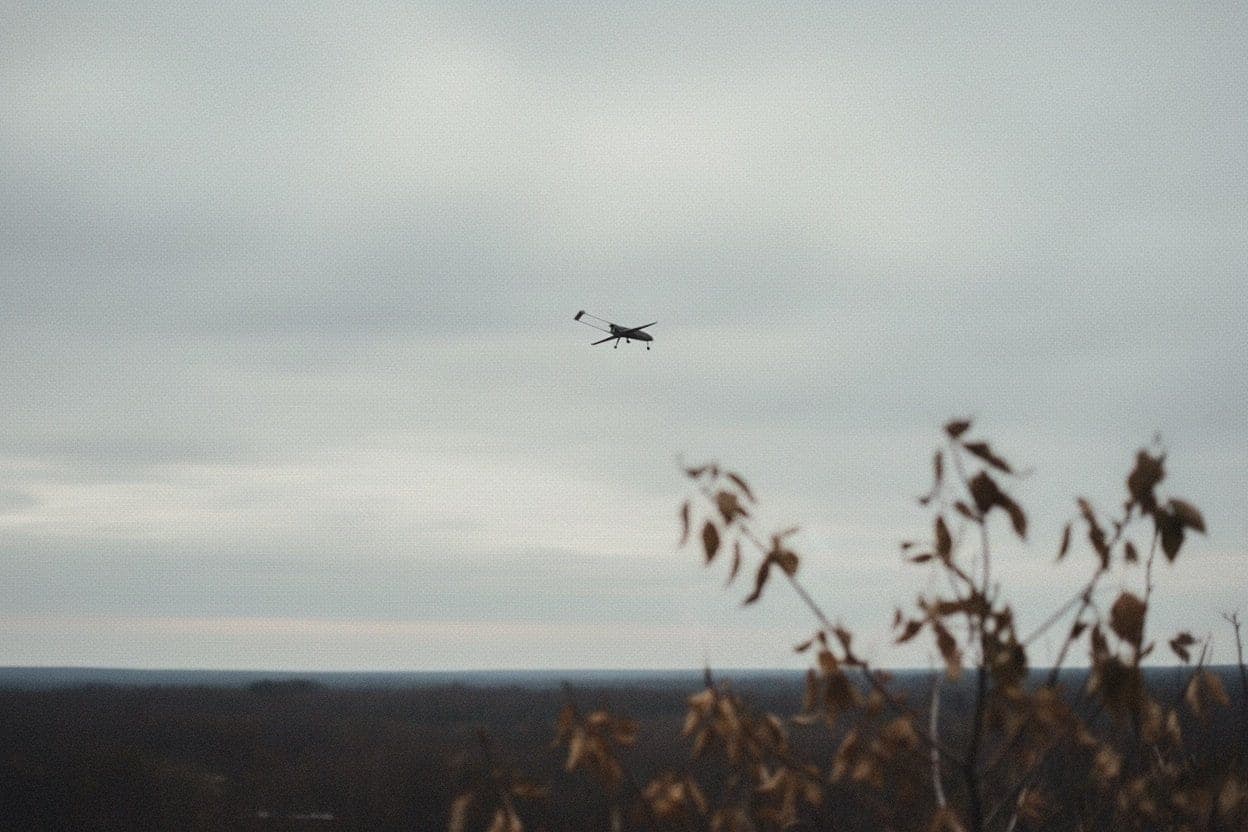
Latvia's army declared an air threat over Balvi and Ludza municipalities at 00:10 local time on November 3, 2026, and suspects the drone fell in Balvi, LSM English reported. On November 1 the army had guessed a Ukrainian drone; on November 3 it called that earlier drone most likely a Russian Geran.
The army says the November 3 drone looked like a type Ukraine's armed forces use. Its type and origin are not confirmed. The two alerts came 29 hours 13 minutes apart.
The army declared a threat over Balvi and Ludza at 00:10 and lifted it at 00:35
The National Armed Forces (NBS) used two interceptor drones from separate launch positions to detect and identify the aircraft. NATO fighters from the Baltic Air Policing mission were activated, and residents received a cell broadcast. The threat was lifted at 00:35, the army said at its briefing.
LSM's overnight report gave slightly different times: 00:07 for the start and 00:33 for the end. Together they put the threat at 25 to 26 minutes. The army said that, on initial information, the object fell in Balvi Municipality. National Guard units are searching on the ground, and the army asked residents not to touch any debris and to call 112.
A witness filmed flashing lights over Krisjani about ten minutes after midnight
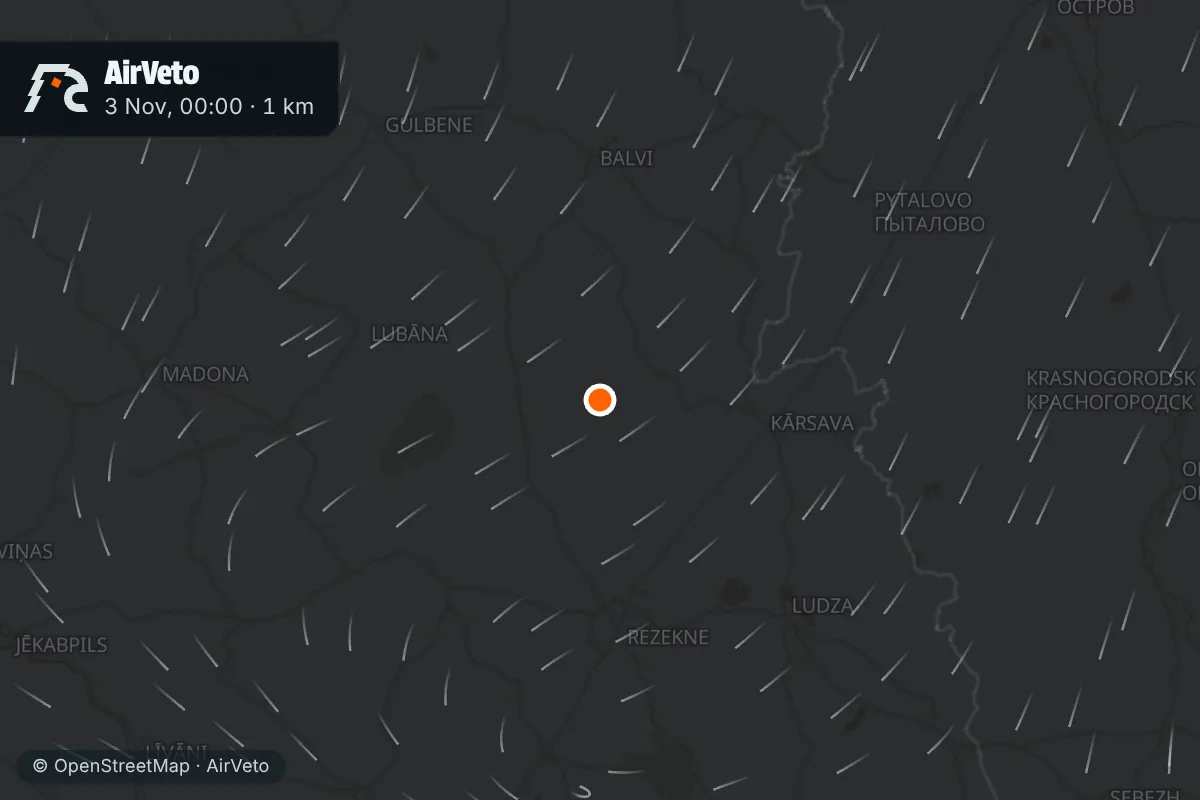
LSM carries an eyewitness video shot around 00:10 that shows flashing lights in the dark sky over Krisjani, a village in Balvi Municipality. The pin on this page marks that village. It is not a crash site, because the army has not published where the drone came down.
The army says the drone may have crashed somewhere in the Balvi district. Its type and origin have not been ascertained.
The army first guessed that the November 1 drone was Ukrainian
The earlier alert covered Kraslava and Ludza municipalities. The threat was declared at 18:57 on November 1 (LSM's Latvian report says 18:59). The drone crossed the Belarus border into Kraslava Municipality at about 19:00. At 19:16 it crossed the Latvia-Russia border in Ludza district.
The army then made its Blaze interceptor drone self-destruct at 19:19 so it would not follow across the border. Residents heard that explosion, not a foreign drone detonating. The alert ended at 19:30.
Asked what the drone was, NBS naval captain Seldzis Grasmanis said the army could not tell. "We can guess it was a Ukrainian drone," he said. "These are only guesses."
Two days later the army called it most likely a Russian Geran
At its November 3 briefing the army reversed that guess. It said the November 1 drone was most likely a Russian Geran-type drone, after analysing its sensor data and the interceptor drone's data and consulting Ukrainian partners. It could not say whether the drone carried explosives.
HotNews put it more firmly: the second drone was most likely Ukrainian and crashed in Latvia. The army's own wording is weaker. It cites a visual resemblance to Ukrainian types and says the crash is suspected, not confirmed. The first alert and the second are 29 hours 13 minutes apart, and both covered Ludza Municipality.
Four earlier drone pages sit within 40 km of Krisjani
AirVeto's archive holds four drone pages with pins within 40 km of Krisjani. The nearest is the June 8 shoot-down at Nautreni, 13.1 km away. Two May pages follow at about 33 km: the Rezekne and Vilani drones of May 7 and the eastern Latvia drone alert of May 19. The August 14 shoot-down over Balvi is 36.3 km away, and the army concluded that drone was Ukrainian.
Wind over Krisjani at midnight blew from the ENE at 1,000 m
At 00:00 local time on November 3, the wind at 1,000 m blew from the ENE at 11 km/h. At 2,000 m it came from the NNW at 11 km/h. At 3,000 m it came from the W at 24 km/h.
The hourly table under the map shows how the wind changed through the night. The drone's altitude has not been reported.
This reconstruction is based on reporting by LSM, LSM English and HotNews, and on AirVeto's wind-model data for the event window. How the model is built and where it is reliable is on the methodology page.
Sources
- LSM English - More details released about recent drone incidents in Latvia (3 Nov 2026)
- LSM - NBS: Svētdien Latvijā, visticamāk, ielidojis Krievijas drons, naktī uz otrdienu - Ukrainas dronam līdzīgs lidaparāts (3 Nov 2026)
- LSM - Beidzies gaisa telpas apdraudējums Balvu un Ludzas novadā; objekts nokrita Balvu novadā (3 Nov 2026)
- LSM - Beidzies gaisa telpas apdraudējums Krāslavas un Ludzas novadā (1 Nov 2026)
- LSM English - Air alert in Ludza and Kraslava municipalities of Latvia is over (1 Nov 2026)
- HotNews - Spațiul aerian al Letoniei, încălcat și de Rusia, și de Ucraina (3 Nov 2026)
- Methodology