

On Sunday evening July 26, 2026, officers from the Kapčiamiestis Border Post in Lazdijai district detected ground vibrations indicating excavation near the village of Pertakas, close to the Lithuanian-Belarusian state border. Border guards positioned themselves at the tunnel and waited. When the first migrants emerged, four officers detained and handcuffed them - but around twenty more then came through the passage and physically overpowered the officers, forcing them to retreat. The handcuffed detainees broke free in the struggle and fled back into Belarusian territory along with the rest of the group. Neither the officers nor the migrants were reported injured. The Lithuanian State Border Guard Service (VSAT) publicly reported the tunnel find on July 29, 2026 without mentioning the confrontation; LRT reported it separately on July 30, 2026, after a VSAT spokeswoman confirmed the incident. On the bank of an unnamed stream on Lithuanian territory, 9.5 meters beyond the physical fence, border guards located an unfinished tunnel approximately 11 meters long, one meter in diameter and 1.5 meters deep. Logs, excavated sand, and buckets were recovered at the site. The tunnel was filled in after investigative steps were completed; a pretrial investigation has been opened.
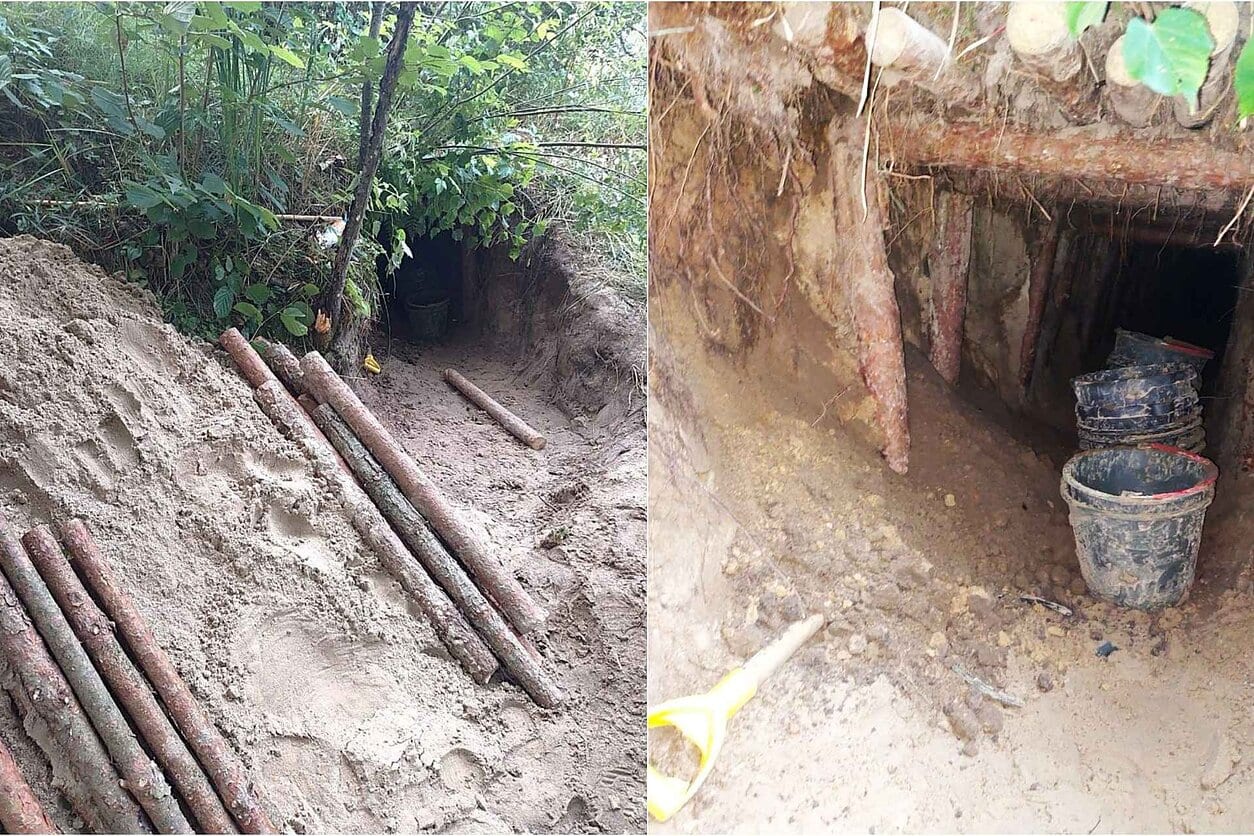
Vibration sensors at the Kapčiamiestis post detected excavation from the Belarusian side
The Kapčiamiestis Border Post operates in Lazdijai district along a stretch of the Lithuanian-Belarusian border where the terrain is characterised by low-lying ground and scattered streams. VSAT has installed technical equipment for detecting ground vibrations along this section; on the evening of July 26, 2026, the system registered a signal consistent with active digging.
A patrol was sent to the Pertakas area. The geography at this section presents an unusual complication: Belarus and Lithuania are separated at this point by a small, unnamed stream, and the physical barrier - a metal fence with barbed wire - is set deeper into Lithuanian territory than the state border line itself, because the stream bank has unstable soil that cannot support a fence structure. The actual state border runs along the stream, while the fence stands some meters further into Lithuania.
Rather than approach the tunnel directly, the patrol positioned itself to intercept whoever emerged. The first migrants to come through were detained by four officers and handcuffed. Roughly twenty more then emerged from the passage and physically overpowered the officers, forcing them to retreat; the handcuffed detainees broke free in the struggle, and the entire group - described as young men in civilian clothing - fled back across the stream into Belarusian territory.
The passage was 11 meters long, 9.5 meters beyond the fence, with no exit under the patrol road
On the bank of the stream, already on Lithuanian territory and 9.5 meters from the physical fence, border guards located an unfinished underground tunnel approximately 11 meters long. It was one meter in diameter and had been sunk to a depth of 1.5 meters below the surface. The tunnel was oriented to run under the patrol road and further into Lithuanian territory beyond it.
The passage had not broken through on the exit side - there was no exit beyond the patrol road on the Lithuanian side - so no one could have used it to enter Lithuania. Next to the tunnel entrance lay logs, presumably intended to reinforce the vault of the passage; excavated sand was piled at the site; buckets had been left inside the tunnel.
After the necessary procedural steps were taken as part of the investigation, the tunnel was filled in with earth. The Lazdijai District prosecution has opened a pretrial investigation into the criminal facilitation of illegal border crossing, per VSAT reporting cited by LRT and Charter97.
VSAT chief: border guards have identified 'dozens' of suspected tunnel sites, Belarusian involvement implied
Rustamas Liubajevas, head of the Lithuanian State Border Guard Service, confirmed that the Pertakas find was not isolated. Speaking after the discovery, Liubajevas told reporters that border guards had identified "dozens" of other locations along the Lithuania-Belarus border where similar underground passages might be under construction or planned, according to Meduza, citing LRT.
Liubajevas also addressed the question of Belarusian state involvement. He said it was impossible to bring timber close enough to the border to construct a reinforced underground passage without the knowledge of Belarusian border guards: there was "little doubt" they were either turning a blind eye or actively assisting the work. Belarusian officials were probably not digging themselves, he said, but the work was being organised with migrants and could not proceed without at least the passive permission of the Belarusian side.
The assessment echoes a pattern documented further along the border. Poland's deputy interior minister, Czesław Mroczek, alleged in a December 2025 interview that Minsk had brought in specialists from the Middle East with tunneling experience to dig into Polish territory, according to RFE/RL; Polish border authorities declined to comment on the claim when RFE/RL asked directly.
VSAT withheld the confrontation even from the Interior Minister; an internal inspection followed
VSAT's 29 July announcement of the tunnel find made no mention of the confrontation with its officers. It only became public on 30 July, when LRT reported it after VSAT spokeswoman Lina Laurinaitytė confirmed the incident, saying disclosure had been held back awaiting clearance from the prosecutor's office leading the pretrial investigation. Interior Minister Martynas Katelynas said he had been told VSAT had stopped a tunnel-digging attempt at the border, but only learned of the confrontation with officers on the Wednesday afternoon after it happened - three days later. VSAT chief Rustamas Liubajevas said the incident had initially seemed routine and that the confrontation had not been captured on recording equipment, but acknowledged responsibility for failing to properly assess its significance and inform the minister. Katelynas ordered a service inspection into VSAT leadership's handling of the incident; Prime Minister Mindaugas Sinkevičius also criticized the delay in making it public.
Update, August 19, 2026: VSAT chief Liubajevas resigns after the inspection finds he broke reporting procedures
Rustamas Liubajevas resigned as VSAT chief, telling Interior Minister Martynas Katelynas of his decision on Monday, 17 August. Katelynas announced it at a press conference the same day, reading a statement in which Liubajevas said he did not want to damage the reputation of the service he had led since December 2019. "No, I certainly didn't push for it - this was the chief's own personal decision," Katelynas told reporters, adding that he had not expected the resignation before their meeting. The government's formal dismissal decree, proposed by the ministry on Tuesday, took effect Wednesday, 19 August.
The internal inspection Katelynas ordered after the confrontation became public concluded that Liubajevas had not followed the ministry's procedures for informing leadership about special incidents at the border. "The general did not follow the established procedures, confirmed by the interior minister's order, on special incidents at the border and in which cases, and when something happens, the political leadership should be informed," Katelynas said, adding that he had learned further detail of the incident only eight or nine days later, after a journalist made it public, and that even then the information he received was inaccurate. No permanent successor has been named; Katelynas said a deputy would take over on an interim basis while the ministry considers a replacement.
Reaction split along expected lines. The union representing pre-trial investigation officers welcomed the resignation but said the underlying situation still needs to be fully investigated. Some opposition politicians instead criticised Katelynas, suggesting Liubajevas had been pressured into stepping down. Others, including national security and defence committee member Dainius Gaižauskas, argued responsibility should extend beyond one official to the wider chain of command. Katelynas separately said VSAT's rules on when officers may use their weapons will be revised for clarity - not to loosen the threshold, he said, but because officers have sometimes hesitated to use force even when justified.
Tunnels found on the Lithuania-Belarus border, July-August 2026
The Pertakas discovery came four days after the detection of the Kabeliai tunnel on July 22, 2026 in Varėna district, approximately 60 km to the north-east along the same state border. The Kabeliai passage was five meters long, one meter in diameter, at 1.5 meters depth, and had not broken through the Lithuanian exit. Both tunnels were found using vibration sensors, both at the construction stage, and both were filled in after investigation.
The pattern continued into August: on August 4, 2026, VSAT's Kabeliai post found a third tunnel near Latežeris village, Druskininkai municipality, detected with equipment supplied by Polish border authorities. VSAT put the total number of attempted underground crossings into Lithuania at 12 since the start of 2026.
Tunnels are rare on the Lithuania-Belarus border compared with drone activity. VSAT recorded 35 drone interceptions in the first seven months of 2026 alone, with underground passages representing a more labour-intensive approach that requires sustained access close to the border on both sides. The 26 July Pertakas tunnel is the longest Lithuanian-border tunnel documented in AirVeto's incident archive.
A full record of border and airspace incidents over Lithuanian territory is at Dronai Lietuvoje. The full incident archive is at incident archive.