
Romania's Danube Delta: four airspace incursions, July 2026
Romanian F-16s shot down three drones over the Danube Delta on July 24–26, 2026. A fourth entered east of Sulina on 27 July and flew to Ukraine without intercept.
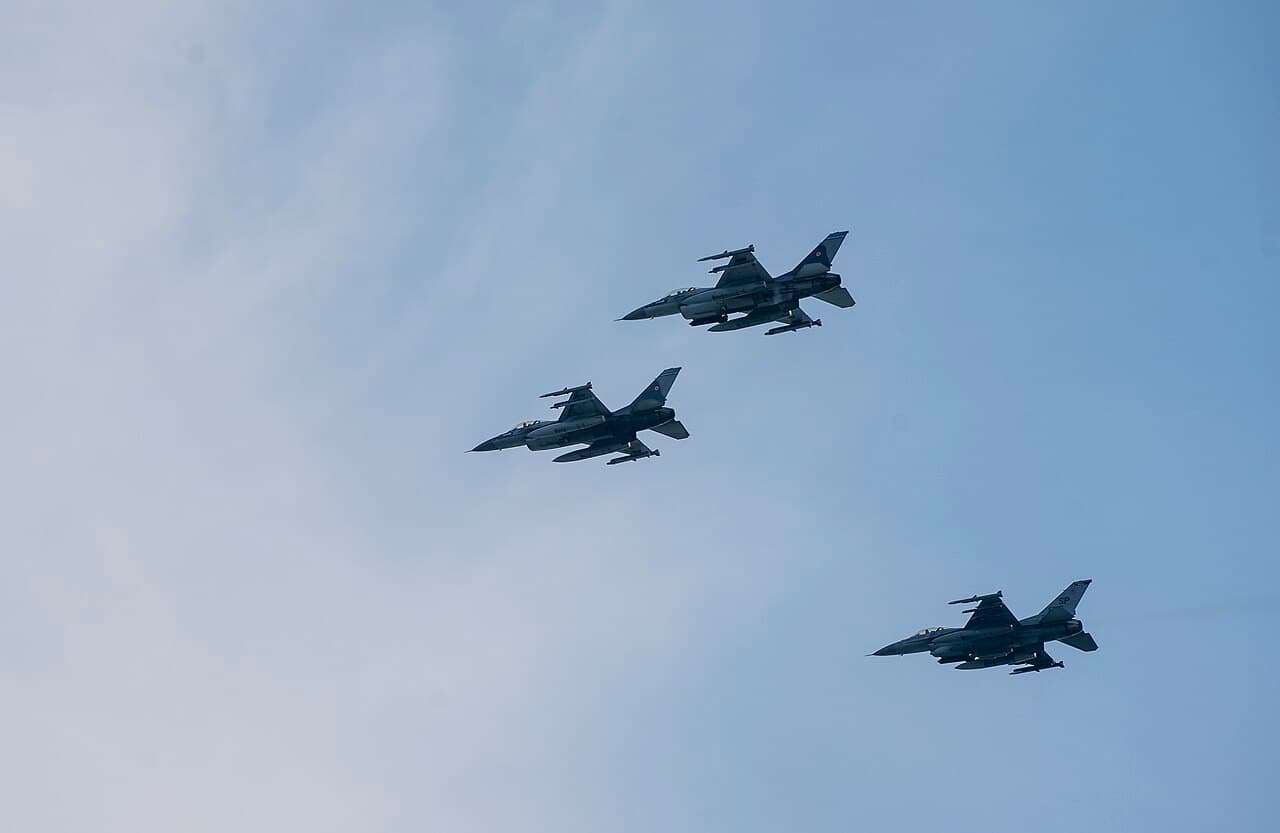
On the morning of July 27, 2026, a drone detected approximately 36 kilometers east of Sulina entered Romanian airspace for the fourth consecutive day. For the first time in the sequence, it left without being shot down.
AirVeto's wind-model data for the event window: At 06:00 UTC on 27 July - during the intercept window - the 500 m layer over the Sulina route showed S wind at 36.5 km/h.
Romania's Ministry of National Defence radar network picked up the target at the Danube Delta–Black Sea entry point. At 08:47 EEST the National Military Command Centre instructed the General Inspectorate for Emergency Situations to issue a RO-Alert warning to residents in Tulcea County. Two F-16s from the 86th Air Base at Fetești were airborne by 08:53 EEST. The drone briefly entered national airspace before crossing back toward Ukraine. Explosions were reported on Ukrainian territory shortly afterwards. The alert was lifted at 10:09 EEST.
The preceding three days had ended differently. On 24 July, a drone that had entered east of Sulina and transited approximately 200 kilometers over Romanian territory was shot down near Padina, Buzău county, Romania's first drone intercept over its own territory. On 25 July, a Shahed-type drone was engaged 10 kilometers west of Sfântu Gheorghe within 12 minutes of border crossing. On 26 July, a drone was brought down 12 kilometers northeast of Sulina over the Black Sea within five minutes of entry. Following that third intercept, Romania summoned Russia's ambassador to the Foreign Ministry.
This page covers all four incidents as a connected sequence. Individual reconstructions: Padina, 24 July · Sfântu Gheorghe, 25 July · Sulina, 26 July.
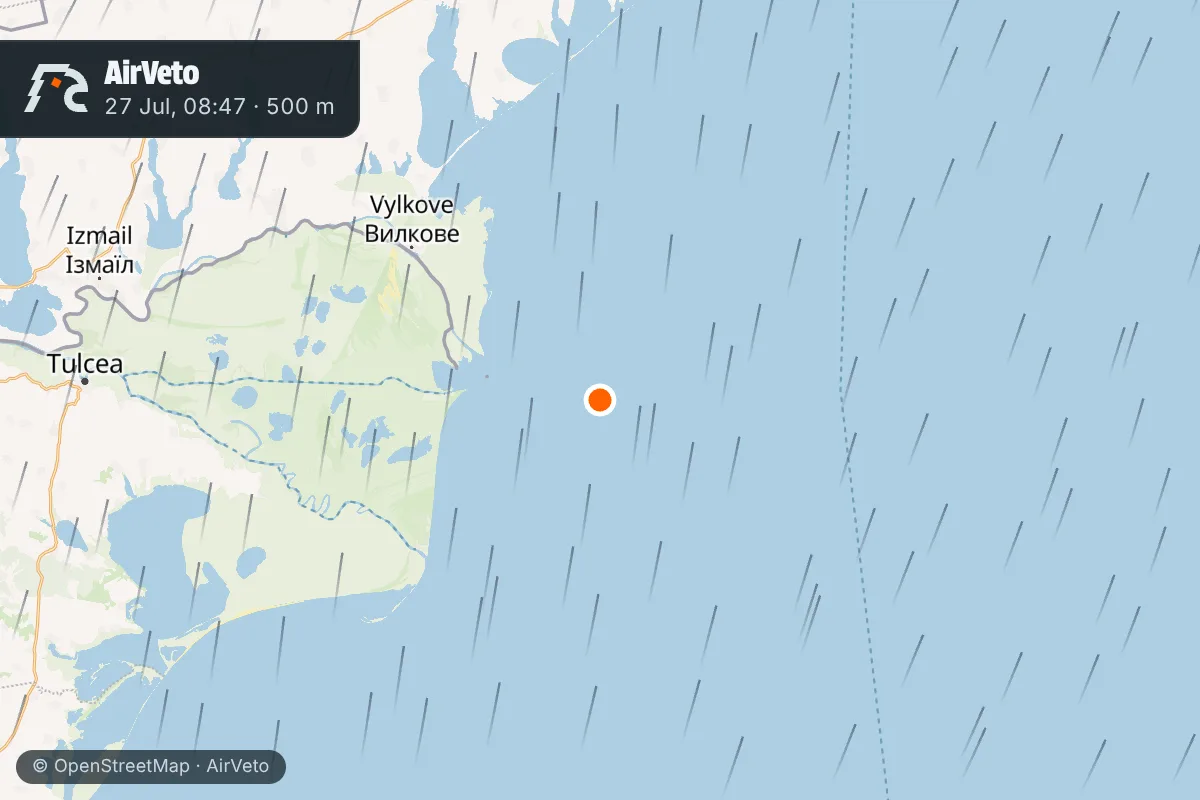
The Danube Delta–Black Sea approach: all four entries from the same direction
All four drones entered Romanian territory from the east, specifically from the direction of Ukraine's Odesa coastal zone and the mouth of the Sulina channel, the primary commercial shipping route into Ukrainian Black Sea ports and a route that has carried Russian Geran-2 and Shahed-type drones toward Ukrainian Danube port targets since 2022. Romanian airspace begins at the delta mouth, which places the Sulina entry directly on any flight path from Russian-controlled territory northwest of the Odesa coast.
The sequence shows a contraction in how far each drone penetrated before being engaged; on the fourth day, no engagement at all:
| Date | Detection point | Shoot-down / outcome | Distance inside | Time inside |
|---|---|---|---|---|
| 24 Jul | ~20 km east of Sulina | Padina, Buzău county | ~200 km | ~80 min |
| 25 Jul | Sfântu Gheorghe, Tulcea | ~10 km west of Sfântu Gheorghe | 10 km | 12 min |
| 26 Jul | Northeast of Sulina | 12 km NE of Sulina, Black Sea | 12 km | 5 min |
| 27 Jul | 36 km east of Sulina | Not engaged; flew to Ukraine | Brief | ~82 min (alert window) |
The 24 July drone required the longest transit before intercept, covering roughly 200 kilometers from the delta entry to the shoot-down point near Padina; the alert system and scramble procedures were being calibrated to the threat in real time. By 26 July, jets were engaging within five minutes and 12 kilometers of the border, over open Black Sea water rather than over inhabited land. The 27 July outcome breaks that pattern.
27 July, the fourth day: entered and exited without intercept
At 08:47 EEST on Monday, 27 July, the National Military Command Centre issued a RO-Alert to Tulcea County before jets were airborne, an indication that the radar track was being processed in real time and the public warning system was running ahead of scramble. Two F-16s lifted off from the 86th Air Base at Fetești at 08:53 EEST. The target had been detected approximately 36 kilometers east of Sulina, further into the Black Sea than the three previous entry points.
The drone briefly entered Romanian airspace. Romania's MND stated it then crossed back toward Ukraine. Explosions on Ukrainian territory were reported shortly afterwards. The RO-Alert for Tulcea County was lifted at 10:09 EEST, approximately 82 minutes after it was issued.
Romania's Ministry of National Defence did not explain in its initial statement why the 27 July drone was not intercepted. Whether the engagement geometry over the Black Sea, the brevity of the airspace transit, or the drone's track played a role had not been confirmed as of the time of reporting. Separately, on 27 July, MApN stated that Russian drones had entered Romanian national airspace 33 times since Russia began targeting Ukraine's Danube port infrastructure.
Diplomatic context from the three-day shoot-down sequence
The 24, 25, and 26 July shoot-downs were the first times Romania had destroyed drones over its own territory after years of incursions without intercept. The change in approach followed the May 29, 2026 strike in which a Geran-2 hit a 10-storey apartment building on Bulevardul Brăilei in Galați, injuring two residents in the first confirmed case of a Russian drone wounding civilians on NATO territory.
Following the 26 July shoot-down, Romania summoned Russia's ambassador to the Foreign Ministry. Foreign Minister Oana Toiu described the diplomatic step as a response to "repeated violations." President Nicușor Dan called the incursions "inadmissible and intolerable for the Russian Federation to continue violating Romania's airspace, which is, at the same time, NATO airspace and European Union airspace," and publicly congratulated Romanian pilots for the three intercepts. Prime Minister Ilie Bolojan described the breaches as "unacceptable."
The drone from the 26 July intercept remained under forensic examination by Romania's General Prosecutor's Office as of reporting. The 24 July drone was confirmed as a Shahed type used by Russian forces; the 25 July drone was confirmed as Shahed-type by Romania's Prosecutor General.
Wind conditions over the Danube delta on 27 July
At 06:00 UTC on 27 July - during the intercept window - the 500 m layer over the Sulina route showed S wind at 36.5 km/h. At 2,000 m the wind backed to SSW at 24.4 km/h; at 3,000 m W at 24.8 km/h. Moderate flow pushing north at low altitude, shifting to push east with height, was the atmospheric background for the crossing. Wind data for the three prior days is on each individual incident page: 24 July, 25 July, 26 July.
This reconstruction draws on reporting by Romania Insider, Agerpres, Ukrinform, Sofia Globe, and European Pravda, and on AirVeto's wind-model data for the July 27, 2026 event window. Methodology: methodology page. Full incident archive: incident archive.
Update - August 2, 2026: a fifth incursion, again without Romanian intercept
A drone entered Romanian airspace near the Danube Delta again on 2 August, the pattern's fifth entry in under two weeks. Romania's Ministry of National Defence said radar picked up the target near the river border with Ukraine at 15:09 local time; an air-raid alert was issued for Tulcea County and F-16s scrambled. The drone spent roughly 20 minutes in Romanian airspace before crossing back into Ukraine, where Ukrainian forces destroyed it - the same non-engagement outcome as 27 July, and the second time in the sequence Romanian jets scrambled without firing.
The 2 August incursion follows the same Danube Delta approach documented across all four July entries, and keeps the sequence's contraction pattern intact: after three consecutive shoot-downs on Romanian or Romanian-adjacent territory (24-26 July), both subsequent entries - 27 July and 2 August - crossed back into Ukraine unengaged rather than being intercepted inside Romanian airspace.
Related location
- Romania - Romania, a NATO member since 2004, shares a Danube-river border with Ukraine at the Black Sea delta and has repeatedly recorded drone debris, intercepts, and naval-drone incidents along that frontier and its Black Sea coast since September 2025.
Sources
- Romania Insider - Drone briefly enters Romanian airspace on fourth consecutive day of incursions (27 Jul 2026)
- Agerpres - MApN: 33 cases of Russian drones entering national airspace since start of Ukraine war (27 Jul 2026)
- Ukrinform - Drone enters Romanian airspace again (27 Jul 2026)
- Sofia Globe - Romania again scrambles F-16s over drone incident (27 Jul 2026)
- European Pravda - Romania scrambles jets over unknown target heading towards Ukraine (27 Jul 2026)
- Euromaidan Press - Romanian jets scramble as Russian drone enters NATO airspace before Ukraine shoots it down (2 Aug 2026)
- Methodology
Last updated: