
At approximately 20:30 local EET (18:30 UTC) on Monday, 17 February 2026, the Lithuanian Crisis Management Centre notified Vilnius International Airport (EYVI) of weather balloons posing a risk to aviation in the approach zone. The airport suspended operations. Traffic restrictions remained in place for approximately 75 minutes, lifting around 19:45 UTC (21:45 local EET). Finnair cancelled its evening services to Vilnius during the restriction window. No injuries were reported.
This was the second balloon-related disruption at Vilnius Airport in 2026, following the 28 January cluster in which eight balloons were intercepted and four suspects arrested. Lithuanian authorities had already intercepted 29 balloon probes in January 2026 and a further 16 in the first two weeks of February alone, a rate that confirmed the launches had become a sustained cross-border operation rather than isolated smuggling runs.
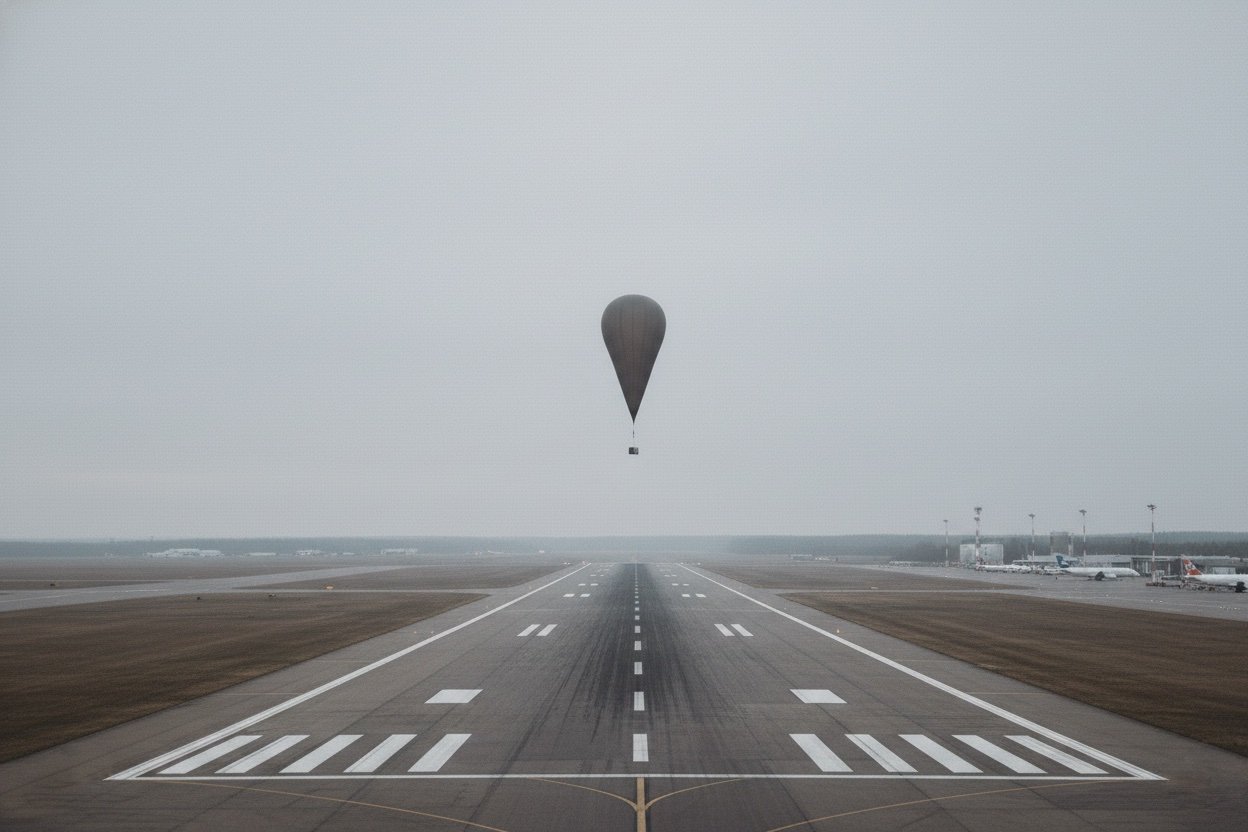
Illustrative file photo. This image is not from the incident described. It shows a contraband-type balloon of the kind that has forced airspace closures at Vilnius Airport.
Finnair evening services cancelled
Finnair cancelled its evening services on the Helsinki-Vantaa to Vilnius route during the restriction window. Helsinki-Vilnius is one of the few direct international connections to Vilnius, and an evening cancellation with no viable same-day alternative left affected passengers waiting until the following morning's schedule. The disruption was operationally more significant than the 75-minute duration alone suggests, since the window coincided with the final inbound services of the day.
What AirVeto's wind layer shows for the event window
The wind layer on the map displays the 700 hPa (approximately 3,000 m) wind field over the Lithuanian-Belarusian border region at the time of the closure. For a contraband balloon released from the Belarusian side to drift toward the Vilnius approach corridor, flow at this level must be arriving from the east, within AirVeto's 85-degree border-normal threshold. The airport sits roughly 30 km west of the Belarusian border; at 700 hPa transit speeds typical of this region, a balloon released near the border can reach the approach zone in under two hours. The Open-Meteo historical model and its documented limits are described on the methodology page.
Part of an accelerating pattern in early 2026
By mid-February 2026, Lithuanian authorities had publicly described the balloon launches as a hybrid threat from the Belarusian government rather than purely commercial smuggling. The rate — 45 probes intercepted in under seven weeks — was consistent with coordinated, repeated launches rather than individual criminal operators working independently.
The February 17 event was the second in a sequence that accelerated through March. A 15 March closure lasting approximately 110 minutes followed three weeks later, and a 22–23 March overnight closure came the night before the Varėna district drone crash on 23 March 2026. By the time of the 9–10 April 2026 closure, which lasted close to seven hours, Vilnius Airport had been disrupted by balloons five times since January. The Vilnius Airport location hub covers every documented closure and wind reconstruction in the AirVeto archive.
Methodology: see /about/methodology. AirVeto is not for aviation, navigation, or safety-critical decisions. Page published 2026-06-04 by AirVeto.