
Ukrainian drone crashes into Lake Lavysas, Lithuania
A Ukrainian military drone crashed near Lake Lavysas, Varėna district, in the early hours of March 23, 2026. Radar missed it; the Prime Minister blamed Russian electronic warfare.
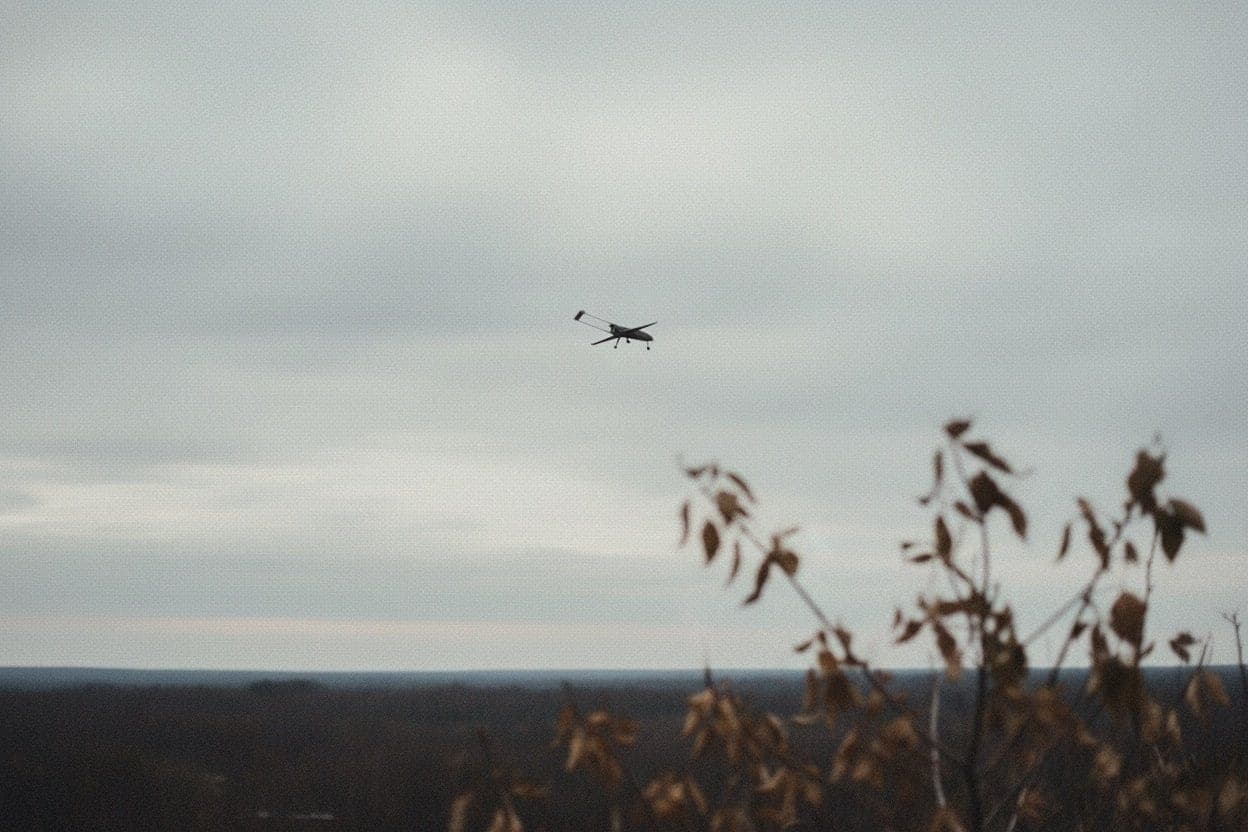
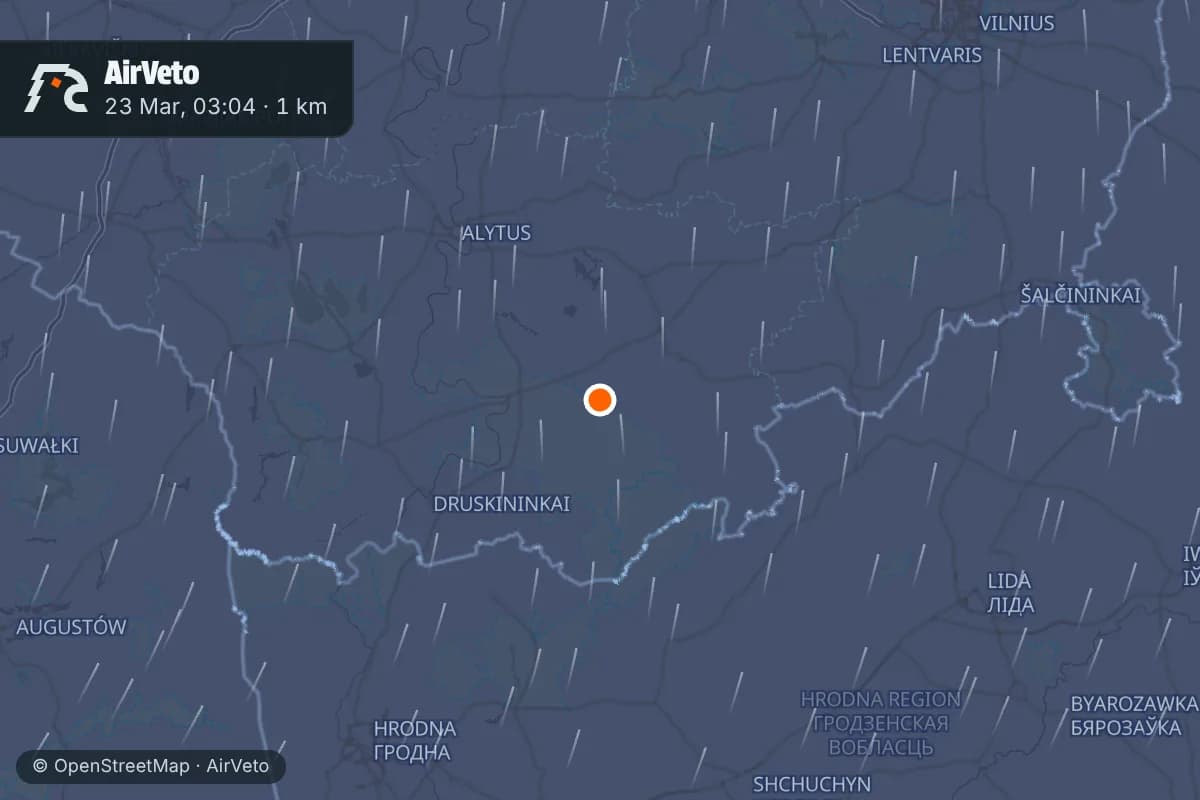
At around 03:04 local time (01:04 UTC) on Monday, March 23, 2026, residents in the Varėna district of southern Lithuania reported a nighttime explosion. A Ukrainian military drone had crashed near Lake Lavysas, roughly 30 kilometers from the Belarusian border. Lithuania activated Plan «Skydas» ("Shield"), its national emergency response protocol, and dispatched police, bomb disposal units, and military specialists to the site.
AirVeto's wind-model data for the event window: At 01:00 UTC on 23 March - during the crash window - the 1,000 m layer over Varėna district showed S wind at 8.5 km/h.
Lithuanian military radar did not register the drone during its flight. Authorities had no track of the route it took into the country or the direction from which it entered. The first reports came from local residents rather than from the air defence network, the same detection gap seen in later Lithuanian drone crashes.
What investigators recovered
Specialist teams recovered an internal-combustion engine, metal fragments, and plastic parts from the crash site. The wreckage was consistent with a fixed-wing long-range drone rather than a contraband balloon, the object type that dominates the rest of the Lithuanian airspace record.
Prime Minister Inga Ruginienė confirmed on 24 March that the drone was Ukrainian. The National Security Commission convened the same day to review the incident.
Why a Ukrainian drone crashed inside Lithuania
According to the Centre for Eastern Studies (OSW), the drone is assessed to have veered off course during a Ukrainian strike on the Russian oil export terminal at Primorsk, on the Gulf of Finland. The most-cited explanation across Baltic capitals is Russian electronic warfare: dense GPS jamming and spoofing along Russia's Baltic coastline pushes Ukrainian long-range strike drones off course, and some continue on corrupted headings into NATO territory before crashing or running out of fuel.
The Varėna crash was the first in what became a recognisable 2026 pattern. Two days later the same Ukrainian strike campaign against Russian Baltic oil infrastructure produced near-simultaneous drone incidents in Latvia and Estonia.
Where this sits in the 2026 sequence
The Lake Lavysas crash opened a run of Baltic airspace incidents that continued into late spring:
- March 25, 2026 - Krāslava, Latvia. A Ukrainian drone crossed from Russia and detonated near Dobročina village in the Krāslava municipality. See the Krāslava drone crash page.
- March 25, 2026 - Auvere, Estonia. A Ukrainian drone struck the chimney of the Auvere power station, two kilometers from the Russian border. See the Auvere power station page.
- May 7, 2026 - Rēzekne, Latvia. Two stray Ukrainian drones came down in eastern Latvia, one striking an oil storage facility. See the Rēzekne / Viļāni incident page.
- May 17, 2026 - Samanė, Lithuania. A second radar-undetected drone crashed in the Utena district. See the Utena Samanė incident page.
The escalation peaked on 19 May, when a Romanian NATO F-16 carried out the first fighter shoot-down of a drone over Estonian airspace, followed by the air-danger alert that closed Vilnius Airport on 20 May.
Wind conditions over Varėna district
At 01:00 UTC on 23 March - during the crash window - the 1,000 m layer over Varėna district showed S wind at 8.5 km/h. Near-calm conditions at altitude were the atmospheric background for the final leg. The model and its documented limits are set out on the methodology page.
This reconstruction draws on reporting by LRT, OSW Centre for Eastern Studies, and AeroTime, and on AirVeto's wind-model data for the event window.
Investigation and aftermath
Lithuanian authorities treated the Varėna crash as confirmation that stray Ukrainian drones could reach Lithuanian territory undetected. The same assessment, and the same Russian-jamming explanation, recurred through every subsequent incident in the series. The full record of Lithuanian drone and airspace-alert incidents, each with the regional wind context at the event window, is collected at the category hub: Dronai Lietuvoje (in Lithuanian).
Related location
- NATO eastern flank - The frontier where EU airspace meets Russia and Belarus across five NATO member states - the active zone of drone incursions, smuggling balloon recoveries, and Baltic Air Policing intercepts since 2025.
Sources
- LRT English - Possible drone crash under investigation after nighttime explosion in southern Lithuania (March 23, 2026)
- LRT English - Incident in Varėna district involved Ukrainian stray drone, Lithuanian PM says (March 24, 2026)
- OSW Centre for Eastern Studies - The Baltic states respond to incidents involving Ukrainian drones (March 25, 2026)
- AeroTime - Suspected cross-border drone explodes in southern Lithuania (March 23, 2026)
- Wikipedia - 2026 Ukrainian drone incursions into the Baltic states
- Methodology
Last updated: