

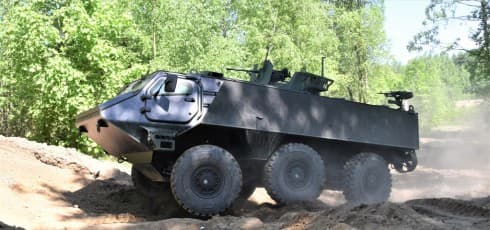
Lithuania's State Defence Council announced in May 2026 its intention to procure 936 Patria 6x6 armoured vehicles. On 25 June, Patria signed a Memorandum of Understanding with KOVO Armor, a Lithuanian defence company, to begin discussions on local production, technology transfer, and lifecycle sustainment. According to Patria, KOVO Armor is the first company in the planned long-term partner network for technology transfer in Lithuania.
936 vehicles. That's a larger fleet than any current CAVS programme participant outside Finland.
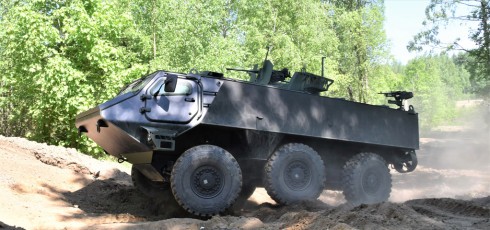 Patria 6x6. Photo: Patria.
Lithuania joins a platform already running on Latvia's patch
The Common Armoured Vehicle System (CAVS) programme launched in 2020 as a joint initiative between Finland and Latvia. It now includes Finland, Latvia, Sweden, Denmark, Norway, Germany, and the United Kingdom, with vehicles also operational in Ukraine.
Latvia's early membership is worth noting. The Latvian corridor — Latgale, near the Russian and Belarusian borders — is one of the territories AirVeto covers for drone incursions. Ground forces there already operate on the Patria 6x6 platform. Lithuania joining the same programme puts both Baltic states on a common vehicle baseline, with shared parts chains and maintenance networks along the same stretch of the eastern flank.
The C-UAS variant exists in this family
In 2025, Patria presented a counter-unmanned aircraft system (C-UAS) configuration of the CAVS 6x6 at the International Armoured Vehicles (IAV) exhibition. The setup pairs a command-and-control vehicle running Patria's Integrated Combat Solution (ICS) software with effector vehicles armed with 50-calibre remote weapon stations, supported by a towed radar.
Lithuania hasn't confirmed procurement of the C-UAS variant. The May 2026 announcement covers the base vehicle platform. But the C-UAS configuration sits within the same CAVS programme Lithuania is entering, not a separate system. A fleet of 936 vehicles is the base from which that upgrade path becomes available.
KOVO Armor is the first, not the last
Patria described KOVO Armor as "the first company of the planned long-term partner network." That phrasing matters. This MoU isn't a contract; it opens negotiations on what local manufacturing looks like — production, technology transfer, skills development, spare parts, and on-site sustainment.
Patria's Executive Vice President for Protected Mobility, Jussi Järvinen:
"Through this cooperation, Patria is taking the first steps for establishing a long-term partnership with Lithuanian industry that delivers capable armoured vehicles and develops national industrial capacity for the future. Together with KOVO Armor, we will advance local production, technology transfer and supply chain integration to create lasting economic and security benefits for Lithuania."
KOVO Armor CEO Agnė Rakštytė:
"KOVO Armor is proud to be the first Lithuanian company to sign an MoU with Patria following Lithuania's strategic intent to acquire Patria's 6x6 vehicles. This step recognises KOVO Armor's expertise in this specialised field, the company's investments in recent years and its rapid growth."
The framing — "first company," "long-term partner network" — signals that more industrial MoUs will follow. Patria runs a multi-company supply model in every other CAVS nation.
Why we're writing about an armoured vehicle deal
AirVeto tracks what moves through airspace: contraband balloons from Belarus, off-course drones from Ukraine, intercepts by Baltic Air Policing. Armoured personnel carriers don't appear on wind reconstructions.
But the 936-vehicle procurement is the same strategic commitment driving up the incident count we document. Lithuania's eastern border — where the Vilnius airport balloon closures stacked up through early 2026, where the Utena District drone alert and the Ignalina alert in May 2026 ran across a two-week window — is exactly the territory these vehicles are being acquired for.
A modern armoured force with organic C-UAS capability in the pipeline changes what the ground layer can do when something crosses in the air. Whether Lithuania eventually fields the C-UAS variant is an open question. The 936-vehicle procurement, with a domestic production partner attached, is not.
Context for the geography: the Suwałki Gap hub and the NATO eastern flank hub.