

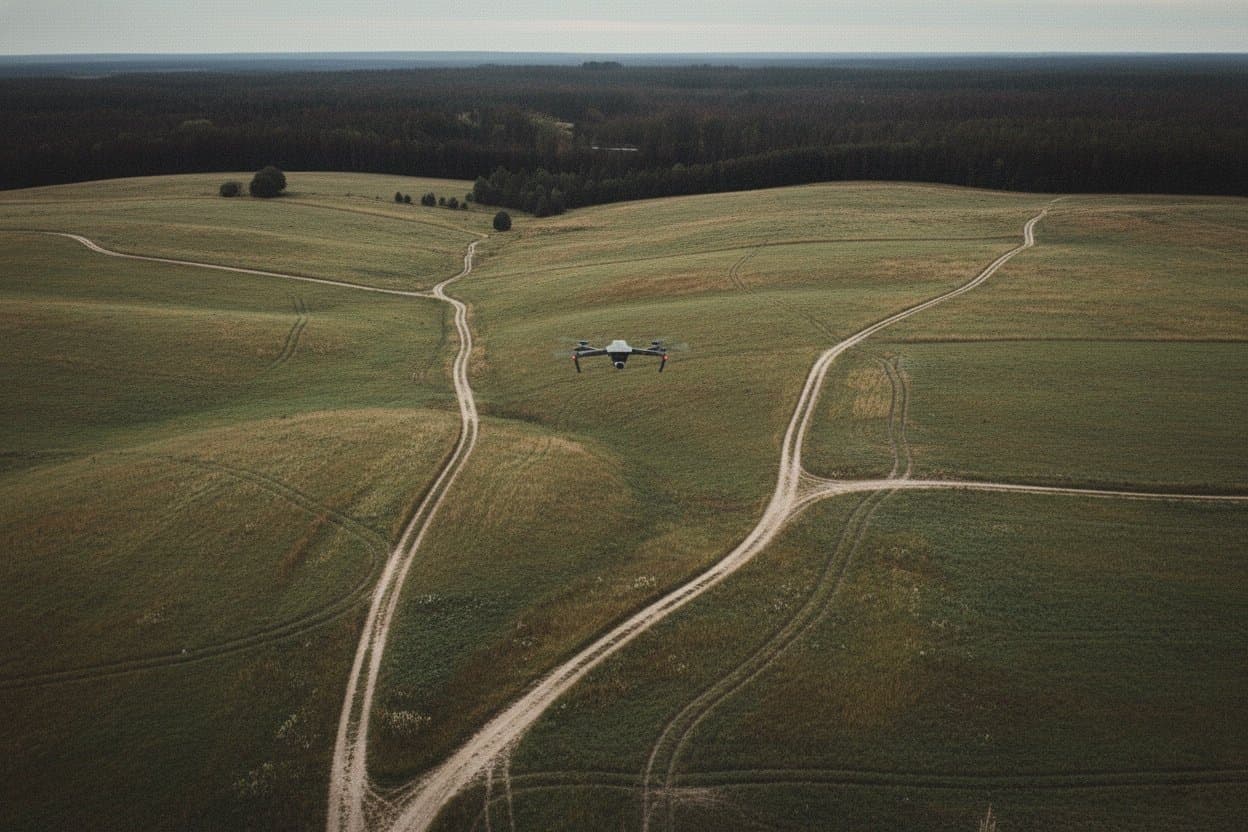
According to LRT, Lithuania's Commander-in-Chief, General Raimundas Vaikšnoras, said funding is secured for the country to field Ukrainian acoustic drone-detection sensors from 2026, adopting a technology built to catch the low-flying drones that radar handles poorly. The system on offer comes from the Ukrainian company Zvook, which listens for the sound a drone or cruise missile makes and triangulates its track across a network of cheap microphones.
Radar is expensive, active, and better suited to fast, high-flying targets. A Shahed skimming in low, or an FPV drone the size of a dinner plate, is exactly what it struggles with. Zvook inverts the economics: instead of one costly sensor, it fields cheap ones in bulk that simply listen.
Zvook detects drones by the sound they make, not by radar
Zvook is a passive-acoustic detection system. Each station carries a curved "acoustic mirror" about half a metre across that concentrates sound onto a microphone, covering close to 200 degrees. Software isolates the acoustic signature of a cruise missile, drone, helicopter, or low-flying jet, then triangulates the track across neighbouring stations. Reported range is up to about 5 kilometres for a drone and 7 kilometres for a cruise missile.
That is well short of a radar's reach, and the short range is the whole design premise. Because each station only listens, it emits nothing an adversary can detect or jam, and it is cheap enough to deploy in bulk so the coverage overlaps.
A network of $500 microphones does what radar can't afford
The economics are the point. A single Zvook station is put at roughly 500 dollars, cheap enough to blanket a region, and the dense overlap between stations is what makes the triangulation accurate. The model is a mesh of cheap ears rather than one expensive eye, which keeps costly interceptor missiles free for the targets that warrant them.
Zvook was reorganised into an independent company in Lviv in 2023 and belongs to Ukraine's Brave1 defence-technology cluster, and it has fielded thousands of sensors across the country. It is often discussed alongside Sky Fortress, a separate Ukrainian acoustic system launched in 2022 with a larger reported network of 10,000 or more sensors and NATO-backed funding to expand. The two are distinct programmes, and the largest sensor counts in circulation usually describe Sky Fortress rather than Zvook.
The NW0 sensor targets the FPV drones that beat electronic detection
In early 2026 Zvook introduced a tactical sensor, the ZVOOK NW0, built to detect first-person-view drones by sound. The type it is aimed at is the fibre-optic FPV drone, which trails a spool of optical cable instead of a radio link and so carries no signal for electronic-warfare systems to pick up. Acoustic sensing is one of the few methods that still catches them. The NW0's declared range is 150 to 450 metres with 360-degree coverage.
Lithuania will field the technology from 2026
Lithuania is the first Baltic state to commit. General Vaikšnoras told LRT that funding is secured, with testing in late 2025 and deployment from 2026 to complement the country's radar-based air defence. The move fits a wider Lithuanian counter-drone push: the Dragoon Fury 26 exercise this July put anti-drone systems into a battalion evaluation at Kazlų Rūda.
NATO interest reaches past Lithuania. Representatives of eleven member states were shown a private European demonstration in which simulated cruise missiles and drones were detected and tracked, and defence ministries have pointed to the Ukrainian experience as proof the approach works at scale.
The drones crossing into Lithuania are what these sensors are built to hear
The Shahed-136 and Gerbera types recur in Polish and Baltic wreckage, and Lithuania has logged repeated drone alerts through 2026, from Ignalina and Utena in May to the Vilnius air alert in June and the Druskininkai and Padvarionys events in July. A dense acoustic net over that airspace is built to catch exactly those crossings.
The full technical breakdown is in the Zvook glossary entry, and the wind-drift method behind AirVeto's incident reconstructions is in the methodology. See the live eastern-border wind field on the map.