
Storm kills one in Lithuania, border winds hit 122 km/h
One system crossed four countries on August 22, 2026. A falling tree killed a man in Lithuania, Poland logged 7,754 fire callouts, and three kilometers up the border wind hit 122 km/h.
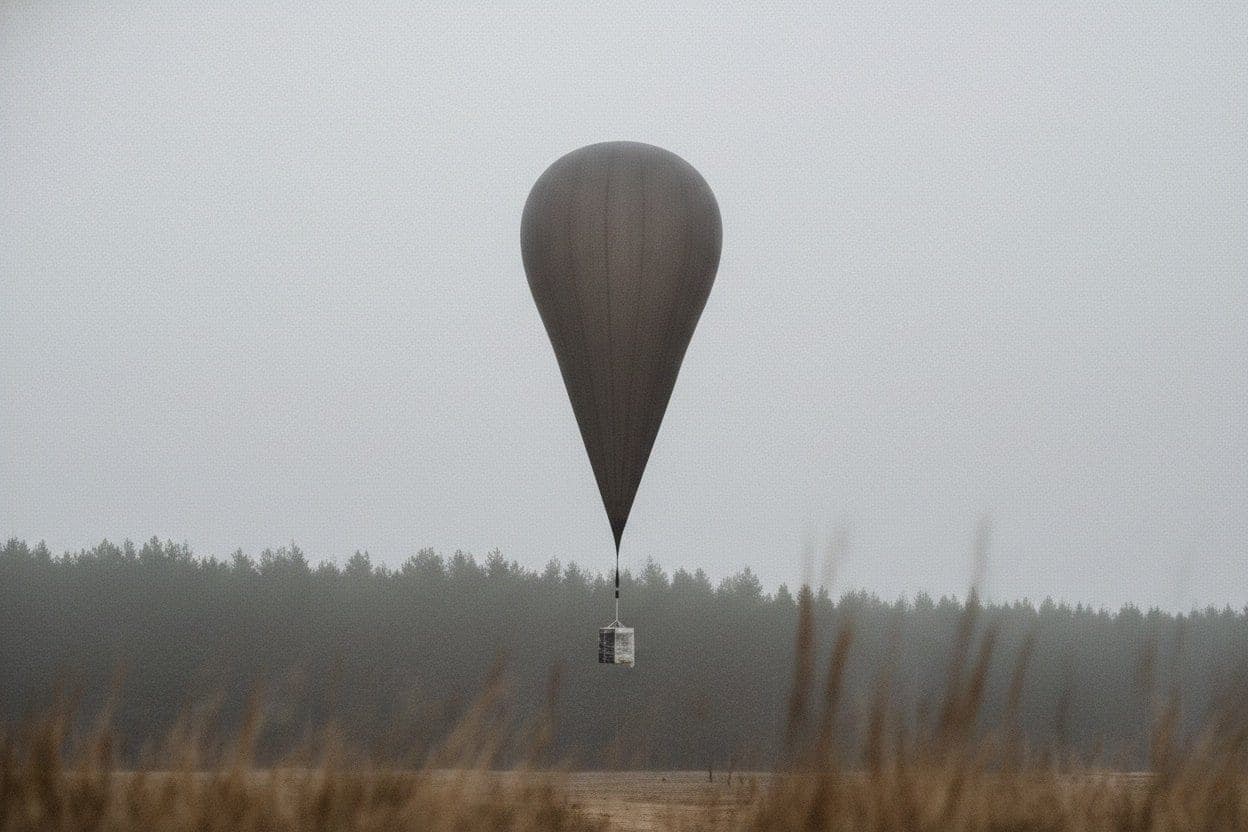
Utena County police found a man born in 1966 dead beneath a tree that fell into a body of water in Mažionys village, Anykščiai district, at around 16:07 local time on August 22, 2026. By evening the Energy Distribution Operator (ESO) counted 240,000 people without power, the Fire and Rescue Department (PAGD) had logged more storm callouts in one day than it had recorded for wind damage in the whole year to date, and Poland had logged 7,754 fire-service interventions and placed 13 army brigades on six-hour standby. Three kilometers above the Lithuanian-Belarusian border, Open-Meteo's ICON-EU model put the wind at 122 km/h driving toward the north-east at 15:00 UTC (18:00 local time), faster than any of the four balloon crossings AirVeto has reconstructed and aimed across the smuggling route rather than along it.
A falling tree killed a man in Anykščiai district
Utena County police reported the body, showing no signs of life, under a tree that had come down in a body of water. Officers opened a pre-trial investigation to establish the cause of death.
Earlier in the afternoon PAGD said it had received no reports of anyone injured by the wind. The death was confirmed after that statement, which is the shape most of this day's figures took: every number moved as the storm ran west across the country.
One day of callouts exceeded the entire year's wind-damage total
PAGD put the day's storm consequences among the worst in two decades. Its own comparison is the sharpest measure available: between January and mid-August, Lithuanian firefighters were called out 1,231 times to deal with strong-wind damage. On 22 August alone they passed that figure, and the count was still rising when they published it.
The callouts concentrated in Kaunas county (323), Vilnius (204) and Alytus (188), with Utena, Marijampolė and Klaipėda between 95 and 110 each. Trees came down on cars 69 times, on buildings 62 times and on power lines 29 times.
The outage count reached 240,000 and emergency calls hit a yearly record
ESO's spokesperson told BNS that 110,000 people were without power and that the figure was still climbing; it reached 240,000 by evening.
The load moved geographically through the day: southern Lithuania in the morning, the centre by midday, the west through the afternoon.
The Emergency Response Centre took 11,460 calls between 07:00 and 18:30, against a normal full-day volume of about 5,000. Deputy head Jelena Montvilienė said the centre was working under its heaviest load of the year, and asked people to keep 112 free for emergencies after ESO system faults pushed outage reports onto the emergency line.
In Panevėžys the storm damaged the dome of a football hall during a volleyball match. Sports department head Živilė Užtupaitė said players were evacuated and nobody was hurt.
Lithuania's state road manager, Kelių priežiūra, reported storm damage across the country: standing water and fallen trees blocking roads at multiple points, three logged reports on the A1 motorway between Vilnius and Klaipėda with traffic partially closed near Vievis while crews cleared trees, and power faults that put train delays in prospect.
Conditions at the airport were visible from the ground. 15min.lt published reader video of an ATR 72 turboprop being pushed off line on final approach into Vilnius, a scheduled passenger flight landing in a crosswind rather than any kind of airspace event.
Poland logged 7,754 fire-service interventions and put 13 brigades on standby
Poland absorbed the heaviest call volume anywhere in the system. The State Fire Service (PSP) recorded 7,754 interventions by 18:00, mostly pumping water out of cellars and streets and clearing branches from roads.
Mazovia took the largest share, 2,197 of the first 6,000 calls, followed by Warmia-Masuria (809) and Kuyavia-Pomerania (800). Twelve scout camps were evacuated as a precaution, and tens of thousands of customers lost power.
Defence Minister Władysław Kosiniak-Kamysz announced a 48-hour readiness order on Saturday morning, running to Monday, so troops could assist civil administration and rescue services. Under it, 13 brigades in voivodeships including Mazovia, Łódź and Lower Silesia must be ready to move within six hours, with seven more available within 24, and the Territorial Defence Forces stay on heightened readiness.
A weather system that moves an army is a useful measure of the same air AirVeto reads for drift.
Latvia's outage count reached about 254,000 by the evening
Sadales Tīkls told LETA that roughly 58,000 of its customers were cut off, mostly in the south-east and south-west. The operator attributed the damage to trees and branches brought down by wind and lightning, and said the situation on the grid was changing continuously.
It changed quickly. Latvian public broadcaster LSM put the evening count at about 254,000 households, alongside flooded streets and falling trees, and reported that the storm had caused injuries. A red warning for heavy rain covered central and western Latvia into the night while an orange gust warning reached almost the whole country, and the State Fire and Rescue Service (VUGD) asked people to call 112 only where there was a threat to life, health or the environment. See the update below.
LSM also reported that gusts were expected to strengthen through the evening and could pass 30 meters per second in places, which is the same order as the 33 meters per second Lithuania recorded on its coast earlier in the day. The storm was forecast to run into Sunday night.
Estonia was still waiting for it
Estonia is the one country in this system where the damage had not yet been counted. The Environment Agency issued an orange warning, and ERR reported the low-pressure system, which arrived from southern Europe, reaching its culmination late on Saturday evening and overnight into Sunday.
The overnight forecast put inland wind at 8 to 14 meters per second gusting to 20, and coastal wind at 21 gusting to 27, with up to 30 meters per second over the Gulf of Riga. That is the same order as the 33 meters per second Lithuania had already recorded on its own coast.
Grid operator Elektrilevi put its control centre and volunteer crisis reserve on increased capacity ahead of it. Board chairman Mihkel Härm advised people to stay indoors as conditions worsened, charge phones and power banks, and keep drinking water and food at home. The Environment Agency forecast 50 to 70 millimeters of rain in 24 hours, reaching 90 in places.
Taken together with the three countries south of it, the sequence is one system tracking north: Poland and Lithuania through the day, Latvia into the evening, Estonia overnight.
The wind that did this was at the surface, and AirVeto measures two kilometers higher
This distinction matters before the altitude numbers are read. The Lithuanian Hydrometeorological Service recorded the day's strongest gusts at Ventės Ragas and Nida on the coast, reaching 33 meters per second, about 119 km/h, with most of the country seeing 15 to 20 meters per second. The Šilutė weather station logged 83 per cent of August's entire monthly rainfall between morning and evening.
Those are surface gusts, and they are what brought down the tree in Anykščiai. AirVeto's reconstructions work at 2,000 and 3,000 meters, where balloons and small drones travel. The two layers happen to be close in magnitude today, which is unusual, but they remain separate measurements: the coastal gust says nothing about the border, and the border reading says nothing about what happened at ground level in Mažionys.
At three kilometers, the wind ran faster than any drift we've reconstructed
AirVeto has published wind reconstructions for four smuggling-balloon crossings, each taken at three kilometers from the same model. Druskininkai in February recorded 19 km/h, Trakai in May 34 km/h, the April Vilnius Airport closure 37 km/h, and the July Kaliningrad balloons 62 km/h, the fastest of the set.
On 22 August the same altitude over the Lithuanian-Belarusian border peaked at 122 km/h, roughly twice the fastest reading in that group and more than six times the slowest. Four reconstructions are a sample from our own archive rather than a climatology, so read this as a comparison against what we've documented, not against a long-term average.
On all three borders the wind ran across the route instead of along it
Direction is the more interesting half of the reading, and it held across the whole eastern frontier.
Lithuania's route depends on wind driving west. That's what carries an object from the Belarusian side onto the Vilnius approach, and it's what the April airport closure recorded, 37 km/h pushing west. On 22 August the flow drove north-east instead, across the line rather than down it.
Over Poland, the Belarus to Podlaskie route depends on wind driving west as well. Through the Suwałki Corridor the flow ran the opposite way. It drove east and peaked near 122 km/h at two kilometers around midday. The strongest reading anywhere AirVeto sampled sat over Krāslava on the Latvian-Belarusian border, 127 km/h at three kilometers driving north-east at 17:00 UTC. Rīga, a couple of hundred kilometers north-west on the coast, ran at roughly half that.
One weather system covered all three Belarus-facing borders at once and pushed across the smuggling route on every one of them. Estonia, which faces Russia rather than Belarus, sits outside that corridor logic even though the same system reached it overnight.
What a wind field like this changes
Drift arithmetic is distance over time, and both terms move at once here. An object at three kilometers in a 122 km/h field covers ground more than three times faster than the same object did during the April closure, which compresses the window between release and arrival.
The error on where it lands widens by the same logic. A release point that puts an object over a specific approach in a 37 km/h flow driving west puts it somewhere else entirely when the field is running north-east at 122 km/h, and small differences in launch altitude or timing translate into much larger differences on the ground.
This is a measurement of the wind field, not an observation of any object. No crossing was reported over any of the three borders during this window.
Update, August 23, 2026: Latvia took the worst of it, Estonia the least
Latvia's outage count kept climbing after this piece first published. Sadales tīkls reported roughly 277,000 households without power on Sunday morning, and said the fault was not confined to the distribution network: outages reached the transmission grid operated by Augstsprieguma tīkls, affecting customers across the country and hitting Kurzeme, central Latvia and the south-east hardest. Latvia's Saturday evening count stood at about 254,000, and that report records injuries.
Estonia, forecast the same system, came through it comparatively lightly. Elektrilevi counted 3,410 households without power on Saturday evening and 1,979 by 07:46 on Sunday, far below the Latvian household count and the Lithuanian outage total. The Environment Agency dropped its second-level warning to first level on Sunday morning and lifted it entirely for Ida-Viru, Lääne-Viru, Järva, Jõgeva and Tartu counties. Rescue crews were called to trees on roads and power lines through Saturday night, and 50 to 70 millimeters of rain fell in 24 hours, reaching 90 in places.
That ordering is the part worth keeping. The system tracked north across four countries: Poland and Lithuania absorbed it during the day, Latvia took the deepest grid damage into the evening, and Estonia came through overnight with the smallest repair job. ERR's Sunday morning readings put the remaining wind on the islands and the west coast, with the warning lifted across the eastern and inland counties, so the storm's strength over Estonia sat offshore rather than over the populated grid.
Reconstructions of earlier crossings sit in the incident archive, and the Lithuanian landing page covers the route in more detail at kontrabandos balionai.
Sources
- 15min.lt - Anykščių rajone nuvirtęs medis mirtinai prispaudė vyrą (22 Aug 2026, citing Utena County police and the Fire and Rescue Department)
- 15min.lt - Dėl oro sąlygų elektros neturi bent 110 tūkst. gyventojų, ugniagesiai sulaukė apie 500 iškvietimų (22 Aug 2026, citing ESO and PAGD)
- 15min.lt - 1,2 tūkst. iškvietimų sulaukęs PAGD: audros padariniai gali būti didžiausi per du dešimtmečius (22 Aug 2026, citing the PAGD Facebook communiqué and ESO)
- 15min.lt - Bendrasis pagalbos centras sulaukė didžiausio šiemet skambučių skaičiaus (22 Aug 2026)
- Onet - Tak wygląda Polska po załamaniu pogody. Ponad 7700 interwencji strażaków (22 Aug 2026, citing the State Fire Service communiqué)
- Polsat News - Nawałnice przeszły przez Polskę. Masa zniszczeń, zalane ulice, zerwane dachy (22 Aug 2026, citing PSP regional breakdown)
- 15min.lt - Dėl Lenkiją nusiaubusių stiprių audrų šalies kariuomenėje paskelbta aukšta parengtis (22 Aug 2026)
- 15min.lt - Šeštadienio vakarą audrų skalbiamoje Latvijoje be elektros liko apie 58 tūkst. namų ūkių (22 Aug 2026, citing Sadales Tīkls via LETA)
- Lrytas - A1 magistralėje eismą trikdo nulūžę medžiai (22 Aug 2026, citing the Kelių priežiūra duty officer; only the three quoted paragraphs are retrievable, the lede is not served to fetchers)
- 15min.lt - Panevėžyje audra apgadino futbolo maniežo kupolą, evakuoti žmonės (22 Aug 2026)
- 15min.lt - Dramatiški vaizdai iš Vilniaus oro uosto: audra blaškė besileidžiantį lėktuvą (22 Aug 2026)
- LSM (Latvian Public Broadcasting) - Traucēta elektroapgāde aptuveni 254 000 mājsaimniecību; sestdienas vētrā arī cietušie (22 Aug 2026, 17:23 GMT)
- LSM - Pēc vētras elektroapgāde traucēta ap 277 000 mājsaimniecību; vēja brāzmas un lietus turpinās arī svētdien (23 Aug 2026, 06:02 GMT, citing Sadales tīkls)
- ERR - Eestit tabanud torm hakkab vaibuma (23 Aug 2026, 07:53 local, citing Ilmateenistus and Elektrilevi)
- ERR News [EN] - Orange weather warning issued as heavy rain and storm winds forecast for Saturday (22 Aug 2026, citing the Environment Agency and grid operator Elektrilevi)
- ERR - Tugev vihm ja tormituul saavutavad haripunkti ööl vastu pühapäeva (22 Aug 2026)
- Open-Meteo ICON-EU forecast model, 700 hPa and 800 hPa wind fields, 22 Aug 2026
Last updated: